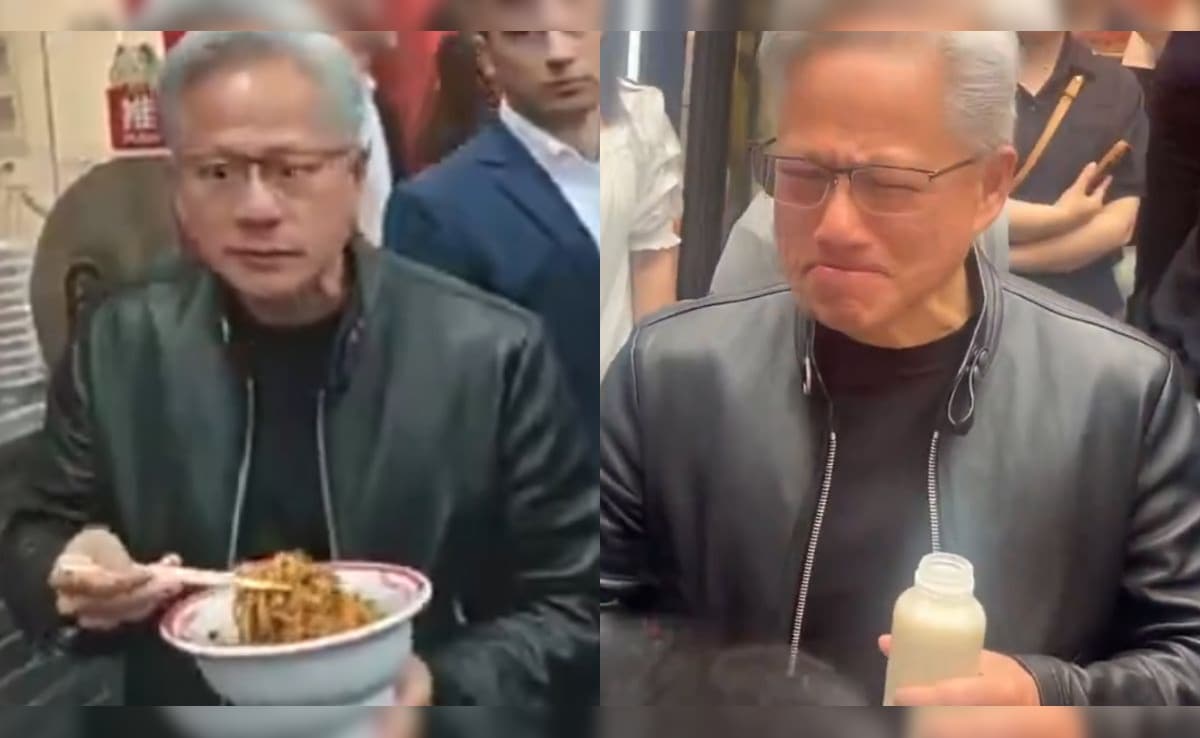
Jensen Huang wore a colorful vest and danced at an annual corporate party in Shanghai. He ate zhajiangmian—fried sauce noodles—at a local Beijing eatery. He smiled for selfies, cracked jokes, and acted like a tourist discovering the joys of local street food.
The mainstream tech press ate it up. They framed it as a charming, humanizing PR tour—a billionaire tech titan getting back to his roots and connecting with the locals. You might also find this similar coverage useful: Stop Telling Engineers to Feed Prompt Engines if You Want Software That Actually Works.
It was a masterclass in corporate distraction.
When a technology executive managing a near-triple-trillion-dollar empire suddenly abandons the boardroom to perform choreographed culinary diplomacy, they are not enjoying a vacation. They are executing damage control. The narrative that these tours are about cultural appreciation or "building bridges" is a soft-brained fantasy for casual observers. As discussed in latest reports by Gizmodo, the effects are significant.
The reality is colder, sharper, and dictated entirely by supply chains and geopolitical strangulation.
The Choreographed Dumpling Diplomacy
Mainstream business journalism suffers from a chronic inability to look past the plate. When a high-profile executive visits a market under severe regulatory pressure, every single movement is calculated.
Think about the mechanics of a high-profile CEO visit to an authoritarian state or a heavily regulated market. You do not just walk into a noodle shop in Beijing with a security detail and a camera crew on a whim. The venue is vetted. The social media push is timed. The "candid" video clips are distributed through specific channels to maximize local sentiment.
Why? Because soft power is the last refuge of a restricted business.
I have watched multinational corporations dump millions of dollars into cultural charm offensives for decades. It is a predictable playbook: when your hardware is getting banned, restricted, or duplicated by domestic competitors, you stop talking about architecture and start talking about appetizers. You attempt to separate the brand from the political friction of its home country.
But a plate of noodles cannot offset a federal export restriction.
The Blind Spot in the "Charming CEO" Narrative
The lazy consensus across the tech press implies that these goodwill tours can smooth over regulatory hurdles. They ask questions like, "Will Jensen Huang’s visit ease tensions for foreign tech companies?"
The premise of the question is completely broken. It assumes that major state actors make trillion-dollar infrastructure decisions based on whether a CEO likes local cuisine.
Let us look at the actual math governing the region Nvidia is trying to court.
The market historically accounted for roughly 20% to 25% of Nvidia’s data center revenue. Following successive rounds of export controls implemented by the US Department of Commerce, that revenue share did not just dip—it cratered. The restrictions specifically targeted the bandwidth and processing caps of high-performance silicon, rendering top-tier hardware illegal to ship without explicit licenses.
Nvidia responded the only way a publicly traded growth machine could: by downgrading its silicon. They engineered market-specific variants—the H20, L20, and L2—designed to sit precisely beneath the performance thresholds set by regulators.
Here is the problem that noodle tours try to hide: the domestic market is no longer buying the downgraded bait.
Local tech giants and cloud infrastructure providers are not stupid. They recognize that paying a premium for crippled architecture leaves them vulnerable. More importantly, domestic semiconductor designers have spent the last three years closing the gap. When a foreign company offers a throttled product, the local alternative—unburdened by external political restrictions—suddenly looks like the only viable long-term bet.
No amount of street food changes the performance-per-watt reality of an inferior chip.
The Synthetic Moat is Evaporating
For years, the tech elite argued that hardware did not matter because of software ecosystem lock-in. The consensus was that developers were so dependent on proprietary compute platforms that they could never migrate to domestic alternatives.
That argument is dying a slow death.
The industry is pouring billions into translation layers, open-source frameworks, and cross-platform compatibility. The goal is simple: make the underlying hardware interchangeable. When software becomes hardware-agnostic, proprietary ecosystems lose their pricing power and their geopolitical leverage.
Imagine a scenario where a major cloud provider successfully migrates 80% of its deep learning workloads to locally produced, non-restricted silicon using open-source optimization libraries. The transition might be painful for six months, but once the pipeline is built, the dependency is broken forever.
When that dependency breaks, a foreign tech company goes from an irreplaceable infrastructure monopoly to a high-priced legacy vendor. That is the exact inflection point where a CEO stops acting like an industry dictator and starts acting like a politician running for local office.
The Real Cost of Corporate Appeasement
There is a distinct downside to this contrarian view: ignoring cultural sentiment entirely is also a mistake. Public relations do have a marginal impact on employee morale and brand perception among mid-level developers. Showing up matters, if only to prove you haven't completely abandoned the territory.
But let us be clear about the hierarchy of influence. Brand sentiment sits at the very bottom. Regulatory compliance, national security mandates, and architectural self-reliance sit at the top.
When the hardware cannot deliver the necessary teraflops because a government agency drew a line in the sand, a viral video of an executive wearing traditional clothing is just noise. It is an expensive distraction designed to soothe shareholders who are watching a massive market slip away.
Stop Asking if the Food Tour Succeeded
The next time you see a tech billionaire smiling beside a street vendor or praising local customs amid a market crisis, look at the quarterly earnings report instead. Look at the shipping manifests. Look at the line items detailing regional revenue concentration.
The real narrative isn't about a CEO connecting with human beings. It is about a corporate empire realizing that its dominance is bound by geography, law, and the relentless rise of domestic competition.
The era of effortless global tech monopolies is over, and all the zhajiangmian in the world won't buy it back.