The air in Kelowna carries a specific weight during the thaw. It smells of damp earth, pine needles, and the lingering ghost of last year’s harvest. For decades, this valley has functioned as British Columbia’s pantry, a sun-drenched stretch of dirt where peaches and cherries turn sugar into gold. But the dirt is getting harder to work. The weather is unpredictable. The costs of moving a glass bottle from a local conveyor belt to a shelf in Vancouver are skyrocketing.
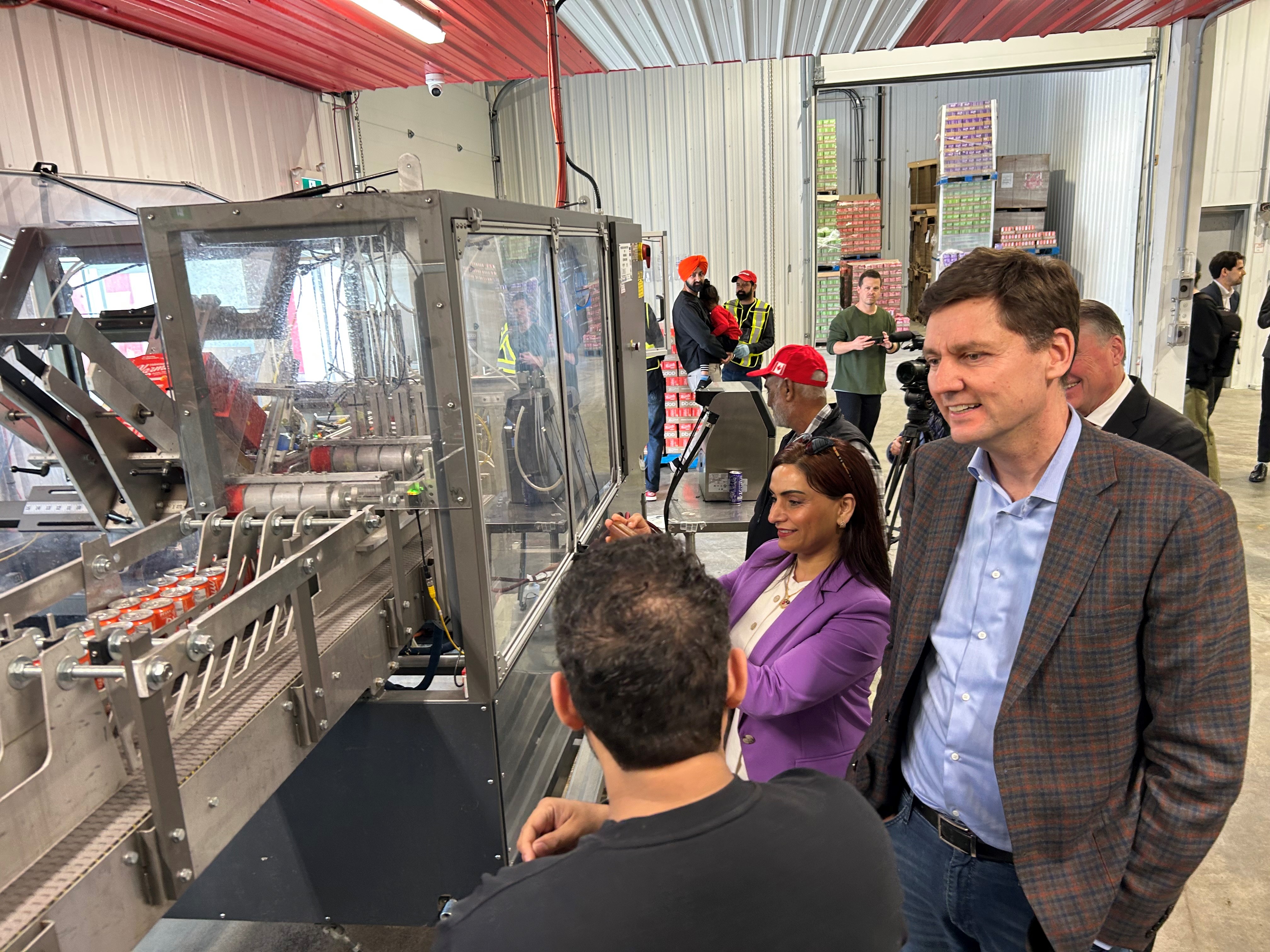
In a small, bustling facility on Baillie Grove, the sound is rhythmic—a metallic percussion of cans clicking into place. This is Farming Karma. It’s a family-run operation that started with a simple question: what do we do with the fruit that isn't "pretty" enough for the grocery store? For the Dhaliwal family, the answer wasn't to let it rot. It was to carbonate it.
When Premier David Eby stood inside that facility recently, he wasn't just there to admire the stainless steel tanks or the crisp pop of a soda tab. He was there to address a systemic fragility that most people only notice when their favorite local brand disappears from the shelf. He was there to talk about the BC Manufacturing Jobs Fund, a $33 million injection of capital designed to stop the bleeding in the province’s industrial heart.
Consider the life of a single apple.
In the old version of the B.C. economy, that apple might be picked, crated, and shipped raw. If it had a bruise, it was waste. If the market price dipped, the farmer lost. But when a company like Farming Karma enters the fray, that apple stays in the community. It gets crushed, filtered, and canned right there in the Okanagan. Value is added. Jobs are created. The "waste" becomes a premium product.
This is what economists call "value-added manufacturing," but that term is too sterile. It’s actually about survival.
The Invisible Wall of Scale
Small manufacturers in British Columbia face a terrifying ceiling. You start in a garage. You move to a small warehouse. You find a loyal following. Then, you hit the wall. To grow—to actually compete with the global conglomerates that dominate our grocery aisles—you need massive, expensive machinery. You need specialized cooling systems. You need automated packaging lines that cost more than a suburban home.
Most local businesses look at that price tag and stop. They stay small, or they wither.
The $1.3 million being funneled into Farming Karma is part of a larger $7.8 million package spread across several regional players. It’s a bridge over that wall. For this specific soda producer, the money means a new, state-of-the-art packaging line. It sounds technical, but the human result is a doubling of their workforce. It means more families in Kelowna can pay their mortgages because a local business decided to buy a better machine.
But why should someone in Victoria or Prince George care about a soda line in Kelowna?
Because the supply chain is a nervous system. When we stop making things here, we become entirely dependent on the whims of global shipping lanes and the stability of foreign borders. We saw what happened when the highways washed out or when the ports froze. If you don't manufacture your own essentials—and your own comforts—you are at the mercy of a world that doesn't care if you're thirsty.
A Portfolio of Resilience
The Premier’s announcement wasn't limited to the fizz of fruit juice. The scope of the funding reveals the sheer variety of things we’ve forgotten we can build ourselves.
- Mass Timber: In the Kootenays, companies are receiving funds to turn B.C. wood into high-tech building materials. Instead of shipping raw logs away, we are engineering the future of sustainable architecture.
- Fabrication and Metal: In the lower mainland, shops are getting the tools to build the components that keep our infrastructure standing.
- Agri-food: Beyond the soda, other producers are scaling up to ensure that "Buy BC" isn't just a marketing slogan, but a logistical reality.
It is a calculated gamble on the part of the provincial government. By spreading $33 million across dozens of projects, they are trying to create an ecosystem where the "Made in B.C." label actually carries industrial weight.
But there is a tension here. You can feel it in the room when politicians speak to workers.
The workers are focused on the immediate—the shift schedule, the reliability of the equipment, the cost of gas. The government is focused on the macro—GDP growth, carbon footprints, and election cycles. The bridge between them is the investment in the physical space. When a provincial grant pays for a piece of equipment, it’s a tangible promise that this specific factory won't be turned into a condo block next year. It’s a stake in the ground.
The Human Cost of Doing Nothing
Imagine a technician named "Sandeep." He grew up in the valley. He knows the orchards. In the old economy, Sandeep might have moved to a tech hub or taken a job in a different province because there wasn't a high-skill role for him in his hometown.
With this expansion, Sandeep stays. He learns to operate a multi-million dollar packaging system. He becomes a specialist. His kids grow up near their grandparents. This is the "fostering" of community that the spreadsheets try to quantify but always fail to capture. The ripple effect of one manufacturing plant is massive. It supports the truck drivers who move the cans, the farmers who grow the fruit, the mechanics who service the line, and the local shops where those employees spend their paychecks.
The challenge, however, is that $33 million is a drop in the bucket compared to the pressures of inflation and the high cost of doing business in B.C.
Critics will point out that government grants are often a "band-aid" on a larger problem of high taxes and complex regulations. They aren't entirely wrong. A grant can buy a machine, but it can't fix a broken regulatory environment. Yet, for the person standing on the factory floor, the nuance of tax policy matters less than the fact that the company just hired ten more people and the lights are staying on.
The Shift in the Wind
There is a certain poetry in the Premier choosing a soda company for this announcement. Soda is an indulgence. It’s something we associate with summer days and easy living. But the production of it is a gritty, demanding business of pressures, temperatures, and timing.
It serves as a metaphor for the province's current state. We want the easy, prosperous "summer" of the B.C. brand, but we are currently in the hard, industrial "spring" where we have to build the infrastructure to sustain it.
The Okanagan is changing. The rows of trees are increasingly flanked by modern industrial parks. To some, this feels like a loss of the valley’s pastoral identity. But look closer at the Farming Karma facility. The fruit in those cans is the same fruit that has grown there for a century. The identity hasn't changed; it has evolved. It has found a way to survive a globalized world by becoming more sophisticated, more efficient, and more stubborn.
As the ceremony ended and the cameras were packed away, the machines didn't stop. They kept clicking. They kept filling. The real story isn't the politician at the microphone; it’s the quiet, relentless hum of a packaging line that represents a family’s dream and a province’s necessity.
We are relearning how to make things. We are remembering that a province that only consumes is a province that eventually starves. The bubbling tanks in Kelowna are a small, sweet sign that we might just be heading in the right direction.
The sun set over the Monashee Mountains, casting long shadows across the valley. Inside the plant, another batch was ready. The fruit was saved. The jobs were secured. For today, the alchemy worked.