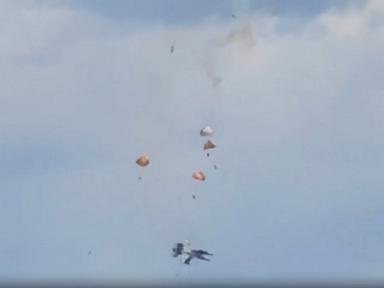
High-performance aerial demonstrations operate at the absolute margin of human and mechanical capability. When two United States Navy EA-18G Growlers collided during the Gunfighter Skies Air Show at Mountain Home Air Force Base in Idaho, the incident provided a stark look at the delicate balance between high-tempo public exhibitions and rigorous military safety protocols. While public reporting focused heavily on the visual spectacle of the crash and the immediate base lockdown, a structural analysis reveals a highly complex system of airspace saturation, specific aerodynamic vulnerabilities, and automated base emergency protocols.
Deconstructing this event requires analyzing three distinct operational phases: the close-formation flight envelope, the mechanics of zero-zero ejection systems, and the structural logistics of an installation-wide lockdown.
The Flight Envelope: Micro-Separation and Wingtip Dynamics
The collision involved two EA-18G Growler aircraft assigned to Electronic Attack Squadron 129 (VAQ-129) based out of Naval Air Station Whidbey Island. During a close-formation aerial demonstration, military aircraft routinely maintain separation distances measured in single-digit feet. Operating within this envelope removes standard margins for error and introduces complex aerodynamic feedback loops.
The primary variable in close-formation flight is the interaction of wake turbulence and wingtip vortices. Every aircraft produces a pair of counter-rotating vortices trailing behind its wingtips, the strength of which is directly proportional to aircraft weight and inversely proportional to speed and wingspan. In a high-G, low-altitude demonstration environment, these vortices become highly concentrated. If a trailing or adjacent aircraft inadvertently breaches the vortex core of a lead aircraft, it experiences an immediate, uncommanded roll moment—often exceeding the authority of the pilot’s flight control inputs.
Initial telemetry and witness footage indicate the two aircraft made structural contact approximately two miles northwest of the installation during a close-formation maneuver. Meteorological data at the time recorded good visibility but noted surface wind gusts of up to 29 mph. In low-altitude environments, high ambient wind gusts interact with terrain features to produce localized mechanical turbulence. When aircraft are operating with a micro-separation buffer, a sudden, asymmetrical wind shear can shift an aircraft's flight path faster than human reaction time (approximately 0.2 to 0.4 seconds) can correct, causing an immediate convergence of flight paths.
Survival Mechanics: Ejection Dynamics and Structural Entanglement
Midair collisions at low altitudes historically yield low survival rates due to spatial disorientation, rapid aircraft destruction, and insufficient altitude for parachute deployment. The survival of all four crew members (two per EA-18G aircraft) indicates the successful operation of the Martin-Baker MK14 Navy Common Ejection Seat (NACES) within its design parameters.
The NACES operates as a "zero-zero" system, meaning it is capable of safely extracting an occupant from an aircraft at zero airspeed and zero altitude. The ejection sequence occurs in a highly synchronized timeline:
- Canopy Clearing: The canopy is either jettisoned via explosive bolts or fractured by miniature detonation cords embedded in the acrylic.
- Catapult Phase: A ballistic rocket motor fires beneath the seat, accelerating the pilot up and out of the cockpit at a rate exceeding 15 Gs to clear the vertical stabilizer.
- Stabilization and Separation: A drogue parachute deploys immediately to stabilize the seat’s pitch and roll, preventing the occupant from tumbling.
- Parachute Deployment: An atmospheric sensor determines the altitude and velocity; at low altitudes, the main parachute deploys immediately, followed by automated seat-man separation.
A unique factor in this specific collision, noted by aviation safety analysts, was the manner of structural impact. Footage indicates the two airframes became physically entangled or struck each other in a way that temporarily arrested their descent or kept the cockpit sections relatively intact prior to the ejection command. This structural buffering provided the vital 2-to-3-second window required for the electronic sequencers in the NACES units to clear all four occupants sequentially without their paths crossing or getting caught in the primary fireball.
Post-Impact Logistics: The Mechanics of an Installation Lockdown
Immediately following the impact at 12:30 PM local time, Mountain Home Air Force Base executed a full installation lockdown. To outside observers, locking down a military base after an accident two miles away may seem counterintuitive. However, in military doctrine, an installation lockdown is a standardized, multi-variable containment protocol designed to preserve life, secure sensitive components, and control the information environment.
An air show environment scales up base population density by a factor of ten, introducing tens of thousands of unvetted civilians into a high-security military zone. When an aircraft incident occurs, the base command structure activates an immediate Divergent Risk Matrix.
[Aircraft Midair Collision]
          │
          ▼
[Activate Incident Command System]
          │
      ┌───┴────────────────────────┐
      ▼                            ▼
[Secure Crash Radius]       [Initiate Base Lockdown]
  - Contain Class Alpha       - Freeze Civilian Movement
    Toxic Hazards             - Clear Emergency Lanes
  - Secure Classified EA-18G  - Enforce Controlled
    Electronic Components       Egress Protocols
The first priority is the deployment of Crash Fire Rescue (CFR) assets. The EA-18G Growler contains specialized composite materials, including carbon-fiber reinforced epoxies, alongside hydrazine, hazardous fuels, and heavy metals. When burned, these materials release highly toxic, carcinogenic particulates into the air. The containment of the subsequent fire and the isolation of the crash site—located one mile north of where the aircrew parachuted—requires strict perimeter control to prevent civilian exposure to toxic smoke plumes.
The second priority is physical security and classified component asset protection. The EA-18G is a specialized electronic warfare platform equipped with sensitive tactical jamming pods, receiver antennas, and classified software architectures. Following a crash, the physical debris field remains highly classified. A lockdown ensures that no unauthorized personnel can exit or enter the base perimeter, preventing the potential compromise of sensitive military hardware before a dedicated security cordon can be established around the debris radius.
The third priority is traffic management and emergency access. A mass influx of spectators trying to flee the base simultaneously creates immediate gridlock on the narrow access roads characteristic of rural military bases like Mountain Home. By ordering a lockdown and instructing spectators to remain in place, base security forces successfully cleared all primary and secondary routes for emergency vehicles, medical helicopters, and military investigative teams. This controlled containment allowed local authorities, including the Mountain Home Police Department, to systematically cancel the remainder of the Gunfighter Skies event and manage a staggered, safe evacuation of civilian vehicles over several hours.
Systemic Safety Thresholds
The incident represents a Class A mishap, defined by the Department of Defense as an accident resulting in property damage of $2.5 million or more, or the total loss of a military aircraft. With two front-line electronic attack aircraft destroyed, the economic loss easily exceeds $130 million.
However, the complete survival of the aircrew changes the long-term operational impact. Military safety investigations will now shift from immediate recovery to data preservation. Investigators from the Naval Safety Command will analyze the aircrafts' deployable flight data recorders, structural debris, and heads-up display (HUD) recordings to isolate the precise variable—whether aerodynamic, environmental, or human—that caused the breakdown in separation parameters. This data will ultimately be integrated back into squadron training profiles worldwide, adjusting the minimum allowable distance thresholds for future public military demonstrations.