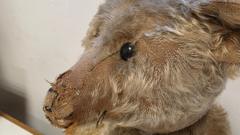
Most people see a worn-out stuffed animal and think of a garage sale. Collectors see a retirement fund. When a century-old teddy bear recently sold for four times its original estimate, it wasn't just a fluke of the auction room. It was a reminder that the market for early 20th-century toys is fueled by a mix of nostalgia, scarcity, and the high-stakes world of "arctophily"—the technical term for bear collecting. If you've got an old bear in the attic, don't toss it. It might be worth a used car. Or a new one.
The bear in question wasn't a modern mass-produced toy. It was a Steiff. For the uninitiated, Steiff is the gold standard. Founded in Germany by Margarete Steiff, the company basically invented the jointed teddy bear as we know it. The specific model that blew past its $1,000 estimate to hit over $4,000 was a classic example of what happens when a piece of history meets a motivated buyer.
What Makes a Hundred Year Old Teddy Valuable
Price tags in the thousands don't happen by accident. You need a perfect storm of condition, brand, and "the look." Most toys from 1910 or 1920 were played with until they fell apart. They were dragged through the mud, chewed by dogs, and left in damp basements. Finding one that survived with its fur intact is rare.
The big one is the "Button in Ear." Steiff started using a metal stud in the left ear around 1904 to fight off cheap knockoffs. If that's still there, the price stays high. If the tag is gone but you can still see the hole where it used to be, you're still in the money. Collectors also look for "mohair" fur—which is actually goat hair—and wood wool stuffing. If you squeeze a bear and it crunches, that's a good sign. It means it's stuffed with excelsior, not modern foam.
The Teddy Roosevelt Connection
We forget that the "Teddy" bear is a political meme. It started with a 1902 hunting trip where President Theodore Roosevelt refused to shoot a black bear that had been tied to a tree. A political cartoonist named Clifford Berryman drew the scene, and the "Teddy Bear" was born.
Steiff grabbed the momentum in Germany. They showed their version at the Leipzig Toy Fair in 1903. An American buyer bought 3,000 of them on the spot. That's why so many of these high-value bears turn up in the U.S. and the UK. They were the "it" toy of the Edwardian era.
Why the Market is Spiking Now
You’d think the market for 100-year-old toys would be dying off as older collectors pass away. It’s actually doing the opposite. High-end toys are being treated like alternative assets, similar to watches or vintage Porsches.
Wealthy collectors aren't buying these to put them in a nursery. They’re buying them as tangible history. When the world feels volatile, people put their money into things that have already survived a century. A bear that survived two World Wars and the Great Depression feels like a safe bet. Plus, there's the "cuteness" factor. You can't hug a stock portfolio.
Spotting a Real Treasure in the Wild
Don't assume every old bear is a Steiff. There were plenty of competitors like Farnell, Bing, and Ideal. Some of those are also valuable, but Steiff remains the king. Look for the long, thin arms. Early bears had arms that reached past their laps, almost to their feet. They also had humps on their backs, like real grizzly bears.
If the eyes are made of glass, that's a plus. If they’re "boot button" eyes—literally black buttons from shoes—that's even better for dating the bear to before 1910.
How to Handle a High Value Find
If you find a bear that looks like it belongs in a museum, stop. Don't wash it. Don't try to sew up a tear yourself. You will destroy the value. Collectors want "honest wear." They hate "restored" toys that look brand new.
Take clear photos in natural light. Look for a local auction house that specializes in toys or "dolls and teddy bears." General estate sales often miss the nuances that drive prices into the five-figure range. A specialized valuer knows how to spot the difference between a 1920s hobby bear and a 1905 "cinnamon" Steiff that could buy you a small house.
If you're looking to start a collection or just want to see if your childhood toy is a hidden gem, check the physical characteristics first. Feel for the internal joints. A valuable bear’s head and limbs should rotate 360 degrees. Check the "pads"—the palms and soles of the feet. If they're made of felt and have four or five stitched claws, you’re looking at quality craftsmanship.
Start by browsing sold listings on sites like Christie’s or specialized toy auctioneers like Vectis. Look at the "sold" price, not the "asking" price. That’s where the reality of the market lives. If your bear has the right pedigree, get an appraisal. Just don't be surprised if that dusty old toy turns out to be the most expensive thing in your house.