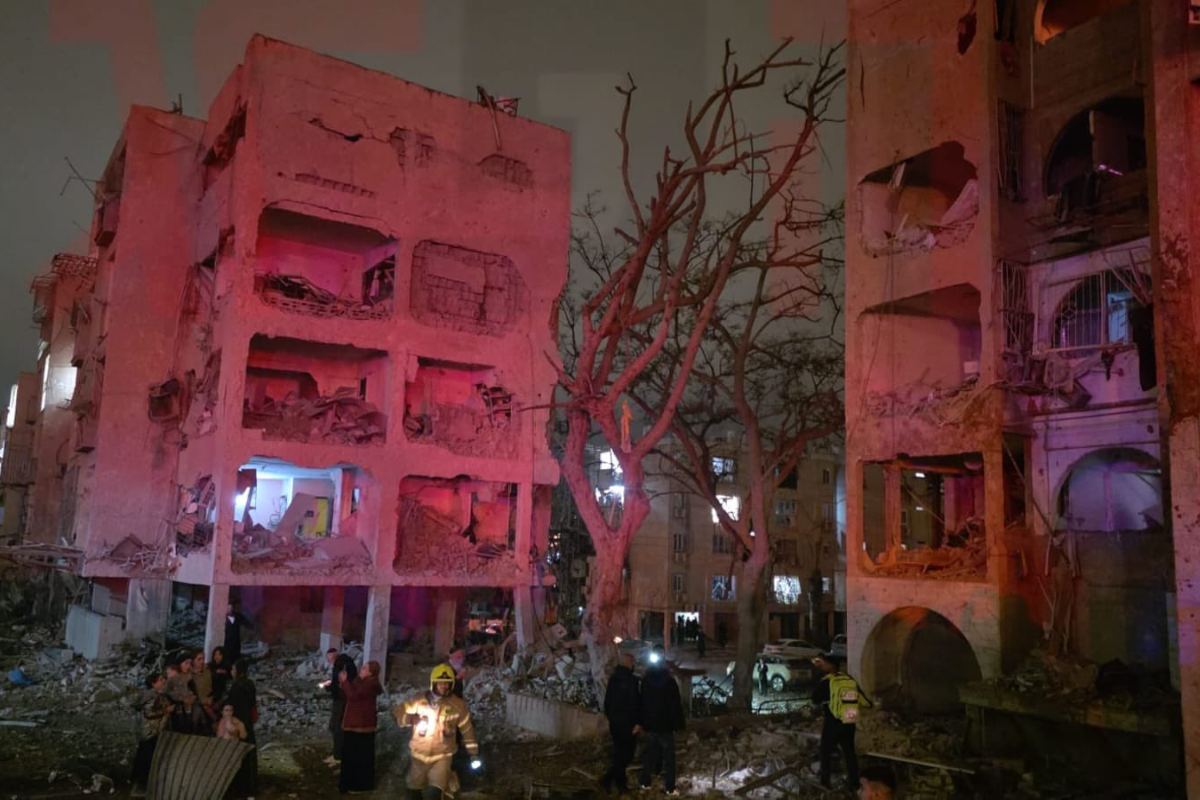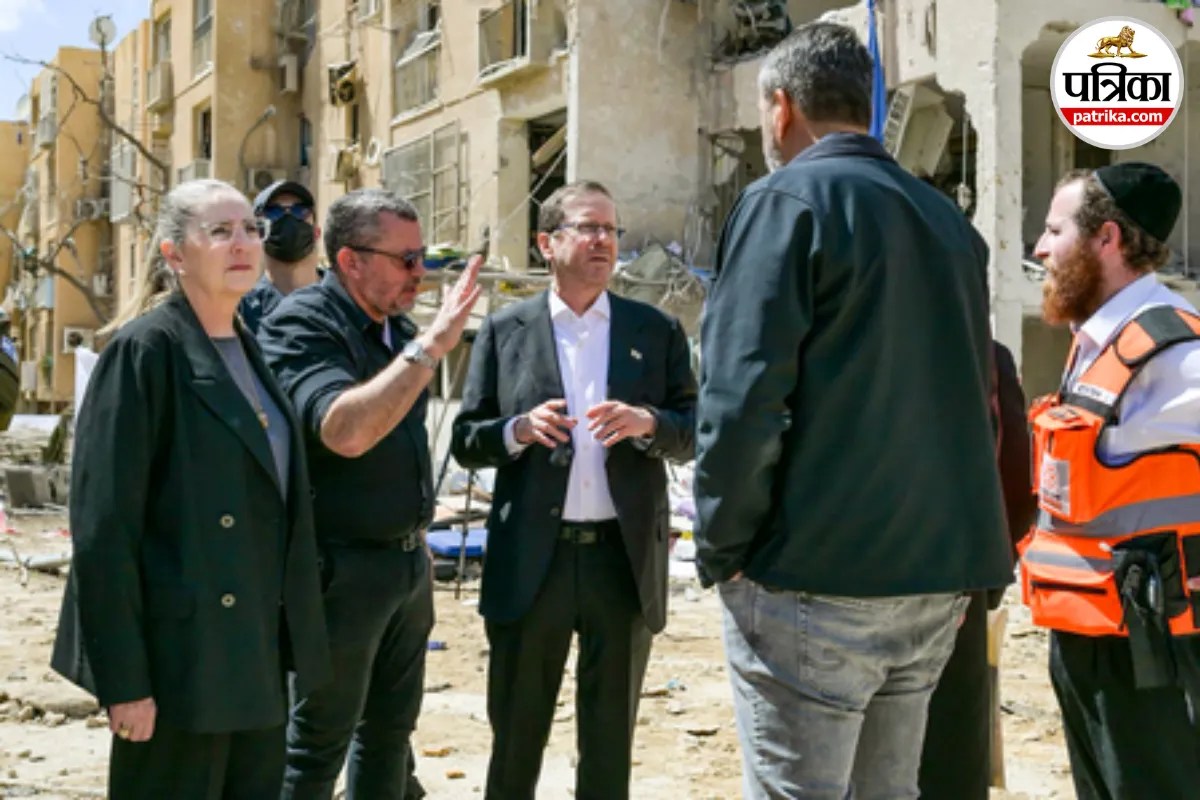
The ballistic missile that tore through the night sky toward Arad was more than a localized explosion. It was a loud, violent signal that the old rules of Middle Eastern engagement have been shredded. While Israeli President Isaac Herzog uses the rhetoric of "crushing the snake’s head," the reality on the ground suggests a far more complex and dangerous strategic shift. Iran has moved from a doctrine of shadow warfare and proxy reliance to direct, state-on-state kinetic action. This transition changes the calculus for every defense ministry from Tel Aviv to Washington.
The strike on Arad, located near the sensitive Nevatim Airbase, highlights a critical vulnerability in what was once considered an impenetrable shield. For years, the narrative surrounding the region’s security focused on the "Iron Dome" and its high-altitude siblings, Arrow and David’s Sling. However, the sheer volume of a coordinated Iranian salvo—comprising drones, cruise missiles, and ballistic projectiles—aims to achieve a simple mathematical reality. It seeks to overwhelm the interceptors. If you fire more rounds than the defense system can track, some will hit. In Arad, they did. If you enjoyed this article, you might want to read: this related article.
The Strategy of Saturation
Military analysts have long warned about the "saturation point." Israel’s multi-layered defense is technically superior to almost anything in the world, yet it faces an existential problem of cost and inventory. An interceptor missile can cost millions of dollars. An Iranian drone or a basic ballistic missile costs a fraction of that. When Tehran launched its waves of attacks, the goal wasn't just to destroy specific buildings, but to force Israel and its allies to deplete their stockpiles of expensive defensive munitions.
This is the grim arithmetic of modern attrition. By targeting areas near Arad, Iran demonstrated it could penetrate the airspace surrounding some of Israel's most guarded military assets. The psychological impact on the civilian population in the Negev region cannot be overstated. When the sirens wail in a town that previously felt insulated from the chaos of the borders, the social contract between the state and its citizens begins to fray. For another perspective on this development, check out the latest coverage from Associated Press.
Beyond the Rhetoric of the Snakes Head
President Herzog’s call to "crush the snake's head" is classic political signaling designed for domestic consumption and international posturing. It frames Iran as the singular source of regional instability. While this simplifies the narrative for the evening news, it ignores the sophisticated web of alliances and domestic pressures driving Tehran’s decisions. Iran is no longer just a "snake" in a hole; it is a regional power that has spent three decades preparing for this exact moment of conventional confrontation.
The "snake" metaphor also fails to account for the internal pressures within the Iranian Revolutionary Guard Corps (IRGC). Hardliners in Tehran have been demanding a direct response to Israeli operations for years. The strike on Arad was a concession to these internal factions, proving that the regime is willing to risk a total regional war to maintain its internal credibility. This isn't just about ideology. It is about the survival of a political system that views any sign of weakness as a death sentence.
The Intelligence Failure of De-escalation
For the last decade, Western intelligence agencies operated under the assumption that Iran would never risk a direct strike on Israeli soil. The belief was that the "gray zone"—where proxies like Hezbollah and the Houthis do the fighting—provided enough of a vent for Iranian aggression. The Arad incident proves that this assumption was a catastrophic miscalculation.
The red lines have moved. What was once unthinkable—a rain of missiles from Iranian territory—is now the new baseline. This shift leaves the international community in a reactive stance. We are no longer talking about preventing a conflict; we are talking about managing one that has already begun. The diplomatic efforts to "de-escalate" often fall flat because they rely on the idea that both sides want to return to the status quo. But the status quo is exactly what Iran wants to destroy.
The Technological Evolution of the IRGC
The missiles reaching Arad are not the erratic Scuds of the 1990s. They are precision-guided instruments. This evolution in Iranian missile technology has happened largely in plain sight, fueled by a mix of indigenous engineering and smuggled dual-use technology.
- Guidance Systems: Improved GPS-independent navigation makes them harder to jam.
- Re-entry Vehicles: Newer warheads are designed to maneuver in the final seconds of flight, making them harder for the Arrow system to track.
- Launch Mobility: Mobile launchers allow Iran to fire and move before satellite surveillance can trigger a counter-strike.
The technical gap between the two nations is closing. While Israel still holds the qualitative edge, the quantitative pressure is becoming unbearable.
The Economic Burden of Permanent Alert
War is expensive, but a state of perpetual "near-war" is perhaps even more taxing on a democratic society. The cost of mobilizing hundreds of thousands of reservists, coupled with the astronomical price tag of missile defense, puts the Israeli economy under a microscope. If every Iranian provocation requires a multi-billion dollar response, the economic exhaustion becomes a weapon in itself.
Investors hate uncertainty. The tech sector, which is the engine of the Israeli economy, thrives on stability and global connectivity. When missiles fall near Arad, it sends a message to the global markets that the region is no longer a safe bet for long-term capital. This is the "soft" damage of the conflict—the kind that doesn't show up in a damage report of a cratered street but reflects in the shrinking GDP and the flight of talent.
The Role of Global Powers
Washington finds itself in an impossible position. Supporting Israel’s right to defend itself is a cornerstone of U.S. policy, yet there is a profound lack of appetite for another "forever war" in the Middle East. The strike on Arad forced the U.S. to engage its own assets in the region, drawing them deeper into a conflict that the current administration would rather see managed through back-channel diplomacy.
Russia and China are watching closely. For Moscow, any diversion of Western military resources away from Ukraine is a victory. For Beijing, the instability provides an opportunity to position itself as the "rational" alternative to American-led security frameworks. The Arad strike isn't just a bilateral issue; it is a chess move on a global board where the players are increasingly willing to sacrifice pawns for strategic positioning.
The Psychological Toll on the Negev
The southern regions of Israel were once seen as a frontier of growth and development. Arad, with its clean air and quiet streets, was a sanctuary. That sanctuary is gone. The sound of explosions overhead has replaced the silence of the desert. The long-term psychological impact on children growing up in these zones will dictate the politics of the next generation. Traumatized populations rarely vote for compromise. They vote for the strongest possible defense, further fueling the cycle of escalation that leaders on both sides claim they want to avoid.
The Myth of Total Defense
The Arad incident should finally bury the myth that technology can solve political problems. You cannot build a wall high enough or a dome strong enough to keep out the consequences of a century of geopolitical friction. While the interceptors did their jobs for the most part, the "leakers" that got through prove that perfect security is a fantasy.
Relying on "The Dome" has perhaps made regional leaders more reckless. If you believe you are invulnerable, you are more likely to take risks. But as the debris in Arad shows, no one is invulnerable. The tactical success of shooting down 90% of incoming fire is a strategic failure if the remaining 10% is enough to trigger a regional conflagration.
The Absence of an Exit Ramp
The most chilling aspect of the current situation is the lack of a clear exit ramp. Both sides have backed themselves into corners where any form of compromise is viewed as surrender. In Tehran, the regime has staked its legitimacy on "resistance." In Jerusalem, the government has staked its survival on "total victory." These two positions are fundamentally irreconcilable.
The strike in Arad was a test. It tested the limits of Israeli defense, the resolve of the American alliance, and the tolerance of the international community. The results of that test suggest that we are entering a period of prolonged, high-intensity friction where the margin for error is zero. A single missile landing in a crowded residential block instead of a vacant lot could be the trigger that moves this from a series of strikes to a total war.
The rhetoric of snakes and crushing blows makes for good headlines, but it offers no path to safety. True security in the region will not come from a more advanced interceptor or a more aggressive speech. It requires a fundamental reassessment of the deterrence models that have clearly failed. Until that happens, the people of Arad, and the millions like them across the region, will continue to live in the shadow of a sky that could turn lethal at any moment.
Military commanders often say that the enemy gets a vote in your strategy. Iran just cast its vote in the ruins of the Negev. Ignoring the implications of that vote—or pretending that a bigger hammer is the only solution—is a recipe for a catastrophe that no missile defense system can stop. The focus must shift from the hardware of war to the software of regional stability, however unlikely that seems in the current climate.
You need to look at the crater in Arad not as a site of physical destruction, but as a monument to the failure of 21st-century diplomacy. If the goal was to keep the peace, the fire in the desert proves we have already lost.