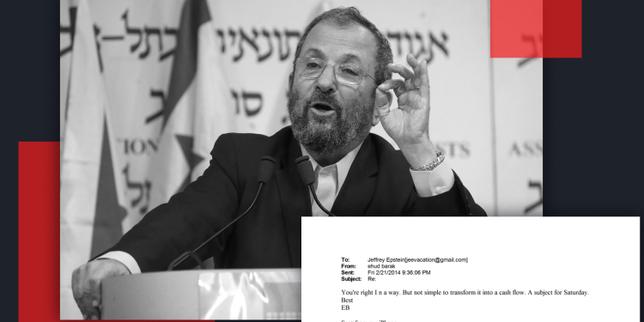
The doorbell of a luxury apartment in the Upper East Side doesn't just ring; it announces an arrival with a discreet, expensive chime. In the mid-2010s, that chime often signaled the entrance of Ehud Barak. He was once the most decorated soldier in Israel’s history, a former Prime Minister, and a man who understood the mechanics of power better than almost anyone alive. But when he stepped through those doors, he wasn't there for a diplomatic summit. He was there to see Jeffrey Epstein.
Power is rarely a straight line. It is a series of overlapping circles, a Venn diagram of influence where the military-industrial complex meets the high-octane world of private equity. For years, the public saw Barak as the elder statesman of the Zionist left, the man who nearly brokered peace at Camp David. Behind the scenes, however, he was navigating a different map. It was a map drawn by Epstein, a man who had turned the accumulation of "great men" into a dark science. If you found value in this piece, you might want to look at: this related article.
The relationship between the two wasn't a casual acquaintance. It was a partnership of mutual utility. Between 2013 and 2017, flight logs and visitor records show Barak as a frequent guest at Epstein’s Manhattan townhouse and his private island. To understand why a man of Barak's stature would tether his reputation to a convicted sex offender, you have to look past the tabloid headlines and into the cold, hard logic of global venture capital.
The Foundation of a Shadow Empire
Money in the world of intelligence and high-level diplomacy doesn't move like a paycheck. It moves through "special purpose vehicles" and opaque investment funds. In 2015, Barak established a company called Carbyne. It was a high-tech startup promising to revolutionize emergency services with "next-generation 911" technology. It was sleek. It was necessary. It was also funded by millions of dollars routed through Jeffrey Epstein. For another look on this story, refer to the recent update from The Guardian.
Imagine a soldier who has spent his life in the mud and the heat of the Middle East. He has commanded divisions. He has held the nuclear codes. When he retires, the world expects him to write a memoir and sit on a few boards. But for a man like Barak, the adrenaline of the battlefield is replaced by the adrenaline of the deal. He needed capital. Epstein had the keys to the vaults.
The investment wasn't just about cash. It was about the network. Epstein functioned as a human switchboard, connecting the brilliance of Israeli tech with the bottomless pockets of New York and Silicon Valley. When Barak defended the relationship later, he spoke of it in purely transactional terms. He claimed he didn't know the extent of Epstein’s crimes at the time, or perhaps more accurately, he chose not to look. In the circles where these men moved, "due diligence" is often a polite term for making sure the check clears.
The Cost of Access
There is a specific kind of blindness that affects the powerful. It is the belief that they can touch pitch and not be defiled. Barak’s frequent visits to the East 71st Street mansion occurred long after Epstein’s 2008 conviction in Florida. The red flags weren't just waving; they were screaming. Yet, the meetings continued.
Consider the optics of a former world leader being photographed entering the home of a known predator, his face partially obscured by a camouflage neck gaiter. It wasn't just a lapse in judgment. It was a demonstration of the "untouchable" mindset. When you have spent decades navigating the world of secret intelligence, you begin to believe that everything—even morality—is negotiable. You convince yourself that the mission, whether it’s peace in the Middle East or a tech IPO, justifies the company you keep.
The invisible stakes here weren't just financial. They were institutional. Every time Barak sat down with Epstein, he brought the weight of the Israeli state with him, whether he intended to or not. To the outside world, Epstein wasn't just a financier; he was a man who had a former Prime Minister on speed dial. That is a level of social currency that no amount of money can buy. It provided Epstein with a shield of respectability that he used to continue his operations for years.
The Disappearing Act
When the second wave of allegations against Epstein broke in 2019, the world watched as his associates scrambled for the exits. The transition from "valued business partner" to "unfortunate mistake" happened overnight. Barak was forced to distance himself, eventually announcing he would sever all ties and buy out Epstein's stake in Carbyne.
But the ghost of the partnership remained. The story of Barak and Epstein isn't just a tale of two men; it’s a window into how the world actually works when the cameras are off. It’s about the "diplomatie secrète"—the secret diplomacy where intelligence assets, political favors, and venture capital are traded like commodities.
In this world, there are no clean hands. There are only hands that are busy.
The tragedy isn't just in the crimes committed by Epstein, but in the ease with which those crimes were ignored by the people we trust to lead us. We want our leaders to be moral compasses, but often they are just navigators, following the scent of the next big opportunity. They move through the halls of power with a sense of entitlement, certain that their contribution to history grants them an exemption from the scrutiny of the common man.
The relationship eventually soured, at least in the eyes of the public. But the structures they built—the funds, the companies, the lines of influence—don't just disappear because one man dies in a jail cell and another loses an election. They remain, woven into the fabric of the global economy, silent reminders of a time when a soldier and a ghost decided to build a world together.
History is written by the survivors, but the truth is often buried in the ledgers. As the dust settles on the Epstein era, the names on the flight logs remain as a testament to a simple, chilling reality: for the right price, even the most decorated hero will walk through a door they know they should never have opened.
The chime of that Upper East Side doorbell still echoes. It is the sound of a deal being struck in the dark, a sound that reminds us that in the rooms where the world is shaped, the most dangerous thing you can lose isn't your money or your power. It’s your shame.