For decades, the "shrimp among whales" strategy defined Seoul’s foreign policy, while Tokyo leaned into the quiet comfort of the American security umbrella. That era ended with the 2025 "reciprocal" tariff wave. By threatening Tokyo and Seoul with 25% across-the-board levies, Donald Trump didn't just rattle markets; he inadvertently forced the two most bitter rivals in East Asia into a foxhole together. The math is simple and brutal: as the United States shifts from being a regional guarantor to a high-priced landlord, Japan and South Korea have realized that their historical grievances are a luxury they can no longer afford.
The primary driver of this sudden warmth isn't a newfound love for shared history, but a cold-eyed calculation of survival. In April 2025, the Trump administration launched a global trade war, initially demanding massive concessions in exchange for avoiding catastrophic tariffs. Tokyo responded with a $550 billion investment pledge, while Seoul followed with $350 billion. This wasn't diplomacy; it was a protection payment. By essentially "buying down" their tariff rates to 15%, these two nations found themselves using the same playbook to survive the same Washington storm.
The Cost of the Shield
The shift in Washington's tone has transformed the security architecture of the Pacific. Under the first Trump term, the demand for a 500% increase in "host nation support" for U.S. troops in Korea was seen as a negotiation tactic. In 2026, it is the baseline. This transactional approach to alliances has eroded the trust that once underpinned the trilateral relationship.
When the U.S. Commerce Department began chairing "Investment Committees" to decide where Japanese and South Korean state-backed funds should be spent—prioritizing U.S. shipbuilding and semiconductors—it sent a clear signal. The United States is no longer interested in maintaining a "networked regional security architecture" unless it pays direct dividends to the American treasury. Consequently, Tokyo and Seoul are looking at each other and seeing the only partners left who understand the specific threat of a rising China and a nuclear-capable North Korea.
Strategic Convergence by Necessity
The irony is that Trump is achieving what years of polite State Department coaxing could not. For decades, American diplomats tried to "foster" (to use a banned term for a failed concept) better ties between Tokyo and Seoul using soft power and cultural exchanges. Trump used a sledgehammer instead.
- Shipbuilding and Logistics: With the U.S. Navy struggling to keep pace with Chinese production, the Trump administration has demanded $150 billion in South Korean investment specifically for U.S. shipyards. This has forced Korean giants like Hanwha and HD Hyundai to coordinate with Japanese suppliers to meet American demands while protecting their own technical secrets.
- The Semiconductor Squeeze: The push to reshore chip manufacturing to the U.S. has hit Samsung and TSMC hard. However, it has also forced a quiet truce in the 2019 Japan-South Korea trade war over semiconductor chemicals. They cannot afford to fight each other while the U.S. is trying to strip-mine their domestic industries for local investment.
- Energy and Minerals: The joint pursuit of critical minerals has led to a surge in Japan-Korea cooperation in Central Asia and Africa. They are realizing that if they compete for the same lithium and cobalt, they only drive the price up for themselves while the U.S. prioritizes its own domestic supply chains.
The Ghost of 2024
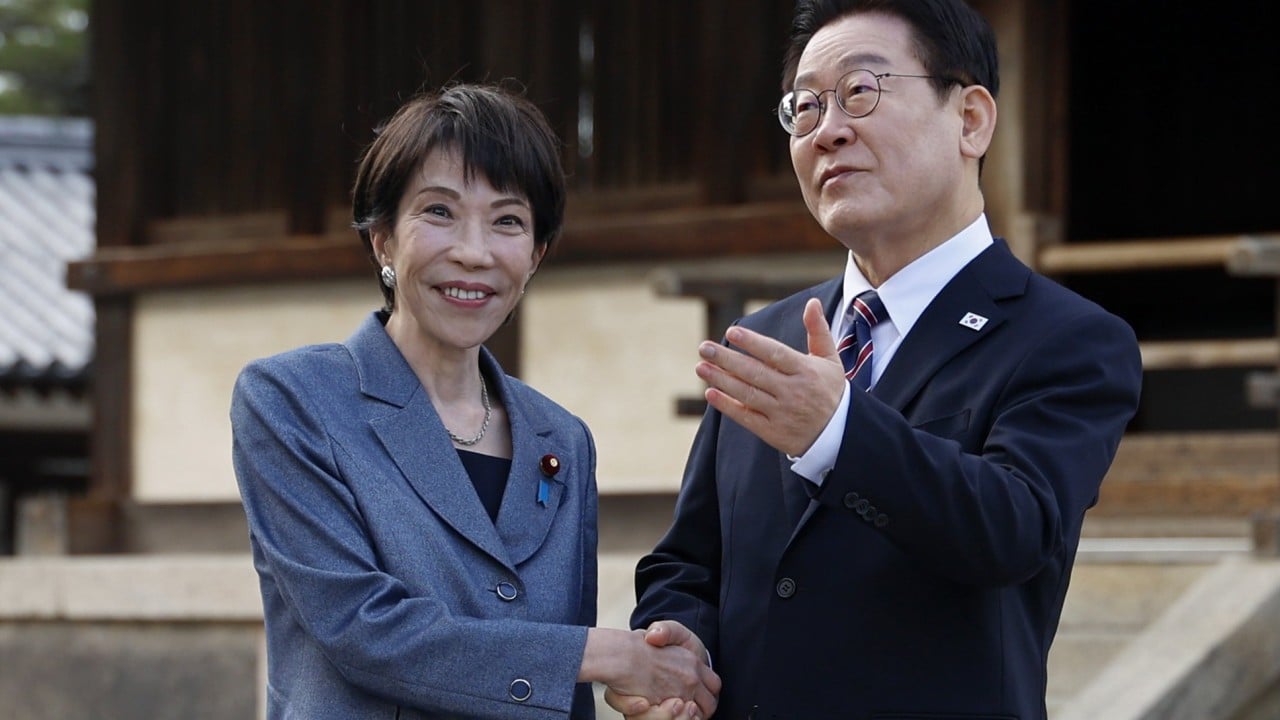
The political backdrop for this forced marriage is precarious. In Seoul, the legacy of Yoon Suk Yeol—who famously attempted a self-coup in late 2024—still hangs heavy over the Blue House. While Yoon's successor, Lee Jae-myung, is a progressive, the geopolitical reality has left him little room to revert to the anti-Japan rhetoric of the past. The threat of a U.S. troop withdrawal, a perennial Trump talking point, remains the ultimate incentive for cooperation.
Meanwhile, in Tokyo, Prime Minister Sanae Takaichi faces a similar bind. A staunch nationalist and protégé of Shinzo Abe, Takaichi would normally be the last person to extend an olive branch to Seoul. Yet, the "America First" policy has been so aggressive that even the most hawkish elements of the Liberal Democratic Party recognize that a fractured East Asia is a banquet for Beijing.
The Shipbuilding Gambit
The most concrete example of this accidental integration is the revitalization of the U.S. shipbuilding industry using Asian capital. The Trump administration’s Memorandum of Understanding (MOU) with South Korea specifies that $150 billion must go into shipbuilding. Because the U.S. lacks the skilled labor and specialized supply chains, Korean firms are being forced to bring in Japanese components and engineering standards to meet the aggressive timelines set by the White House.
This isn't a "synergy" born of mutual respect; it is a shotgun wedding choreographed by the U.S. Commerce Department. Japanese and South Korean engineers who previously wouldn't share a lunch table are now co-designing the very yards that will build the next generation of American logistics vessels.
The Limits of Transactionalism
There is a hollow core to this new alliance. While the economic and military coordination is real, it lacks a foundation of public support. In South Korea, memory of the 2024 martial law attempt is fresh, and any move that looks like "submissiveness" to Tokyo is still political poison. In Japan, the suspicion remains that South Korea could flip back to a pro-China or anti-Japan stance with the next election.
The Trump administration’s focus on "leverage over implementation" means that while these countries are spending more on defense and investing more in the U.S., the actual ability of their forces to operate together remains stunted. We are seeing a buildup of hardware and a flow of capital, but a decline in the shared values that once made the trilateral relationship more than just a balance sheet.
The "Investment Committee" model, where the U.S. identifies projects and foreign governments provide the cash, essentially turns Japan and South Korea into venture capitalists for American industrial policy. They are paying for the privilege of remaining allies. This might work as a short-term extraction strategy, but it leaves the regional order fragile. If the U.S. security guarantee is seen as a commodity that can be priced, then Tokyo and Seoul will eventually start shopping for a better deal—or building their own store.
A New Pacific Reality
This isn't the "tapestry" of cooperation that liberal internationalists dreamed of. It is a cynical, hard-edged alignment born of shared anxiety. By treating allies as economic competitors first and security partners second, the Trump administration has removed the safety net that allowed Japan and South Korea to bicker for seventy years.
The historical grievances haven't vanished. The "comfort women" statues and the disputes over the Dokdo/Takeshima islands are still there, but they have been moved to the back burner because the house is on fire. The irony is that by being the most disruptive force in the region, Donald Trump has done more to integrate the Asian power bloc than any "pivot to Asia" ever could. He has shown them that in a world of "America First," they are very much on their own.
Japan and South Korea are now operating on a simple premise: if they don't hang together, they will most certainly be taxed separately.