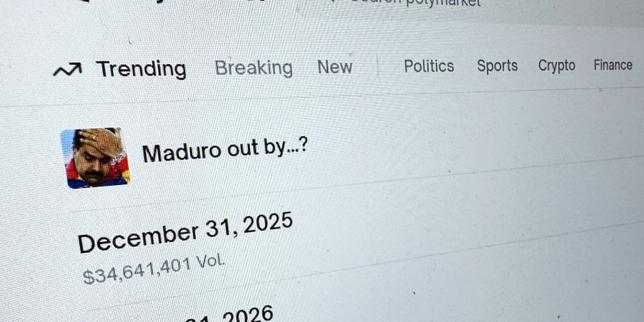
The indictment of a U.S. Army staff sergeant for allegedly utilizing classified intelligence to trade on the outcome of the Venezuelan election via Polymarket exposes a critical vulnerability in the convergence of decentralized finance (DeFi) and intelligence operations. This case functions as a practical stress test for the Efficient Market Hypothesis within the context of prediction markets. When an actor with access to non-public, high-fidelity data—specifically regarding the movement of Venezuelan President Nicolás Maduro—attempts to monetize that data, the market ceases to be a tool for collective wisdom and instead becomes a vector for state-level security breaches and financial crime.
The Triad of Exploitation: Intelligence, Prediction, and Profit
The mechanics of this incident rest on three distinct pillars that define the modern landscape of high-stakes prediction.
- Privileged Access: The individual in question held a position that granted access to sensitive briefings regarding Venezuelan political stability and the specific movements of regime leadership.
- Market Liquidity: Polymarket provided a venue where "shares" in a specific geopolitical outcome (e.g., "Will Maduro stay in power?") could be bought and sold with relatively low friction.
- The Incentive Gap: The disparity between a military salary and the potential returns on a six-figure prediction market position creates a rational, albeit illegal, incentive for insider trading.
The fundamental breakdown occurs where "alpha"—the excess return on an investment—is generated not through superior analysis of public variables, but through the extraction of classified state secrets. This transforms a prediction market from a forecasting tool into a laundering mechanism for information arbitrage.
Mapping the Information Flow and Logic of the Short
The strategy employed by the accused was a binary bet on regime change or political collapse. In prediction market terms, this is a volatility play predicated on a "black swan" event that the actor knows is actually a "grey rhino" (a highly probable but ignored threat) because they are viewing the internal planning documents of the opposition or the intervening powers.
The logic follows a specific sequence of causality:
- Step A: Identify a high-purity signal within classified channels (e.g., specific dates of planned protests or internal military defections).
- Step B: Assess the "priced-in" probability on Polymarket. If the market gives a 10% chance of a Maduro exit, but the classified data suggests a 70% chance, the Information Discrepancy is 60%.
- Step C: Execute trades via a decentralized platform to leverage pseudonymity.
The failure of this strategy lies in the On-Chain Audit Trail. While the trader likely assumed the decentralized nature of Polymarket and the Polygon network would shield them, the transparency of the ledger allows federal investigators to map wallet addresses to physical IP logs and financial on-ramps. The transparency of the blockchain effectively becomes a trap for those attempting to use it for covert financial gain.
The Cost Function of Insider Geopolitics
In traditional equity markets, insider trading is regulated through the SEC and strict reporting requirements. Prediction markets operate in a regulatory vacuum that fluctuates by jurisdiction. However, when the "inside information" is a matter of national security, the cost function shifts from financial penalties to criminal prosecution under the Espionage Act or related statutes concerning the mishandling of classified data.
The damage to the prediction market ecosystem is two-fold:
- Price Distortion: Insider activity drives the price to a level that reflects the secret data, not the public consensus. This makes the market's predictive value useless for legitimate analysts who use these platforms to gauge public sentiment.
- Regulatory Backlash: High-profile cases of "Shorting a Dictator" via classified intel provide regulators with the ammunition needed to classify these platforms as high-risk gambling or unregulated derivatives, leading to geo-blocking or total shutdowns.
This creates a negative feedback loop. As the risk of prosecution increases, only the most reckless actors remain, further degrading the quality of the market signal and inviting more intense state scrutiny.
Systematic Vulnerabilities in Geopolitical Forecasting
Most observers view this as a simple story of greed. A more rigorous analysis reveals it as a failure of Internal Controls and OPSEC within the intelligence community. The ability of a mid-level soldier to translate their daily briefings into a financial position on a global platform suggests that current "need to know" protocols do not account for the speed and accessibility of DeFi.
We must categorize the types of information that are most vulnerable to this type of exploitation:
- Tactical Movements: Short-term bets on specific military or police actions.
- Diplomatic Shifts: Medium-term bets on sanction lifting or treaty signings.
- Leadership Health/Succession: Long-term bets based on non-public medical or intelligence reports.
The Maduro case falls into the tactical and leadership categories. By betting on the "fall" of a leader, the soldier was effectively betting on the success of his own organization’s objectives—or at least the information his organization was tracking. This creates a moral hazard where the person responsible for monitoring a situation has a direct financial interest in a specific, potentially chaotic, outcome.
The Paradox of Transparency vs. Anonymity
The central irony of the Polymarket prosecution is that it was enabled by the very thing crypto-evangelists praise: Permanent, Public Ledgers.
The investigation likely followed a standard "follow the money" framework:
- Identify the Wallet: Find the specific accounts that made contrarian, high-volume bets immediately preceding or during specific news cycles.
- Cross-Reference On-Ramps: Link the wallet to a centralized exchange (CEX) where KYC (Know Your Customer) data is stored.
- Correlate Physical Presence: Match the timing of the trades with the access logs of the classified facilities.
This methodology renders the "pseudonymity" of the blockchain irrelevant. The ledger provides a perfect, immutable record of the crime, which is then used as evidence in a traditional court of law. For the strategist, the takeaway is clear: decentralized markets are not "dark" markets; they are the most transparent markets in existence, provided the state has the tools to de-anonymize the endpoints.
The Strategic Play for Market Participants and Regulators
The evolution of prediction markets requires a shift from a "laissez-faire" approach to a Risk-Mitigated Forecasting model.
For the platforms, the move is to implement Volatility Dampeners and Anomaly Detection Algorithms that flag suspicious betting patterns in the same way that the NYSE flags suspicious activity before a merger announcement. If a market on a Venezuelan election sees a sudden, massive influx of capital from a wallet previously linked to a U.S. military base's regional IP, that market's integrity is compromised.
For the intelligence community, the requirement is an update to Standard Operating Procedures (SOPs). Personnel with access to high-value geopolitical data must be briefed on the specific legal ramifications of prediction market participation. The threat model has expanded from "selling secrets to a foreign power" to "arbitraging secrets on a global blockchain."
The Maduro-Polymarket incident is not a one-off anomaly. It is the first major collision between the ancient world of statecraft and the new world of decentralized, permissionless speculation. As liquidity in these markets grows, the incentive to "bet on the briefing" will only intensify. The only viable defense is a combination of aggressive legal deterrents and the inherent transparency of the blockchain itself, which ensures that while you can make the bet, you can never truly hide the stakes.
The immediate tactical move for stakeholders is the development of a "Geopolitical Integrity Index." This would involve using historical trade data to identify "leakage points" where market prices moved significantly ahead of public news, allowing for the isolation of specific nodes—whether they be government agencies or corporate boardrooms—where information security is failing. This transforms the problem of insider trading into a diagnostic tool for organizational health.
The final strategic reality is that prediction markets have reached a scale where they can no longer be ignored by the state. This prosecution marks the end of the "frontier" era for geopolitical betting. From this point forward, every contrarian bet made by an individual in a position of power will be viewed through the lens of potential espionage. The market's "wisdom" is being replaced by the state's "surveillance," and the resulting equilibrium will define the next decade of digital finance.