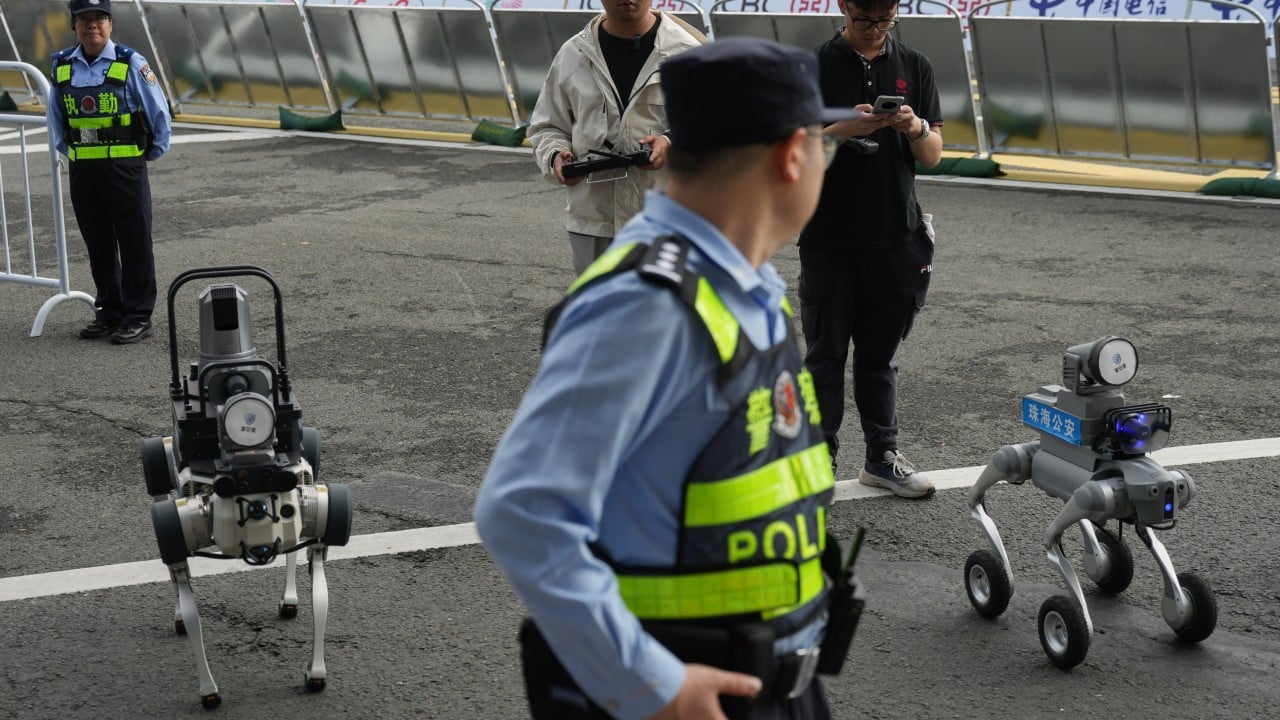
The People’s Armed Police (PAP) shift toward "zero human contact" riot control represents a fundamental transition from human-centric policing to a technology-mediated suppression framework. This evolution is not merely a search for tactical efficiency but a strategic re-engineering of the internal security cost function. By removing the physical proximity of the human officer from the target population, the state seeks to decouple political stability from the inherent risks of frontline casualties and the psychological friction of direct physical confrontation.
The Triad of Non-Contact Suppression
The move toward remote riot control operates across three distinct technological vectors. Each vector addresses a specific failure point in traditional crowd management: the fatigue of the human operator, the unpredictability of close-quarters combat, and the political cost of visual violence.
1. Unmanned Ground Vehicles (UGVs) as Force Multipliers
Autonomous and semi-autonomous ground units serve as the primary physical barrier between the state and the crowd. These units carry modular payloads—teargas launchers, high-decibel acoustic devices, and strobe lights—that can be deployed without exposing PAP personnel to projectiles or physical assault. The logic here is attrition-based; a robot does not experience fear or fatigue, allowing it to maintain a defensive perimeter indefinitely.
2. Aerial Surveillance and Dispersal Networks
The integration of drone swarms provides a vertical dimension to crowd management. Beyond simple observation, these platforms are being equipped with net-guns for targeted apprehension and chemical dispersal systems. The psychological impact of overhead, omnipresent surveillance creates a "panopticon effect" where the lack of a visible human adversary makes resistance feel futile and disorganized.
3. Remote Directed Energy and Non-Lethal Weaponry
High-frequency millimeter-wave systems (often referred to as heat rays) and Long Range Acoustic Devices (LRADs) represent the technical pinnacle of zero-contact control. These systems interact with the human nervous system from a distance, inducing pain or disorientation without causing permanent physical trauma. This allows for the "denial of space" without the optics of bloody physical altercations that often fuel further unrest.
The Economic and Political Cost Function
The adoption of remote systems is driven by a cold assessment of the "unit cost of control." Traditional policing is expensive, not only in terms of salaries and equipment but in the long-term healthcare and psychological support required for officers involved in high-intensity civil unrest.
- Variable Cost Reduction: While the initial capital expenditure (CAPEX) for a robot-dense security force is high, the operating expenses (OPEX) are significantly lower than maintaining a large standing human force capable of the same coverage.
- Risk Transfer: In a high-stakes riot, the injury of a PAP officer carries a high political weight. The destruction of a drone or UGV, by contrast, is a mere line item in a maintenance budget.
- Information Asymmetry: Remote systems collect granular data—facial recognition, gait analysis, and thermal signatures—in real-time. This turns a riot into a data-mining exercise, where the state identifies leaders and agitators without ever engaging the main body of the crowd.
Structural Bottlenecks in Automated Policing
Despite the technological promise, the "zero human contact" model faces significant structural and logical hurdles. Technology does not eliminate the friction of war; it merely shifts where that friction occurs.
The first bottleneck is Signal Latency and Jamming. Remote-controlled units depend on robust communication links. In a dense urban environment with significant electronic interference or active jamming by sophisticated protestors, the link between the operator and the machine becomes a single point of failure. If the PAP cannot guarantee 5G or satellite redundancy, a "zero contact" unit becomes an expensive, immobile paperweight.
The second limitation is The Ethics of Algorithmic Escalation. When a human officer faces a crowd, there is a micro-second of judgment before force is applied. While this judgment can be flawed, it is adaptable. Automated systems, particularly those using AI to trigger dispersal mechanisms, operate on binary logic. If the system misinterprets a specific crowd movement as an attack, it may escalate force prematurely, potentially turning a peaceful assembly into a violent confrontation through its own rigid response parameters.
The Decoupling of Accountability
A critical outcome of zero-contact policing is the sanitization of the "act of suppression." When an officer strikes a protestor, there is a direct line of physical and moral agency. When a technician in a command center miles away clicks a mouse to activate a microwave emitter, that agency is diluted.
This creates a "Bureaucratic Distance" that serves two purposes:
- Operator Retention: It reduces the PTSD and moral injury associated with internal security work, ensuring a more stable and compliant security workforce.
- Plausible Deniability: The state can attribute "malfunctions" or excessive force to technical glitches or algorithmic errors rather than policy decisions, complicating the landscape of international human rights monitoring.
Tactical Evolution and Counter-Measures
As the PAP deploys these systems, the nature of civil unrest will inevitably adapt. The transition to remote control triggers a predictable cycle of "Measure-Countermeasure." We can expect to see a rise in low-tech asymmetric tactics designed to blind or confuse automated sensors:
- Visual Obfuscation: High-powered lasers and aerosol paints used to blind UGV cameras and drone optics.
- Kinetic Sabotage: Simple physical traps—wire, glue, or physical barriers—that exploit the mobility limitations of wheeled or tracked robots in rubble-strewn environments.
- Cyber-Physical Exploitation: Attempts to hijack or spoof the control frequencies of the remote units, potentially turning the state’s hardware against its own perimeter.
The PAP's internal strategy must account for the fact that a machine, while physically superior, lacks the situational intuition to handle "Black Swan" events in a crowd. A robot can hold a line, but it cannot negotiate.
The Strategic Shift to Predictive Suppression
The end-state of this technological trajectory is not just the control of a riot after it starts, but the prevention of the riot through pervasive, automated presence. The PAP is moving toward a "State of Constant Perimeter," where the transition from routine surveillance to active riot control is instantaneous and automated.
Success in this model is measured by the total absence of physical contact. If a protestor is dispersed by an invisible sound wave or a remote-controlled drone before they ever see a human officer, the state has achieved its goal: the maintenance of order with zero political friction. The risk, however, is that this clinical approach to suppression creates a pressure cooker effect. By removing the human face of authority, the state may inadvertently dehumanize the population it seeks to control, leading to more radicalized and desperate forms of resistance.
The operational directive for internal security forces now shifts from "Physical Engagement" to "Information Dominance." The commander of the future is not a general on a horse or a colonel in a riot shield; they are a systems architect managing a fleet of autonomous assets designed to make dissent physically impossible and technologically invisible.