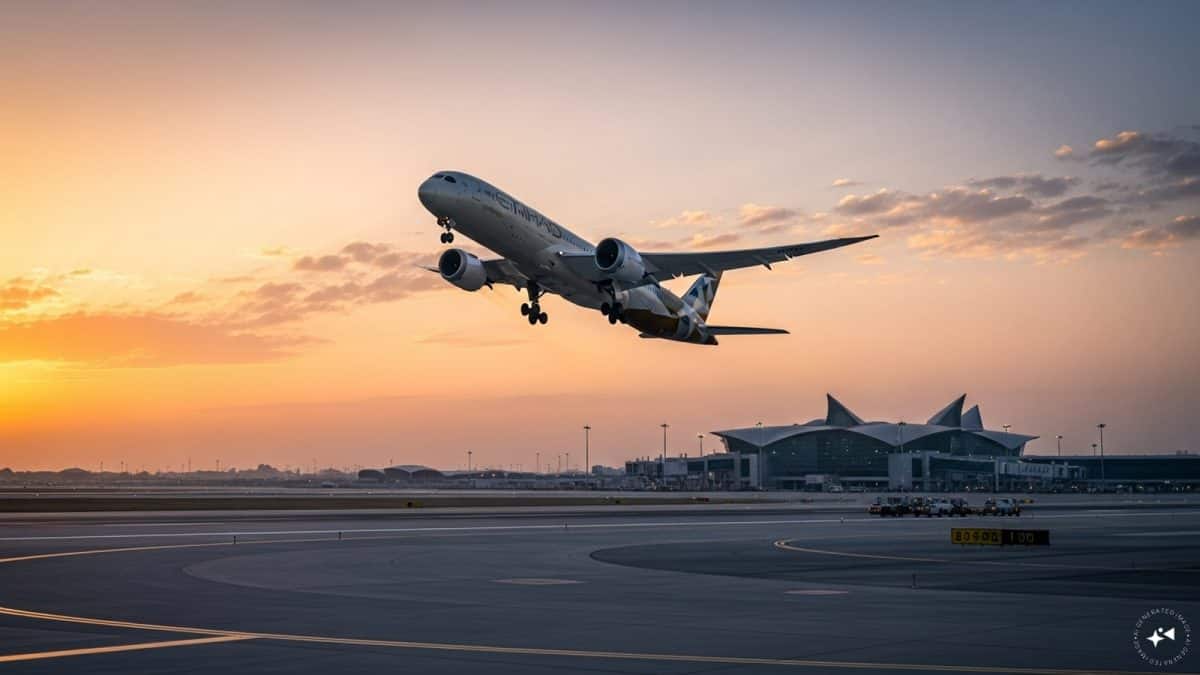
The resumption of passenger flights from Abu Dhabi following Iran’s formal distancing from recent Gulf strikes represents more than a logistical recovery; it is a recalibration of the regional risk premium. In high-stakes aviation corridors, the "Return to Normalcy" is governed by a tripartite validation process involving military intelligence sharing, sovereign guarantees, and insurance actuarial adjustments. When Iran signaled a strategic pivot away from active kinetic involvement in Gulf maritime and aerial strikes, it lowered the perceived probability of "misidentification accidents"—the primary fear of commercial carriers operating in crowded, high-tension airspaces.
The Triad of Aviation Risk Mitigation
For a hub like Abu Dhabi (AUH) to resume operations after a period of heightened threat, three specific variables must align. The absence of any one of these creates a "no-fly" bottleneck that overrides commercial demand.
- Sovereign De-confliction Signals: This involves direct or third-party (often via Muscat or Doha) communication where a regional power explicitly defines its "strike radius" and "exclusion zones." Iran’s distancing act functioned as a verbal de-escalation, providing the diplomatic cover necessary for the UAE’s General Civil Aviation Authority (GCAA) to lower the domestic threat level.
- War Risk Insurance (WRI) Thresholds: Commercial aviation cannot function without hull and liability insurance. When a region is flagged for potential kinetic conflict, premiums spike or coverage is suspended. A flight taking off signifies that underwriters have moved the risk from "active combat" back to "contingent tension."
- NOTAM (Notice to Air Missions) Revisions: The technical mechanism for resuming flights is the lifting of restrictive NOTAMs. These digital bulletins inform pilots of real-time hazards. The transition from "prohibited" to "cautionary" status is the final technical hurdle in the chain of command.
The Economic Cost Function of Airspace Closures
The suspension of flights from a major global transit point like Abu Dhabi triggers a cascading financial penalty. The cost is not merely lost ticket revenue; it is a disruption of the "Global Hub-and-Spoke" efficiency model.
- Network Decay: For Etihad Airways, every hour a plane sits on the tarmac in Abu Dhabi, a corresponding connection in London, New York, or Singapore is severed. The cost of re-accommodating thousands of passengers across a global network often exceeds the direct operational loss of the cancelled flight itself.
- Asset Underutilization: A Boeing 787 or Airbus A350 is a multi-hundred-million-dollar asset that generates value only when in motion. Grounding these assets for even 48 hours forces a massive spike in the "cost per available seat kilometer" (CASK), as fixed leasing and maintenance costs remain static while revenue drops to zero.
- Cargo Latency: High-value, time-sensitive goods (pharmaceuticals, electronics, and cold-chain logistics) utilize the belly hold of passenger planes. A shutdown in the Gulf creates a global supply chain bottleneck, particularly for the Europe-Asia trade artery.
Geopolitical Signaling as a Market Stabilizer
The Iranian statement distancing itself from the strikes was a calculated move in "Grey Zone" diplomacy. By denying involvement, Tehran provided the Gulf states with a "face-saving" exit from a defensive posture. This allows for the resumption of economic activity without the Gulf states appearing to ignore a direct threat.
This dynamic creates a specific feedback loop:
- Step A: Kinetic event occurs (strike).
- Step B: Ambiguity is maintained to test international resolve.
- Step C: Regional economic hubs (Abu Dhabi, Dubai) freeze to prevent catastrophic loss.
- Step D: Diplomatic "distancing" occurs to prevent total regional escalation.
- Step E: Technical re-opening of corridors based on the new, albeit fragile, status quo.
The Vulnerability of the Strait of Hormuz Corridor
The Abu Dhabi flight path is uniquely sensitive due to its proximity to the Strait of Hormuz. Commercial airliners departing from AUH often climb through altitudes that overlap with the detection range of both UAE and Iranian surface-to-air missile (SAM) batteries.
The primary technical risk in this environment is Target Misidentification. In a high-alert state, the electronic signature of a climbing civilian jet can, under specific atmospheric or technical glitches, resemble a military transport or a large-scale drone. Iran’s move to distance itself from the strikes effectively tells regional air traffic control (ATC) centers that their radar operators can return to "standard identification protocols" rather than "hair-trigger" engagement rules.
Strategic Divergence in Airline Response
Not all carriers react to de-escalation with the same velocity. There is a clear hierarchy in how airlines resume service:
- Flag Carriers (Etihad): As the state-owned airline, Etihad’s resumption is a political statement of confidence. They are the first to fly because their risk appetite is aligned with national strategic interests.
- Regional Partners: Carriers from neighboring states follow once they receive secondary confirmation through diplomatic channels.
- International Long-Haul Carriers: Western airlines (British Airways, Lufthansa, Air France) typically wait for a 24-to-48-hour "stability window" after the first flight departs. They rely on their own internal security assessments and often prioritize crew safety over immediate schedule restoration.
This staggered return to the skies serves as a real-time barometer of geopolitical trust. The first passenger flight out of Abu Dhabi was not just a commercial event; it was a successful "test of the waters."
Technical Constraints of Rapid Re-mobilization
Restarting a grounded hub involves complex "Cold Start" mechanics. When a flight "takes off after a distancing," the following systems must be synchronized:
- Crew Duty Limits: Pilots and cabin crew have strict legal limits on how long they can be "on duty." Mass groundings often "timeout" entire crews, requiring a massive logistical effort to fly in fresh staff or reset schedules.
- Ground Handling Surge: Resuming flights creates a "logjam" at the gates. Ground crews must handle the backlog of delayed aircraft while simultaneously processing the new, scheduled departures.
- Fueling and Provisions: Supply chains for aviation fuel and catering must be ramped back up from a "standby" state to "active" state in a matter of hours.
The Fragility of the Current De-escalation
While the resumption of flights is a positive indicator, it does not imply a removal of the underlying threat. The region remains in a state of "High-Frequency Low-Intensity Conflict." The distancing by Iran is a tactical pause, not a structural shift in foreign policy.
Airlines are now operating under a "Dynamic Risk Overlay." This means that flight paths are likely being adjusted in real-time based on live intelligence. Instead of the most direct route over the Gulf, flights may be directed further south or west, increasing fuel burn but providing a wider safety buffer from Iranian coastal batteries. This "Security Surcharge"—measured in additional fuel and flight time—is the hidden cost of doing business in a contested geography.
Operational Directive for Regional Transit
The resumption of service at Abu Dhabi dictates a shift in regional transit strategy. Stakeholders must move from "Crisis Management" to "Redundant Routing."
- Diversification of Transit Hubs: Corporate and logistics entities should no longer rely on a single Gulf hub for critical paths. The Abu Dhabi-Iran friction demonstrates that a "single-point-of-failure" exists in the Persian Gulf aviation sector.
- Real-Time Intelligence Integration: Carriers must integrate private intelligence feeds that monitor regional "chatter" and military movements, bypassing the delay inherent in official government NOTAMs.
- Contractual Force Majeure Review: The brief shutdown serves as a catalyst to review "Force Majeure" clauses in transport and insurance contracts, specifically defining what constitutes an "unacceptable risk" in the context of state-level "distancing" maneuvers.
The tactical play here is to exploit the current window of stability while hardening the infrastructure against the next inevitable spike in tension. The flight from Abu Dhabi proves the system can bend without breaking, but the elasticity of the Gulf’s aviation sector has finite limits. Immediate focus should remain on establishing secondary "safe corridors" that utilize the inland airspace of the Arabian Peninsula, reducing the dependency on the narrow and volatile coastal routes.