John stands at the edge of a fence line that has defined his family for three generations. The air in Tennessee during July doesn't just sit; it weighs. It smells of curing hay, diesel exhaust, and the metallic tang of an approaching thunderstorm. For decades, the math of this land was simple. You raised cattle, you prayed for rain, and you fought the creeping exhaustion of thin margins. But today, the view has changed.
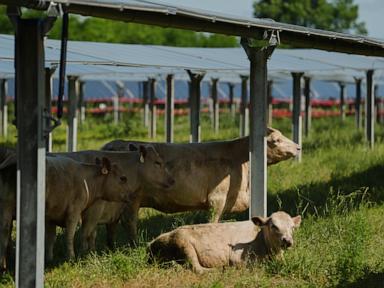
The rolling green hills are now striped with silicon. Rows of dark, glass-faced panels tilt slowly toward the sun, tracking it like mechanical sunflowers. Beneath them, the shadows are deep and cool. And in those shadows, the cows are waiting.
For years, the American farmer has been told a story of "either/or." Either we use the land to feed the world, or we use it to power the world. We were led to believe that green energy and traditional agriculture were locked in a zero-sum game—a border war where every acre of solar panels was a victory for the grid and a funeral for the farm. But on a sprawling ranch in Tennessee, that narrative is being dismantled by the steady, rhythmic sound of a Hereford heifer chewing her cud.
The Sun is a Double-Edged Sword
To understand why this matters, you have to understand the physiology of a cow. Cattle are hardy, but they are not invincible. When the Tennessee sun hits triple digits, a cow’s metabolic priority shifts from growing to surviving. They stop eating. They huddle under the lone, bedraggled oak tree in the corner of the pasture, trampling the grass into dust and concentrating manure in a single, muddy spot. This is heat stress. It thins the milk, slows the weight gain, and drains the farmer's bank account.
Traditional solar farms usually solve this by "clearing" the land. They scrape it flat, pile on gravel, or spray industrial-grade weed killer to keep the vegetation from shading the panels. It is a sterile, industrial solution. It creates power, but it kills the soil. It turns a living ecosystem into a giant battery component.
The Tennessee project flipped the script. Instead of fighting the grass, they invited the mowers in. Only these mowers have four legs, wet noses, and an instinctive drive to turn cellulose into protein.
Consider the physics of the "win-win" that critics said was impossible. The solar panels act as a massive, distributed canopy. On a blistering afternoon, the temperature under a solar array can be significantly lower than in an open field. The cows aren't huddling under a single oak tree anymore; they have acres of shade. They graze longer into the day. They stay hydrated. They put on weight faster because their bodies aren't burning calories just to keep their internal temperature from spiking.
The Moisture Miracle
The benefits aren't just for the livestock. They are for the dirt itself.
In a standard Tennessee summer, the sun bakes the moisture right out of the topsoil. The grass turns brittle and brown by August. But the panels create a microclimate. As the sun moves, the "shadow pattern" moves with it, giving every square inch of grass a break from the direct UV assault. This reduces evaporation. The soil stays damp. The grass stays lush.
There is a specific kind of magic in seeing a solar technician and a rancher standing on the same patch of dirt, both smiling for entirely different reasons. The technician sees "vegetation management"—a fancy term for keeping the weeds from blocking the light—handled for free by the cattle. No gas-powered mowers. No chemical sprays. The rancher sees a secondary revenue stream. The solar company pays a "lease" for the land, providing a guaranteed check that doesn't depend on the price of beef or the whims of a drought.
It is the ultimate hedge against a changing climate. If it doesn't rain, the solar panels still produce power. If the grid is stable, the cattle still produce beef. The land is working twice as hard, but it’s being exhausted half as much.
The Invisible Stakes of the Heartland
This isn't just about Tennessee. This is about the existential crisis of the American Heartland. Every year, thousands of acres of family-owned farmland are sold off to developers. Why? Because the kids don't want to work sixteen-hour days for a "maybe" paycheck. They see the struggle, the debt, and the unpredictability, and they head for the cities.
When a farm is sold for a housing subdivision, that land is gone forever. You don't "un-pave" a cul-de-sac. You don't turn a shopping mall back into a pasture.
But a solar ranch? That is a reversible decision. The panels sit on steel piles driven into the earth. If, in thirty years, we find a better way to make power, those piles can be pulled out. The land underneath is not just preserved; it’s been enriched by three decades of rotational grazing and protection from erosion. This technology isn't replacing the farm; it’s acting as a life support system for it.
The skeptics often point to the "industrialization" of the countryside. They see the panels as an eyesore. But look closer. Look at the eyes of a farmer who finally has enough breathing room to fix the barn, or buy a new tractor, or tell his daughter that yes, there is a future for her on this land. The "eyesore" starts to look a lot like a lifeline.
The Engineering of Coexistence
Making this work isn't as simple as just opening a gate and letting the cows in. It requires a fundamental shift in how we build things.
Standard solar arrays are often built low to the ground to save on steel costs. To accommodate cattle, the panels have to be raised. The wiring has to be tucked away in hardened conduits, protected from a thousand-pound animal that might decide a junction box looks like a decent scratching post. The spacing between the rows must be wide enough for a tractor or a feed truck to pass through.
It costs more upfront. Of course it does. But the long-term math is undeniable. By integrating the two, we solve the "land use" conflict that has stalled renewable energy projects across the Midwest and the South. We stop the fighting at the town hall meetings. When the community sees that the sheep are still grazing and the cows are still calving, the fear of the "new" begins to evaporate.
The Tennessee experiment is proving that we don't have to choose between our heritage and our future. We don't have to sacrifice the pastoral beauty of the South to meet the energy demands of the 21st century.
The Quiet Revolution
The sun begins to set over the Tennessee ranch, casting long, geometric shadows across the clover. The cattle move with a slow, deliberate grace, unaware that they are part of a grand experiment in planetary survival. They only know that the grass is sweet and the shade is cool.
For the farmer standing at the fence, the "human-centric" reality is simple. He can hear the low hum of the inverters converting sunlight into electricity for the town down the road. He can hear the steady breathing of his herd. For the first time in a long time, the two sounds don't clash. They harmonize.
This is the bridge we’ve been looking for. It’s not built of lofty promises or abstract carbon credits. It’s built of steel, glass, and the ancient, unbreakable bond between a man, his animals, and the dirt beneath his boots.
The battle for the dirt isn't about who wins. It’s about making sure the dirt stays alive long enough for the next generation to inherit it. In the quiet fields of Tennessee, the truce has finally been signed.