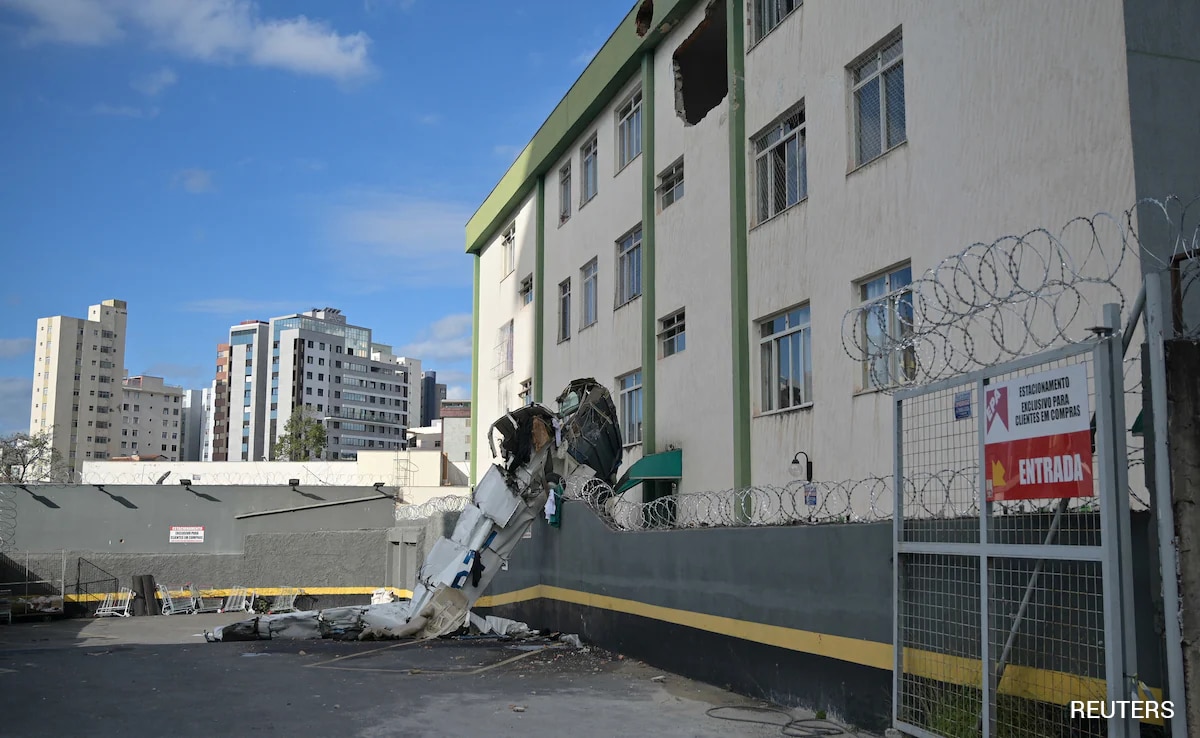
On Monday, May 4, 2026, the quiet Silveira neighborhood in Belo Horizonte, Brazil, became the stage for a harrowing aviation disaster. A small twin-engine Embraer EMB-721C, carrying five souls, lifted off from Pampulha Airport only to succumb to mechanical failure minutes later. The aircraft clipped a three-story residential building, resulting in the deaths of three individuals—including the pilot—and leaving two others in critical but stable condition. While the structure of the building spared residents on the ground from harm, the incident serves as a brutal reminder of the vulnerabilities inherent in the nation's sprawling general aviation sector.
The investigation, currently helmed by the Brazilian Air Force and the Aeronautical Accidents Investigation and Prevention Center (CENIPA), remains in its infancy. Initial accounts suggest the pilot reported operational difficulties immediately after departure, forcing a desperate attempt to return or maneuver toward safety. Yet, this localized tragedy highlights a broader, more systemic issue that the industry often prefers to keep under wraps.
The Illusion of Safety in General Aviation
General aviation in Brazil is a massive, diverse machine. It encompasses everything from executive transport and air taxis to private recreational flying and agricultural operations. With the third-largest civil aviation system globally, the country maintains an enormous fleet of executive and light aircraft. However, the sheer scale of this infrastructure masks a significant disparity in safety oversight compared to commercial airline operations.
Commercial carriers operate under strict, constant scrutiny. Every maintenance log, flight hour, and pilot training cycle is logged and verified. Conversely, the general aviation sector often functions within a more fragmented environment. Owners, private charter services, and small operators face economic pressures that can, in some instances, translate into corners being cut.
Mechanical failures do not occur in a vacuum. They are often the end product of a long chain of events: deferred maintenance, substandard parts, or pilot fatigue. When a private operator faces thin margins, the temptation to delay an expensive engine overhaul or overlook a subtle warning light in the cockpit becomes a risk-reward calculation. This is not to imply that the pilots in the Belo Horizonte incident were negligent, but rather to highlight that the system relies heavily on the individual operator's integrity. When that integrity is strained by financial hardship, the margin for error effectively vanishes.
The Regulatory Gap
Brazil has made strides in modernizing its aviation regulations. The National Civil Aviation Agency (ANAC) has implemented frameworks, such as those governing fractional ownership, to bring more structure to the market. Yet, regulation is only as effective as the enforcement mechanism behind it.
The challenge lies in the sheer geographic breadth of Brazil. Monitoring thousands of private flight operations across a continent-sized nation is a logistical nightmare. While CENIPA is widely respected for its objective and thorough accident investigations, its role is often reactive. It analyzes the aftermath, identifies the broken link, and issues recommendations. The preventative side of the equation—the day-to-day policing of private operators to ensure adherence to safety standards—is where the system remains vulnerable.
Consider the role of maintenance. An aircraft owner might opt for a less certified shop to save on costs, or a pilot might feel pressured to complete a flight despite lingering technical doubts. These are human factors that laws on paper struggle to address. The transition from private usage to commercial air taxi services creates a gray area where safety requirements can become blurred if the oversight isn't absolute.
The Human Factor and Economic Pressure
The aviation industry is notoriously unforgiving. When a machine that relies on precise mechanical functionality meets human error or extreme conditions, the outcome is usually binary: success or catastrophe.
In recent years, the Brazilian market has seen growth fueled by the agribusiness sector and the recovery of oil and gas exploration. This demand has increased the utilization of turboprops and helicopters. More flight hours mean more wear and tear. If the maintenance infrastructure does not grow in lockstep with the fleet, the probability of failure rises proportionally.
The industry must confront the reality that professionalization is not an optional upgrade. It is a fundamental necessity. Many private pilots operating in general aviation lack the rigorous, institutionalized recurrent training programs that commercial airline pilots undergo. They often fly solo or in small teams, meaning they lack a secondary set of eyes to challenge a poor decision or notice a missed checklist item.
Looking Beyond the Wreckage
The investigation into the Belo Horizonte crash will likely focus on the specific technical failures of the EMB-721C. Technicians will tear down the engines, examine the flight recorders, and analyze the communication logs with the control tower. They will find the "how." The "why," however, is a deeper, more uncomfortable question.
It is easy to blame a mechanical failure. It is harder to blame the economic reality that forces a pilot to take off with an aircraft that has not been serviced to the highest possible standard. It is harder to acknowledge that the expansion of the market has outpaced the safety culture necessary to sustain it.
This incident should not be viewed as an isolated misfortune. It is a symptom of a sector that is growing faster than its safety net. Until the industry mandates a higher standard of transparency, rigorous maintenance compliance, and standardized pilot training across the entire spectrum of general aviation, these tragedies will continue to occur. The debris in Belo Horizonte will be cleared, and the building will be repaired, but the fundamental risks remain in the sky. It is time for a cold, hard evaluation of the hidden costs of flying private in Brazil, before the next failure occurs.