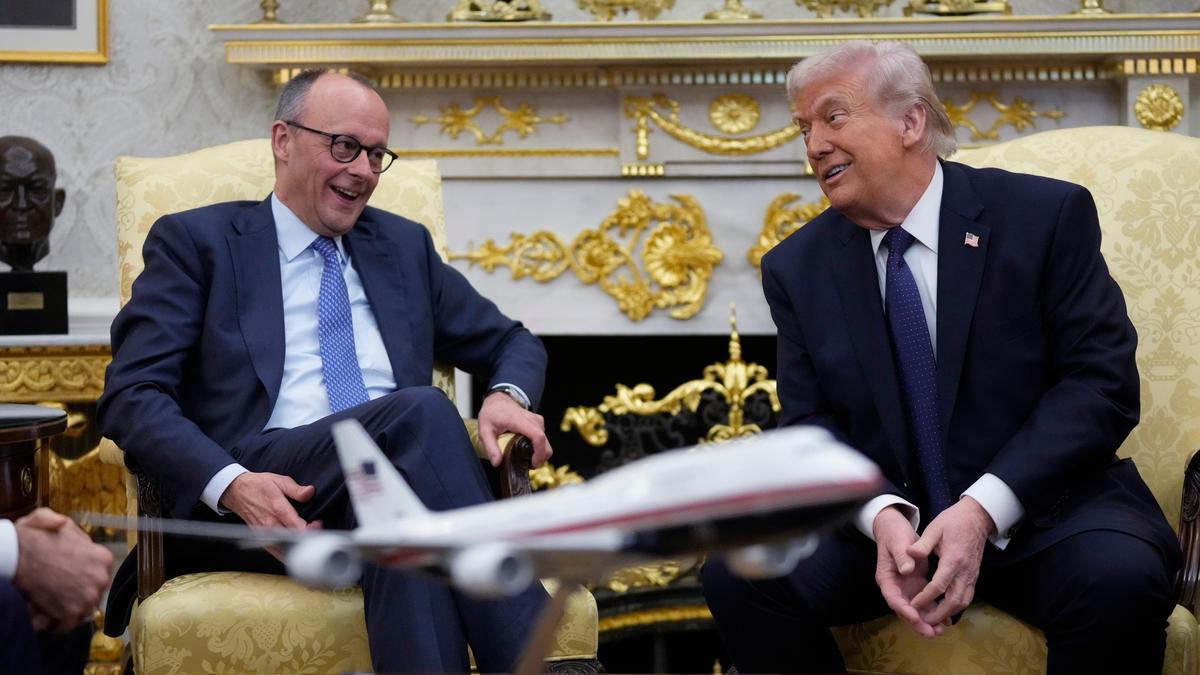
The Oval Office handshake between Donald Trump and Chancellor Friedrich Merz marks more than a shift in diplomatic tone. It signals a hard-coded pivot in European security. For decades, Germany operated under a self-imposed restraint, a "civilian power" that preferred checkbook diplomacy to kinetic action. That era died this week. By coordinating with the United States on targeted strikes against Iranian-backed infrastructure, the Merz administration has effectively shredded the post-Cold War playbook. Germany is no longer just the banker of Europe. It is becoming its sword.
The immediate reality is stark. German logistical support and intelligence sharing were critical components in the recent operations aimed at degrading Iranian drone manufacturing capabilities. While the White House was quick to praise this newfound cooperation, the motivations behind Merz’s decision-making go far deeper than mere transatlantic solidarity. This is a cold, calculated move to secure German energy interests and assert dominance within a fractured European Union.
The End of Strategic Ambiguity
For years, Berlin tried to play both sides of the Iranian equation. They wanted the Joint Comprehensive Plan of Action (JCPOA) to survive to protect Siemens and Volkswagen contracts, even as Tehran’s proxies destabilized the Middle East. Merz has decided that the cost of that ambiguity is now too high.
The Chancellor’s visit to Washington wasn't a social call. It was a strategy session on how to insulate the European economy from Middle Eastern volatility. By aligning with Trump’s aggressive stance on Iran, Merz is betting that a short-term escalation will lead to a long-term stabilization of global shipping lanes. Specifically, the Red Sea. Germany’s export-heavy economy is uniquely vulnerable to maritime disruptions. Every time a Houthi missile targets a container ship, the German industrial heartland feels the vibration. Merz isn't just helping Trump; he is protecting the profit margins of the DAX 40.
This isn't a passive partnership. Sources within the Chancellery suggest that German intelligence provided the specific geographical data required to bypass certain radar gaps in the region. This level of tactical integration would have been unthinkable under the previous coalition. It represents a fundamental change in the German "Basic Law" interpretation regarding out-of-area operations.
Rebuilding the Bundeswehr on the Fly
To understand why Merz is moving this fast, you have to look at the state of the German military. It has been a joke for thirty years. Tank crews training with broomsticks because they lacked barrels was not a meme; it was a reality of the 2010s. Merz has inherited a broken machine and is using the Iran crisis as a catalyst for a massive, accelerated rearmament program.
The cooperation with the U.S. serves as a live-fire laboratory for the new German military doctrine. By participating in these strikes, the Bundeswehr is gaining operational experience that it simply cannot get in a classroom. Merz is also using the political cover of "defending democracy" to push through defense spending hikes that would have sparked riots three years ago.
The business community is already lining up. Rheinmetall and Hensoldt are seeing order books swell as the government pivots toward a permanent state of high-readiness. This is the "Zeitenwende" finally getting teeth. Merz understands that in a world of "America First," Germany must be useful to avoid being sidelined. By providing the logistical backbone for Middle Eastern operations, Berlin ensures it remains the indispensable partner in Europe, effectively leapfrogging France in the race for regional leadership.
The Risks of the New Atlanticism
This gamble is not without significant peril. The German public remains deeply skeptical of military intervention. Merz is walking a razor's edge between being a global statesman and being perceived as a Washington surrogate.
- Domestic Backlash: The Far-Left and Far-Right in Germany are already forming an unholy alliance against this "militarization."
- Energy Vulnerability: While Germany has moved away from Russian gas, a total break with Iran or a wider regional war could send oil prices to levels that would cripple German manufacturing.
- Retaliation: Berlin is now a Tier 1 target for Iranian cyber-warfare. The BSI (Federal Office for Information Security) has already reported a spike in probing attacks against the German power grid since the strikes began.
The relationship between Trump and Merz is also transactional at its core. Trump views Germany through the lens of trade deficits and defense spending percentages. Merz knows this. He is offering military cooperation as a "down payment" to avoid the looming threat of universal baseline tariffs on German automobiles. It is a trade: German blood and intelligence for the survival of the Mercedes-Benz export market.
The Economic Engine Behind the Bombs
We must look at the industrial logic. Germany's transition to a green economy requires massive amounts of capital and stable trade. If the Middle East burns, the transition fails. By helping the U.S. neutralize Iranian threats to energy infrastructure, Merz is attempting to buy the time necessary for the German "Energiewende" to actually work.
The strikes also serve as a warning to other actors. By showing that Germany is willing to use force to protect the international order, Merz is signaling to Moscow and Beijing that the "soft" Europe they used to push around is gone. This is a psychological operation as much as a kinetic one.
The Chancellor’s meetings at the White House focused heavily on the "Three Seas Initiative" and how German engineering can replace Chinese influence in Eastern Europe. Merz is selling a total package: German security, German tech, and German stability, all backed by American fire power.
A New Hierarchy in Brussels
The French are watching this with growing unease. For decades, the unofficial deal was that France ran the military side of Europe while Germany ran the bank. Merz just broke the deal. By forming a direct, military-focused line to the Trump White House, he has effectively sidelined Paris.
The "Merz Doctrine" is simple: Germany will lead Europe by being the most reliable American ally on the continent. This shifts the center of gravity in the EU toward Berlin in a way we haven't seen since the reunification. It also complicates the EU's common foreign policy. If Berlin is acting in lockstep with Washington on Iran, the "strategic autonomy" championed by Emmanuel Macron becomes a dead letter.
The implications for the defense industry are enormous. We are likely to see a shift toward American-standardized equipment across the continent as Germany leads the way in procurement. This is a windfall for Lockheed Martin and Raytheon, but it also creates a massive opening for German firms to integrate into the U.S. supply chain.
The Ghost in the Machine
We cannot ignore the intelligence aspect. The BND (Federal Intelligence Service) has historically had better "human intelligence" (HUMINT) assets in the Middle East than almost any other Western agency. During the Cold War and through the Iraq years, Berlin kept channels open that Washington couldn't.
Merz is now weaponizing that data. The precision of the recent strikes suggests that the target list wasn't just generated by satellites; it was verified by boots on the ground or deep-cover assets that have been in place for years. By sharing this "crown jewel" intelligence with the Trump administration, Merz has made himself a partner that Trump cannot afford to insult. It is the ultimate insurance policy against the "America First" instinct to abandon European allies.
This isn't just about Iran. It’s about the future of the North Atlantic Treaty Organization. Merz is reinventing NATO from the inside out, turning it into a coalition of the willing where the "willing" are those who can actually deliver results.
The question now is how far Merz is willing to go. If Tehran retaliates against German assets, does the Chancellor double down or retreat? History suggests that Friedrich Merz is not a man who enjoys retreating. He has spent his entire career waiting for this moment to lead Germany back to the center of the world stage.
The strikes in the Middle East are the opening salvo of a new century. Germany has decided that the luxury of neutrality is a thing of the past. In the high-stakes poker game of global geopolitics, Berlin just pushed its chips to the center of the table.
Watch the North Sea ports and the industrial hubs of the Ruhr Valley. If you see an uptick in security and a shift toward 24-hour production cycles, you know the "Merz Doctrine" is in full effect. Germany is no longer waiting for permission to be a world power. It is simply acting like one.