The British government has hit the brakes on the sovereignty transfer of the Chagos Archipelago, a move that effectively traps Mauritius in a diplomatic waiting room and leaves the displaced Chagos people in a state of perpetual limbo. By shelving the handover, Prime Minister Keir Starmer has opted for a defensive crouch, prioritizing short-term domestic political optics over long-term geopolitical stability and international law. This retreat does not just stall a territorial dispute; it reignites a decolonization firestorm that London was supposedly desperate to extinguish.
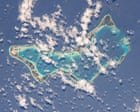
The core of the issue rests on the strategic base at Diego Garcia. While the UK and the United States view the island as an unsinkable aircraft carrier essential for monitoring the Indo-Pacific, the rest of the world increasingly sees it as a relic of imperial overreach. Mauritius, backed by a series of crushing legal victories at the International Court of Justice (ICJ) and the United Nations, now vows to pursue a policy of "unrelenting decolonization." They aren't just looking for a seat at the table anymore. They want to flip the table entirely.
The Diego Garcia Trap
For decades, the United Kingdom has maintained that the British Indian Ocean Territory (BIOT) is essential for global security. This argument usually starts and ends with Diego Garcia. The base is a logistical powerhouse, supporting long-range bombers and nuclear submarines. It is the nerve center for operations spanning from the Middle East to the South China Sea.
However, the legal ground beneath the base has turned to quicksand. The ICJ ruled in 2019 that the Chagos Islands were unlawfully separated from Mauritius in 1965, three years before Mauritian independence. The UN General Assembly followed up with a thumping majority demanding the UK withdraw its "colonial administration." By halting the handover, the Starmer administration is essentially betting that they can ignore the international rule of law while simultaneously lecturing other nations about following it.
The strategic risk is immense. By refusing to finalize the deal, the UK is pushing Mauritius closer to other global powers. If London won't play ball, Port Louis will find partners who will. This isn't a hypothetical threat. China has been steadily increasing its footprint in the Indian Ocean, and a disgruntled Mauritius is a prime candidate for new security and infrastructure partnerships. The UK’s attempt to "secure" Diego Garcia by holding onto it might actually be the very thing that compromises its long-term viability.
The Human Cost of Strategic Ambiguity
We often talk about Chagos in terms of maps and military hardware, but the reality is measured in broken lives. In the late 1960s and early 70s, the British government forcibly removed the entire population of the archipelago to make way for the US base. They were dumped in the slums of Port Louis or the outskirts of Crawley, left to rot without compensation for years.
The current freeze on the sovereignty deal is a fresh wound for the Chagossian community. There is no unified voice among the displaced; some want full return to the outer islands, others want massive reparations, and some simply want the right to live on Diego Garcia itself. By shelving the deal, the UK has essentially told these people that their right to self-determination is secondary to a lease agreement with Washington.
The British government’s primary fear is a legal domino effect. If they admit the Chagos Archipelago was illegally detached, it opens the door for similar claims in other Overseas Territories. It is a classic bureaucratic stall. They are waiting for a more convenient time that will never arrive.
Sovereignty versus Security
The UK argues that Mauritius cannot guarantee the "security" of the base. This is a thin veil for the fear that a Mauritian government might one day succumb to pressure from Beijing or simply hike the rent to astronomical levels.
Yet, the proposed deal—the one now gathering dust—actually included a 99-year lease back to the UK for Diego Garcia. Mauritius was willing to play ball. They were offering a path that satisfied the military requirements of the West while satisfying the legal requirements of decolonization. Starmer’s hesitation suggests a lack of confidence in Britain’s ability to manage a bilateral relationship with a former colony without holding the deed to the land over their heads.
The Ghost of East of Suez
There is a historical irony at play here. In 1968, Britain announced its "East of Suez" withdrawal, admitting it could no longer afford to be a global policeman. Keeping Chagos was the exception, a small footprint designed to maintain relevance. Now, that footprint has become a tripwire.
London is currently obsessed with its "Indo-Pacific Tilt." The goal is to prove that post-Brexit Britain is still a major player in the world’s most dynamic region. But you cannot tilt into a region while holding onto a colonial grievance that the entire region opposes. The African Union and ASEAN members see the Chagos situation as a litmus test for "Global Britain."
When the UK condemns the occupation of territory in Europe while maintaining its own contested administration in the Indian Ocean, the charges of hypocrisy write themselves. This isn't just about a few islands; it’s about the credibility of the entire British diplomatic apparatus.
The Mauritian Response
Mauritius is not the small, powerless island nation it was in 1965. It is a sophisticated, upper-middle-income economy with an aggressive legal strategy. Prime Minister Pravind Jugnauth has signaled that if the UK won't negotiate in good faith, Mauritius will move to have the BIOT declared an illegal occupation in every international forum available.
They are already remapping the area. They are issuing their own maritime charts. They are even talking about organizing "fishing expeditions" to the outer islands, protected by international observers. This is a campaign of "administrative encroachment." They are making the British presence so awkward and so legally expensive that London will eventually have to fold.
A Failed Policy of Inertia
The decision to shelve the deal wasn't a strategic masterstroke. It was a reaction to internal pressure from the right wing of the British political spectrum, which views any surrender of territory as a sign of national decline. But true national strength isn't found in clinging to a contested rock; it is found in creating stable, legal frameworks that protect interests for a century.
By failing to act, the UK has ensured that:
- The legal status of Diego Garcia remains "congested" and vulnerable to international sanctions.
- Relations with the African Union will continue to sour.
- The Chagossian people remain pawns in a game of high-stakes poker.
- China is handed a persistent diplomatic cudgel to use against Western "hypocrisy."
The belief that the UK can simply "wait out" the decolonization movement is a fantasy. The momentum is entirely on the side of Mauritius. The longer the UK waits, the worse the eventual deal will be.
British officials often point to the "special relationship" with the United States as the reason for the delay. Washington is notoriously paranoid about any change to the status of Diego Garcia. However, even the US would prefer a settled legal status over a permanent international dispute. A 99-year lease under Mauritian sovereignty is infinitely more secure than a contested occupation under a British flag that the UN no longer recognizes.
The Starmer government thought they were buying time. In reality, they were just increasing the price of the eventual exit. You cannot preach a "rules-based order" while standing on a piece of land that the highest court in the world has told you to give back. The Chagos Islands are no longer a strategic asset; they are a mounting diplomatic debt that the UK refuses to pay, even as the interest rates climb.
The maps are already being redrawn in Port Louis, regardless of what the bureaucrats in Whitehall decide to do with their files. Britain is no longer deciding whether to leave; it is only deciding how much more damage it wants to do to its global reputation before it is forced out.