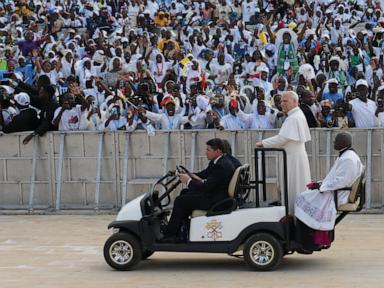
The Pope did not go to Muxima just to pray. To suggest so is to ignore the weight of the soil beneath the Shrine of Our Lady of Muxima, a small village perched on the banks of the Kwanza River in Angola. While mainstream reports focus on the optics of a religious pilgrimage, the reality is far more pointed. The Pontiff’s presence at this site represents a calculated attempt to reconcile the Catholic Church with its own shadow—specifically its role as the spiritual infrastructure that supported the trans-Atlantic slave trade for centuries.
Muxima was not merely a spiritual retreat. During the height of the Portuguese occupation, it served as a strategic inland fortress and a gateway for the human trafficking pipeline. The Kwanza River was the artery through which millions of souls were pumped toward the coast of Luanda, destined for the Americas. By kneeling here, the Vatican is attempting to perform a massive spiritual exorcism on a site that remains the most visited pilgrimage destination in sub-Saharan Africa.
The Fortress and the Font
The Church of Our Lady of Muxima was built in 1599. It sits within eye-shot of the Fortress of Muxima, a military structure designed to protect Portuguese interests against local resistance and to secure the flow of "black gold." This proximity is not accidental. In the colonial era, the cross and the sword were two sides of the same coin.
Missionaries would often baptize captives in mass ceremonies before they were loaded onto ships. This was not always an act of mercy. Under Portuguese law, baptism was a legal requirement for export. It served as a cosmic branding exercise, theoretically "saving" the soul while the body was sold into a life of misery. When the Pope speaks of "healing" at Muxima, he is addressing this specific, historical entanglement where the sacraments were used to grease the gears of a global commodities market.
The site remains a complex symbol for Angolans. On one hand, the "Mamã Muxima" (Mother Muxima) is a figure of profound devotion and comfort for the poor. On the other, the very stones of the chapel were laid during a period when the Church provided the moral justification for the subjugation of the African continent. This tension is what makes the Papal visit more than a photo opportunity. It is a confrontation with a past that the Vatican has spent the better part of a century trying to reframe.
The River of No Return
To understand why Muxima matters, you have to look at the Kwanza River. For the Portuguese, the river was a highway. For the local population, it was a wound. Historical records indicate that the Luanda-Muxima axis accounted for a staggering percentage of the total slave exports to Brazil.
The geography of the site facilitated a specific kind of logistics. Captives taken from the interior were marched to Muxima, held in the shadows of the fortress, and then moved downstream. The Church provided the administrative veneer for this operation. Priests were often paid in "pieces," a chilling contemporary term for enslaved human beings. This financial link between the expansion of the faith and the expansion of the slave market is the "why" that most news cycles choose to omit.
Modern pilgrims flock to the site because they believe the water and the earth of Muxima have miraculous properties. They bring their sick, their broken, and their desperate. But the miracle the Vatican is searching for is of a different sort. They are looking for a way to maintain the Church’s dominance in a rapidly growing African market while acknowledging that the foundations of that growth were built on a legacy of systemic violence.
The Geopolitics of a Pilgrimage
Angola is currently the crown jewel of the Catholic Church in Africa, but that status is under threat. Pentacostalism is sweeping through the Luanda slums and the rural interior with the force of a gale. These new movements often criticize the Catholic Church for its colonial baggage, painting it as a European import that hasn't fully apologized for its history.
The Pope’s visit to Muxima is a defensive maneuver as much as it is a spiritual one. By centering the Church's narrative on a site of historical trauma, the Vatican is attempting to "indigenize" its image. They are claiming Muxima not as a colonial outpost, but as a site of African suffering and resilience. It is an attempt to pivot from being the religion of the oppressor to being the companion of the oppressed.
Whether this works depends on how much the Church is willing to disclose about its historical ledgers. Apologies are cheap. Structural change and the repatriation of historical records or artifacts taken during the colonial period are the real metrics of sincerity. At Muxima, the Pope spoke of the "cries of the poor," but the echoes of those who were sold under the shadow of that same church remain much louder in the historical record.
The Myth of Neutrality
We often hear that the Church was "a product of its time." This is a lazy defense used to bypass the fact that there were contemporary voices—even within the clergy—who decried the slave trade as a violation of every Christian tenet. The decision to support the trade at Muxima was an economic one. The missions needed funding, and the slave trade was the primary engine of the Angolan economy.
Today, Muxima is being transformed into a massive tourism and religious hub. The Angolan government has poured millions into the "Muxima Project," aimed at turning the village into a world-class pilgrimage site capable of holding a million people. This brings up a new set of problems. Who benefits from this modernization? If the local population is displaced to make room for luxury hotels and sprawling plazas, the cycle of exploitation simply changes its wardrobe.
The Unspoken Debt
The Catholic Church is one of the largest landowners in the world, a wealth partially built on the tithes and labor of the colonial era. While the Pope’s prayer at the shrine is a powerful gesture, it does not address the material debt owed to the descendants of those who were shipped out via the Kwanza River.
There is a growing movement among African intellectuals and activists demanding more than just "spiritual healing." They are asking for a full accounting. This includes the opening of the Vatican archives to allow researchers to trace the specific lineages of families broken apart at Muxima. Without these concrete actions, visits to shrines like Muxima risk becoming a form of "grief tourism" for the ecclesiastical elite.
The pilgrims who travel hundreds of miles on foot to reach the shrine don't care about Vatican politics. They care about the Virgin Mary’s promise of a better life. They touch the walls of the old church with a fervor that is both humbling and tragic. They are looking for hope in the very place that, for their ancestors, was the end of hope.
The Kwanza River still flows past the shrine, indifferent to the prayers and the politics. It remains a silent witness to the millions who were carried away from their homes. The Church can build new plazas and the Pope can offer new prayers, but the water remembers what the history books often try to forget. The true test of the Church’s presence in Africa isn't found in the size of its cathedrals, but in its willingness to stand in the wreckage of its own making and admit that the cross was once used as a hammer.
Survival of the Shrine
The physical structure of the Muxima church has survived wars, humidity, and neglect. It is a testament to the durability of both the faith and the colonial project. In the 1990s, during the height of the Angolan Civil War, the shrine remained a neutral zone, a rare feat in a conflict that spared almost nothing. This "sacred" status is what the Vatican is now leveraging to project an image of peace and stability in a region that has known very little of either.
However, the "peace" offered at Muxima is fragile. It is built on a foundation of silence regarding the specific mechanics of how the Church profited from the Atlantic trade. To move forward, the Vatican must stop treating these sites as mere locations for prayer and start treating them as crime scenes that require a full, transparent investigation.
The reality of Muxima is found in the dirt. It is found in the unmarked graves and the oral histories passed down by the families who stayed behind while their brothers and sisters were sent across the ocean. When the Pope left Angola, the cameras followed him, but the questions remained. The shrine is not a conclusion; it is a cold, hard evidence locker of a history that is still being written.
If you go to Muxima today, you will see the ruins of the fortress looking down on the chapel. It is a visual reminder that for centuries, the power to save souls was indistinguishable from the power to destroy lives. The Church's path to redemption doesn't lead through a gift shop or a new H2-style development project. It leads directly back into the dark hold of the ships that once waited at the mouth of the Kwanza.
You cannot pray away a debt that hasn't been acknowledged.