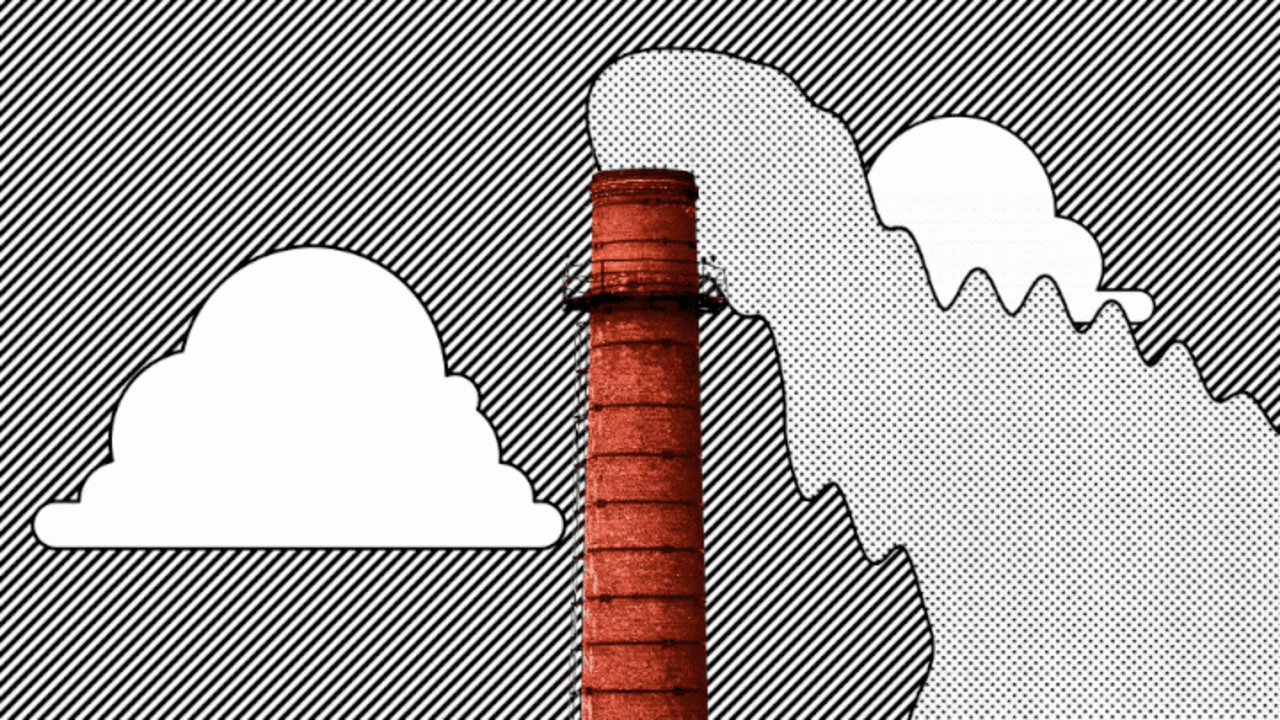
The Jalabiya cement plant sat in the Syrian desert like a monument to industrial hope. It was a billion-dollar bet on the future of a country that, for a brief moment in 2010, looked like it might actually have one. To the executives sitting in the glass-walled offices of Lafarge in Paris, the plant was a triumph of globalization. To the workers on the ground, it was a paycheck that kept the lights on in a region where the darkness was beginning to gather.
Then the world broke.
The Arab Spring soured. Protests turned to gunfire, and gunfire turned to a multi-front civil war that tore the map of Syria into a jagged mosaic of fiefdoms. Most foreign companies did the logical thing: they packed their bags and fled. But Lafarge stayed. They didn't stay out of a sense of duty to the Syrian people or a belief in the sanctity of infrastructure. They stayed because the kilns were hot, the limestone was plenty, and the profit margins were too seductive to abandon.
To keep the cement flowing, the company had to make a choice. They could protect their employees, or they could protect their investment. They chose the concrete.
The Cost of Doing Business
Imagine a middle manager. Let’s call him Omar. He is a hypothetical composite of the dozens of local staff who risked their lives every morning just to punch a clock. Omar wakes up in a village controlled by one rebel group, drives through a checkpoint manned by another, and spends his shift at a factory surrounded by a third.
By 2013, the third group was the Islamic State.
ISIS didn't care about industrial standards or carbon footprints. They cared about taxes. They set up checkpoints on the roads leading to the plant, stopping the trucks carrying the raw materials and the workers. To keep the factory running, Lafarge executives authorized a series of "donations." This wasn't a one-time bribe slipped to a corrupt border guard. It was a systematic, monthly payroll for some of the most brutal terrorist organizations on the planet.
Internal documents later revealed a cold, calculated spreadsheet of complicity. Lafarge paid roughly $5.5 million to various armed groups, including ISIS and the Al-Nusra Front. They weren't just paying for protection; they were purchasing "passports" from terrorists so their employees could cross the front lines.
The irony was suffocating. A company founded on the principle of building things—bridges, homes, hospitals—was directly funding the people who were systematically blowing them up.
The View from Paris
In the high-ceilinged boardrooms of France, the war in Syria was a series of reports and risk assessments. The disconnect was total. While executives debated the "geopolitical instability" of the region, their staff in Jalabiya were living in a nightmare.
The company went so far as to use a shell middleman to negotiate with ISIS. They sent emails discussing "taxes" paid to "the local authorities," a euphemism so thin it was transparent. They were buying time. They were waiting for the war to end so they could dominate the reconstruction market. They wanted to be the ones to provide the cement for the new Syria, ignoring the fact that the hands they were shaking were the ones currently soaking the soil in blood.
This is the seductive trap of corporate momentum. Once a project becomes "too big to fail," the ethics of its survival become secondary. The "sunk cost" isn't just money; it's the moral identity of the institution. Lafarge didn't set out to fund a caliphate. They set out to protect an asset. But in the vacuum of a failing state, those two goals became indistinguishable.
The Midnight Abandonment
The breaking point didn't come when the first head was rolled in a public square. It didn't come when the reports of mass executions reached Paris. It came when the plant was no longer profitable and the danger finally eclipsed the greed.
In September 2014, ISIS finally moved to take the plant by force.
The French staff had already been evacuated. They were safe in Europe, watching the news from the comfort of their homes. But the Syrian workers? They were left behind. There was no evacuation plan for Omar. There were no armored buses for the men who had spent years risking their lives to keep the kilns burning.
As ISIS fighters closed in, the local workers were forced to flee on their own, scrambling into the desert as the black flags rose over the silos. The company that had paid millions to terrorists to "ensure safety" couldn't spend a dime to ensure the survival of its own people once the cement stopped moving.
A Historic Reckoning
For years, the story of Jalabiya was a quiet scandal, whispered about in the corridors of human rights NGOs. But the law eventually caught up. In a landmark case that sent tremors through every multinational boardroom in the world, Lafarge was charged in a U.S. federal court.
They weren't just charged with a regulatory slip-up. They were charged with providing material support to a foreign terrorist organization.
In October 2022, the company—which had since merged to become Holcim—pleaded guilty. They agreed to pay a staggering $778 million in fines and forfeitures. It was the first time a company had been convicted in the U.S. of supporting terrorism. The judge described the conduct as an "unthinkable betrayal."
But the money is just a number on a balance sheet. The real cost is measured in the lives that $5.5 million helped take. Every bullet, every explosive, and every propaganda video produced by ISIS during that window was, in some small part, subsidized by a French cement maker.
The Ghost in the Concrete
We like to think of corporations as soulless entities, but they are made of people. They are made of decisions. The tragedy of Lafarge isn't that a "company" funded terror; it's that individual men and women, educated at the best schools in Europe, looked at a spreadsheet and decided that a cement plant was worth more than the lives of the people it would inevitably destroy.
They saw the world through the lens of a "neutral" market. They convinced themselves that they were staying out of politics by paying off everyone involved. But there is no such thing as neutrality in the face of genocide. When you pay a killer to let you work, you are no longer just a builder. You are a patron.
Today, the Jalabiya plant is a ruin. The sun-bleached concrete stands as a tombstone for a brand of corporate hubris that believed it could dance with the devil and leave the ballroom clean.
The cement is dry now. It is hard and cold. But if you look closely at the foundations of the world we’ve built, you start to see the cracks where the ethics were traded for "continuity." You realize that the most dangerous thing in a war zone isn't always the man with the gun. Sometimes, it’s the man with the checkbook, sitting thousands of miles away, wondering if the morning’s production targets will be met.
The kilns are cold. The money is gone. All that remains is the weight of what was built on that blood-soaked ground.