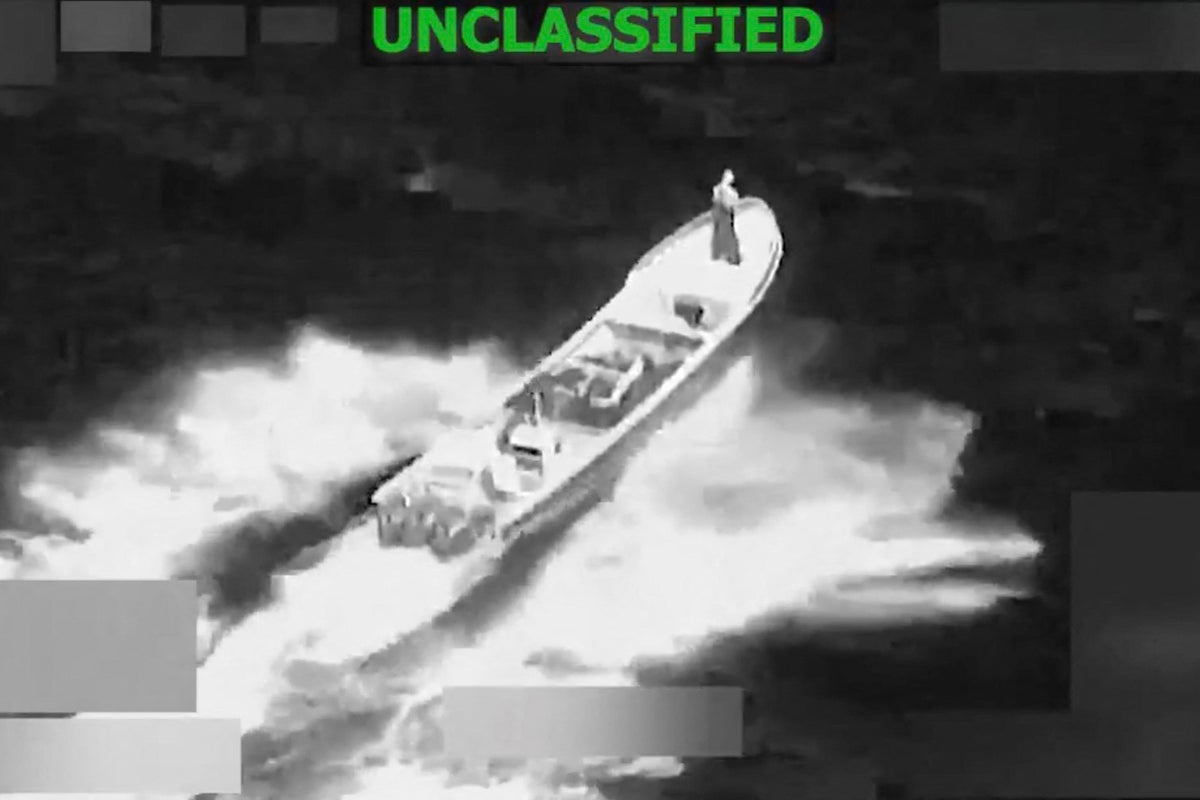
The recent kinetic engagement in the eastern Pacific that left five dead serves as a grim reminder that the maritime drug war has shifted from a game of hide-and-seek into a high-stakes tactical conflict. While official reports frame these events as standard interdictions of "alleged drug boats," the reality on the water reveals a far more complex and lethal evolution in smuggling tactics and naval response. The U.S. Coast Guard and Navy are no longer just chasing wooden pangas. They are squaring off against low-profile vessels (LPVs) and semi-submersibles engineered with sophisticated stealth capabilities, forcing boarding teams into life-or-death split-second decisions.
The Engineering of Stealth on the High Seas
To understand why these encounters are becoming increasingly fatal, we have to look at the naval architecture of the modern cartel. The "drug boats" mentioned in brief news wires are often custom-built marvels of desperate engineering. These vessels are designed to sit mere inches above the waterline, coated in lead-shielded paint to absorb radar pulses and equipped with muffled exhaust systems that vent underwater to mask thermal signatures. Expanding on this theme, you can find more in: Why Pakistan is moving 13,000 troops and fighter jets to Saudi Arabia.
When a U.S. vessel detects one of these craft, they aren't looking at a traditional boat on a radar screen. They are hunting a "ghost." The detection often happens via long-range infrared sensors or high-altitude surveillance drones rather than traditional line-of-sight. By the time a cutter moves in for the intercept, the psychological pressure on both sides is at a breaking point.
The smugglers, often recruited from impoverished fishing villages with the promise of a life-changing payday, find themselves trapped in a fiberglass tube filled with thousands of pounds of high-grade narcotics and hundreds of gallons of volatile fuel. They know that if they are caught, the cargo must be scuttled. The tension is a powder keg. One wrong move, one flash of a weapon, or even a sudden lurch of the vessel in heavy swells can trigger a lethal response from a boarding team trained to expect the worst. Experts at BBC News have provided expertise on this matter.
The Rules of Engagement in International Waters
The legal and tactical framework for these strikes is governed by a patchwork of international maritime law and bilateral agreements. When the U.S. military or Coast Guard uses force, they do so under strict Use of Force (UOF) policies. However, the definition of "hostile intent" is notoriously fluid in the middle of a moonless night in the Pacific.
In the latest incident, the transition from a pursuit to a lethal strike suggests a perceived immediate threat to the intercepting units. We are seeing an increase in "non-compliant" vessel tactics where smugglers attempt to ram U.S. interceptors or brandish small arms to deter boarding. This is a massive shift from the early 2000s, where the standard procedure for smugglers was to simply throw the cargo overboard and surrender.
The cartels have raised the stakes. They now often employ "scouts"—separate, legal fishing vessels that monitor patrol patterns—and "decoys" that lead cutters away from the primary cargo. This creates a high-attrition environment for U.S. crews who are often operating at the edge of their endurance.
The Logistics of Scuttling
One of the most dangerous moments of any interdiction is the scuttle. Most modern LPVs are built with integrated "scuttle valves." When the crew sees the blue lights of a Coast Guard Over-the-Horizon (OTH) boat, they pull a lever that floods the hull in seconds.
The goal is twofold: destroy the evidence and force the U.S. crew into a search-and-rescue (SAR) operation instead of a law enforcement one. While the Americans are busy pulling drowning men out of the water, the drugs—and any evidence of who sent them—sink to the bottom of the Pacific. In the chaos of a sinking vessel, fatalities are almost inevitable. If the boat sinks too fast, the crew gets trapped. If the U.S. team tries to board while the boat is taking on water, they risk being dragged down with it.
The Technology Gap and the Surveillance State
The U.S. response to this maritime insurgency is increasingly reliant on "persistent overwatch." This involves a combination of P-8 Poseidon aircraft, MQ-9 Reaper drones, and satellite telemetry. The goal is to create a "kill chain" that identifies a target thousands of miles away and vectors a cutter into position with surgical precision.
Despite this massive technological advantage, the "flow" of narcotics has not significantly diminished. For every vessel stopped, dozens more make it through. This is the "balloon effect" in action: squeeze the transit zone in the Caribbean, and the volume swells in the Pacific. Squeeze the Pacific, and the cartels move further west or utilize "mother ships" that stay in international waters, offloading to smaller craft just outside territorial limits.
The cost of these operations is staggering. A single deployment of a National Security Cutter can cost the taxpayer hundreds of thousands of dollars per day. When an engagement ends in five deaths, the return on investment is scrutinized not just by human rights advocates, but by military strategists who wonder if we are using a billion-dollar hammer to hit a five-cent nail.
The Human Element of the Pacific Transit
We often talk about cartels as monolithic entities, but the men on these boats are often the most disposable assets in the entire supply chain. They are the "mules of the sea." Many are forced into service through debt bondage or threats against their families. When five people die in a strike, we aren't losing the kingpins or the chemists; we are losing the labor.
This creates a cycle of escalation. As U.S. tactics become more aggressive, the cartels simply recruit more desperate people and provide them with slightly better hardware. The "alleged drug boats" are essentially suicide missions with a high profit margin.
The psychological toll on U.S. service members is also a factor that rarely makes the headlines. Coast Guardsmen are trained primarily for life-saving. Turning that training toward lethal interdiction in the dark of night creates a specialized kind of trauma. These are not traditional soldiers on a battlefield; they are law enforcement officers operating in a space where the "patrol zone" is millions of square miles of empty ocean.
The Intelligence Failure
Why are these strikes happening now? Intelligence suggests that the purity and volume of cocaine coming out of South America have reached record highs. The production hasn't just recovered post-pandemic; it has industrialized. With more product to move, the cartels are taking more risks. They are willing to lose five men and a boat if it means the other ten boats get through.
The U.S. strategy has remained largely the same for decades: interdiction at sea. But as the recent fatalities show, the "sea" has become a more violent theater. The lack of a comprehensive land-based strategy to address the production and the demand means the Navy and Coast Guard are essentially trying to mop up a flood while the faucet is still running at full blast.
Analyzing the Kinetic Shift
The use of the term "strike" instead of "accident" or "mishap" is significant. It implies a deliberate application of force. In the maritime environment, this usually means "disabling fire"—shooting out the engines of a vessel. However, shooting at a small, moving target on a rolling sea from a moving platform is an exercise in extreme difficulty.
The margin for error is measured in centimeters. If a round hitting an engine block instead hits a fuel line or a crew member, the situation turns catastrophic instantly. The Pacific is an unforgiving environment where a disabled boat becomes a coffin in a matter of minutes if the weather turns.
The Future of the Deep Water War
We are approaching a point where the use of unmanned surface vessels (USVs) by cartels will become the norm. We have already seen "ghost boats" controlled by GPS and satellite link with no human crew on board. When these become common, the current U.S. strategy of interdiction will have to be completely rewritten. You cannot "arrest" a robot, and "disabling fire" on an unmanned craft carries no human cost—but it also provides no intelligence.
Until then, we are stuck in this lethal transition period. The U.S. will continue to deploy its most advanced sensors and its most highly trained boarding teams to intercept fiberglass shells filled with white powder and desperate men.
The five deaths in the eastern Pacific won't be the last. They are a symptom of a systemic failure to address the root causes of the global drug trade, leaving the dirty work to be done on the waves, far from the eyes of the public. We are fighting a 21st-century war with a 20th-century mindset, and the ocean is a very large place to hide the bodies.
If the goal is truly to stop the flow of narcotics, the current emphasis on mid-ocean kinetic engagements is a failing grade. We are trading lives for kilograms in a market that has an infinite supply of both. The real crisis isn't just the drugs; it's the fact that we have accepted this level of violence as the "cost of doing business" on the high seas.
Stop looking at the statistics of seizures and start looking at the maps of the intercepts. The violence is moving further out, deeper into the blue water, where there are no witnesses and the only record of the engagement is a redacted after-action report and a few burials at sea. The ocean doesn't keep secrets, but the bureaucracies that manage these wars certainly do. The next time a brief report mentions a strike in the Pacific, understand that it represents a failure of policy, a triumph of desperation, and a testament to the fact that we are no closer to winning this war than we were forty years ago.