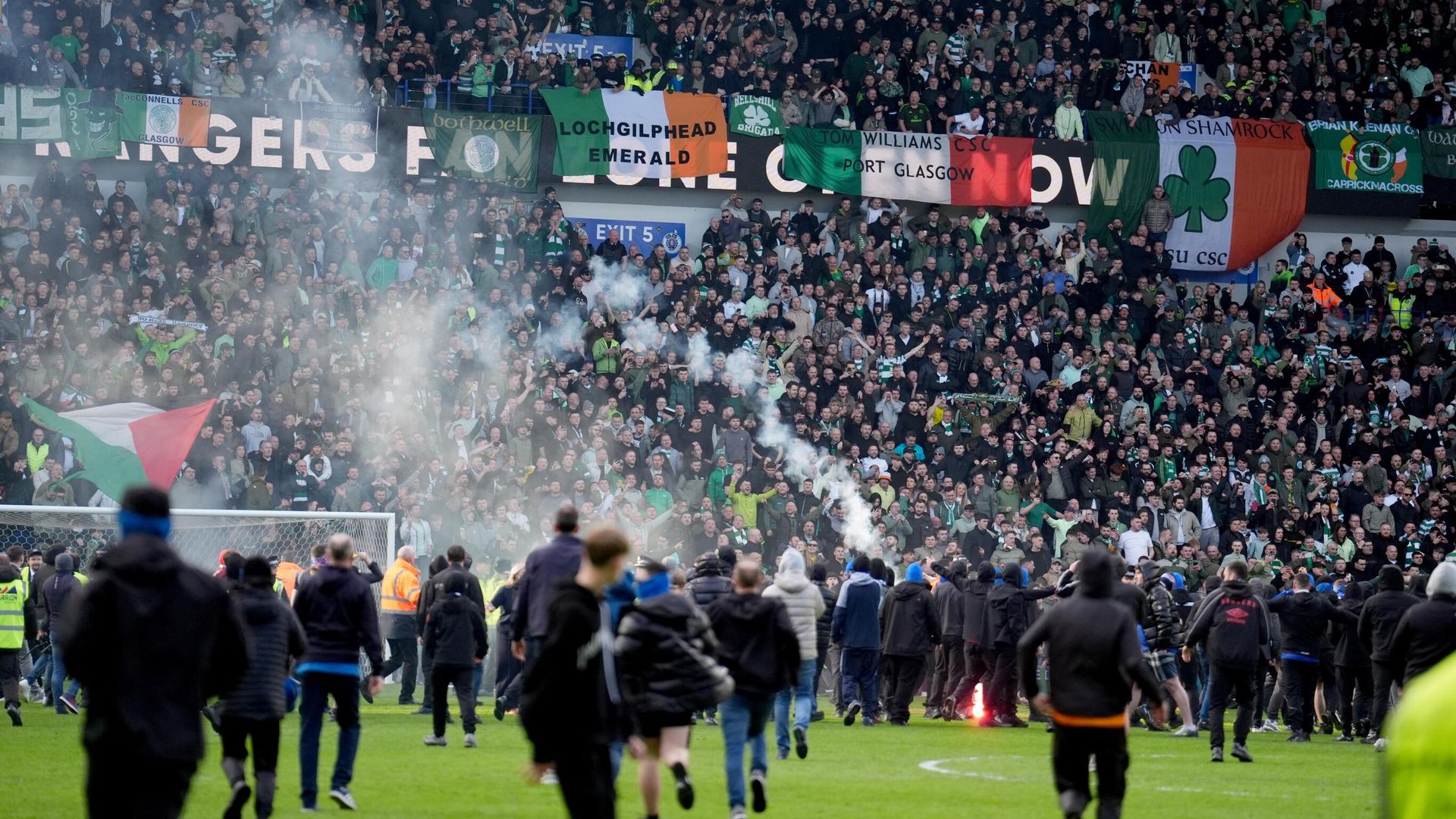
The air in Glasgow on derby day doesn’t just carry the scent of rain and fried food. It carries a charge. It is a static electricity that raises the hair on your arms long before the first whistle blows. You feel it in the subway carriages, where the silence is too heavy, and in the pubs, where the laughter is just a semi-tone too loud. It is the friction of two tectonic plates—the red, white, and blue against the hoop-green and white—grinding together until something inevitably snaps.
When the final whistle blew at Ibrox or Celtic Park, the scoreboard theoretically settled the argument. But for the police officers standing in the drizzle and the residents pulling their curtains shut, the game was only beginning.
Nine people started their evening with the roar of the crowd. They ended it in the back of a van.
The arrests following the latest clash between Rangers and Celtic are not just numbers on a blotter. They are the recurring symptoms of a fever that the city cannot quite shake. It starts with a shouted slur across a line of fluorescent-vested officers. It escalates into a scuffle on a street corner where the CCTV doesn’t quite reach. Before the sirens fade, nine individuals are in custody, facing charges of disorder, and the authorities are already scanning the high-definition footage to find the others. There will be more. There are always more.
The Anatomy of the Aftermath
Consider a young man we will call Callum. He isn’t a career criminal. He has a job, a girlfriend, and a dog. But when he wears that specific shade of blue or green, he isn't just Callum anymore. He is a soldier in a century-old proxy war.
As the crowds filtered out of the stadium, the adrenaline that had been pumped into his system for ninety minutes had nowhere to go. The loss felt like a personal bereavement; the win felt like a divine mandate. When he crossed paths with a group wearing the "wrong" colors near a train station, the tribal circuitry in his brain overrode a decade of social conditioning. A bottle was thrown. A punch landed.
The police report will summarize this as "disorder." For Callum, it is the moment his life fractures. A criminal record in Glasgow for football-related violence is a heavy coat to wear. It stays with you in job interviews. It stays with you at airport security. It is the high price of a moment’s lost composure.
The police aren't surprised. They approach these fixtures with the weary expertise of a bomb squad. They know the hotspots—the narrow lanes of the Gallowgate, the bridges over the Clyde, the transport hubs where rival streams of fans are forced to merge. The nine arrests made in the immediate wake of the match were the low-hanging fruit, the ones who were too loud or too slow to disappear.
The real work happens now, in quiet rooms filled with monitors.
The Digital Dragnet
The modern fan lives under a microscope. Every street corner in the city center is mapped by a lens. Every gesture is recorded. The "number expected to rise" isn't a vague threat; it is a statistical certainty based on the sheer volume of data the Police Scotland analysts are currently sifting through.
They look for the instigators. They look for the faces that appear in multiple frames of a skirmish. They use facial recognition and clothing matches to track a troublemaker from the stadium gates to the scene of a crime miles away.
There is a specific kind of dread that comes with a knock on the door three days after a match. The heat of the moment has cooled. The hangover is gone. You’re sitting on your sofa watching TV when the reality of your actions catches up with you. That is the ghost that haunts the "expected" arrests. The wait is often worse than the handcuffs.
The Invisible Stakes
Why does this keep happening? To an outsider, it is just twenty-two men chasing a ball. To Glasgow, it is identity. It is history. It is a way of belonging to something larger than yourself in a world that often feels isolating.
The tragedy is that this deep-seated passion is so easily weaponized. The disorder isn't an accident; it’s a byproduct of a culture that sometimes struggles to separate sporting rivalry from genuine animosity. When we talk about the nine arrests, we are talking about the failure of a community to police its own edges. We are talking about the moment where the beauty of the game is choked out by the ugliness of the grudge.
The cost isn't just borne by those in the cells. It’s paid by the families who worry when their sons go to the game. It’s paid by the taxpayers who fund the massive security operations. It’s paid by the reputation of a city that has worked so hard to move past its "No Mean City" image, only to have it dragged back into the light every time the derby rolls around.
The Long Walk Home
The streets eventually emptied. The broken glass was swept up by the early morning shift. The rain washed the spilled beer into the gutters.
But for those nine individuals, and the dozens more who are looking over their shoulders today, the match isn't over. They are caught in the slow, grinding machinery of the legal system. They are waiting for the phone to ring or the door to rattle.
The city moves on, as it always does. The scarves are tucked away in drawers. The chants fade into the gray sky. Yet, beneath the surface, the static remains. We wait for the next fixture, hoping that next time, the only thing that breaks is a record, and the only thing captured is the glory of the goal.
The police vans sit idling in the shadows of the precinct, ready for the names that haven't been added to the list yet. They are patient. They know that in this city, the shadows have a long memory.