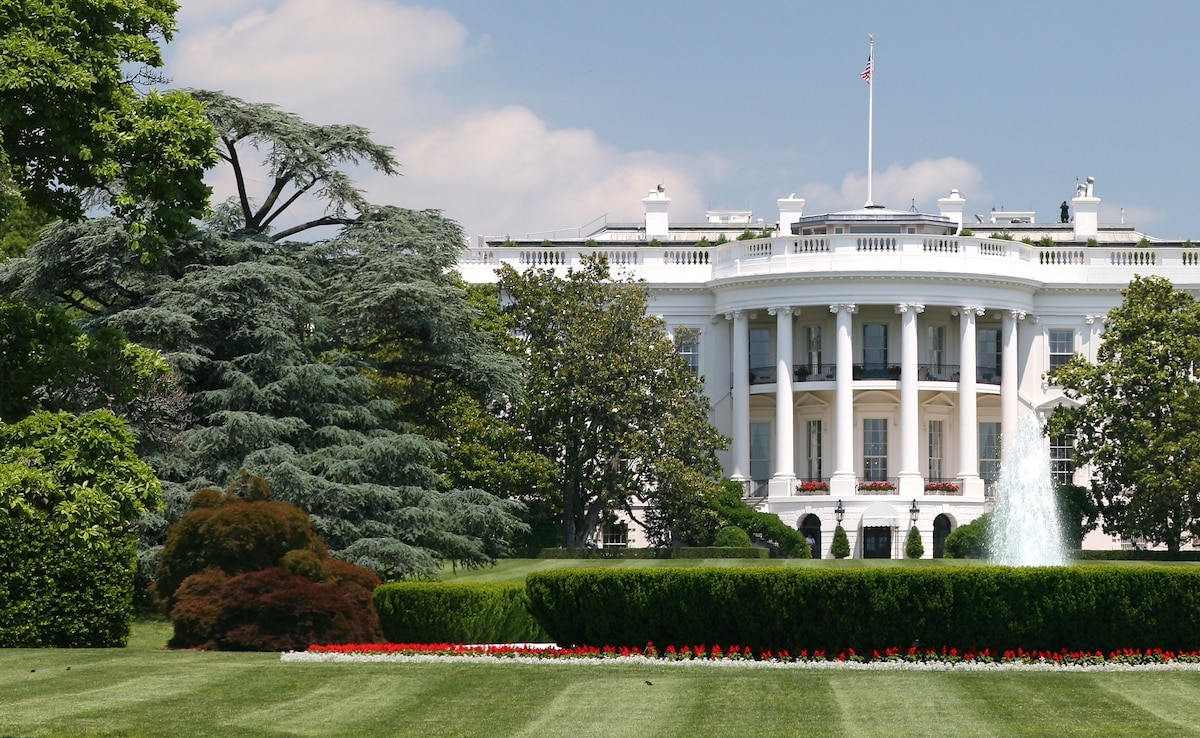
The security perimeter surrounding the executive mansion is often described as an impenetrable bubble, yet recent history proves it is more of a high-stakes psychological barrier. When the Secret Service opened fire on an armed man near the White House fence, the immediate result was a lockdown and a flurry of breathless news alerts. However, the surface-level reporting of a "brief disruption" masks a more troubling reality about the evolution of urban security and the increasing frequency of perimeter tests. This wasn't just a random act of aggression; it was a physical manifestation of the rising friction between public access and presidential protection.
Law enforcement neutralized the threat quickly. That is the official line. But for those who study the mechanics of federal protection, the event raises questions about how an individual with a firearm could even approach the most monitored zip code in the country without being intercepted sooner. The White House is not a fortress on a hill; it is a civilian-occupied building in the heart of a dense, bustling city. That proximity creates a permanent vulnerability that technology has yet to fully solve.
The Fragility of the Inner Ring
The Secret Service operates on a philosophy of concentric circles. The further you are from the President, the less scrutiny you face. But as the outer layers become more porous due to high foot traffic and public demonstrations, the "Inner Ring" bears the brunt of the pressure. When a gunman reaches the iron fence, the system has already failed at several earlier checkpoints.
Security experts argue that the current reliance on physical barriers and human observation is reaching its limit. The man involved in this recent shooting was able to draw a weapon before he was engaged. This indicates a gap in pre-emptive surveillance. While the agent on the ground acted with necessary force, the goal of elite protection is to ensure that force is never required because the threat is identified blocks away.
The lockdown that followed was a standard operating procedure, but the psychological impact ripples much further. It reinforces a siege mentality within the executive branch. Every time the gates are bolted and the press corps is ushered into the basement, the symbolic openness of the American government takes a hit.
Technical Failure or Human Error
Every major security breach in the last decade has been followed by a promise of better technology. We are told about sophisticated sensors, facial recognition, and acoustic gunshot detection. Yet, time and again, the final line of defense remains a lone agent making a split-second decision.
Proactive intelligence is supposedly the backbone of the Secret Service, yet most "fence-jumpers" or perimeter threats are individuals known to local law enforcement or social services. There is a recurring breakdown in communication between the agencies that track potential threats and the tactical teams guarding the North Lawn.
- Intelligence Gaps: Information about disgruntled individuals often gets stuck in bureaucratic silos.
- Reaction Time: Once a weapon is visible, the window for a non-lethal resolution disappears.
- Crowd Cover: The constant presence of tourists provides a perfect screen for bad actors.
We have to consider the possibility that the sheer volume of data being collected is actually hindering the mission. If every person with a camera or a protest sign is flagged as a potential risk, the signal-to-noise ratio becomes impossible to manage. The agent who fired the shot wasn't looking at a data feed; they were looking at a human being with a gun.
The High Cost of the Zero Failure Mandate
The Secret Service is the only agency in the world where a 99% success rate is a total failure. This "zero-failure" mandate creates an environment of extreme stress that leads to high turnover and morale issues. When an incident like this happens, the internal investigation often looks for a scapegoat rather than examining the systemic flaws in the security posture.
The reality is that D.C. is an open city. You can walk within feet of the fence line. You can fly a drone nearby if you are daring enough. You can stand in Lafayette Square and scream at the windows of the Oval Office. This is by design. A democracy requires its leaders to be accessible, but that accessibility is the very thing that makes them targets.
The Urban Warfare Shift
Protecting a head of state in a modern city has shifted from a secret service task to an urban warfare exercise. The perimeter has been pushed back repeatedly—Pennsylvania Avenue is no longer a through-street for cars—but the threats are evolving faster than the bollards. We are no longer just looking for "the man in the crowd." We are looking for the man who has spent months radicalizing in an online vacuum, who arrives at the White House not to make a political point, but to end a narrative.
This recent shooter fits a pattern of "lone-wolf" actors who lack a formal organizational tie. These are the hardest threats to track. They don't have a communications network to intercept. They don't have a known safe house. They simply show up.
Beyond the Iron Fence
If the goal is to prevent these incidents, the solution isn't more iron or more agents. It is a fundamental rethinking of how the federal government interacts with the local environment. Washington D.C. is being partitioned into "Green Zones" and "Red Zones," much like a conflict territory. This move toward isolation might protect the individual, but it erodes the institution.
The shooting on the perimeter is a warning shot for the agency. It highlights that even with a massive budget and the best training in the world, the distance between a normal afternoon and a national tragedy is only a few inches of steel. The Secret Service must move beyond the reactive "see a threat, shoot a threat" model and integrate more deeply with the social and digital fabric that surrounds the capital.
The incident was handled. The threat was stopped. But the underlying instability that brought that man to the fence remains unaddressed. Until the gap between intelligence gathering and tactical response is closed, the White House will remain a target that is surprisingly easy to touch. The agents did their job, but the system is straining under the weight of a world that has become far more volatile than the architecture was built to handle.
Stop looking at the fence. Look at the street.