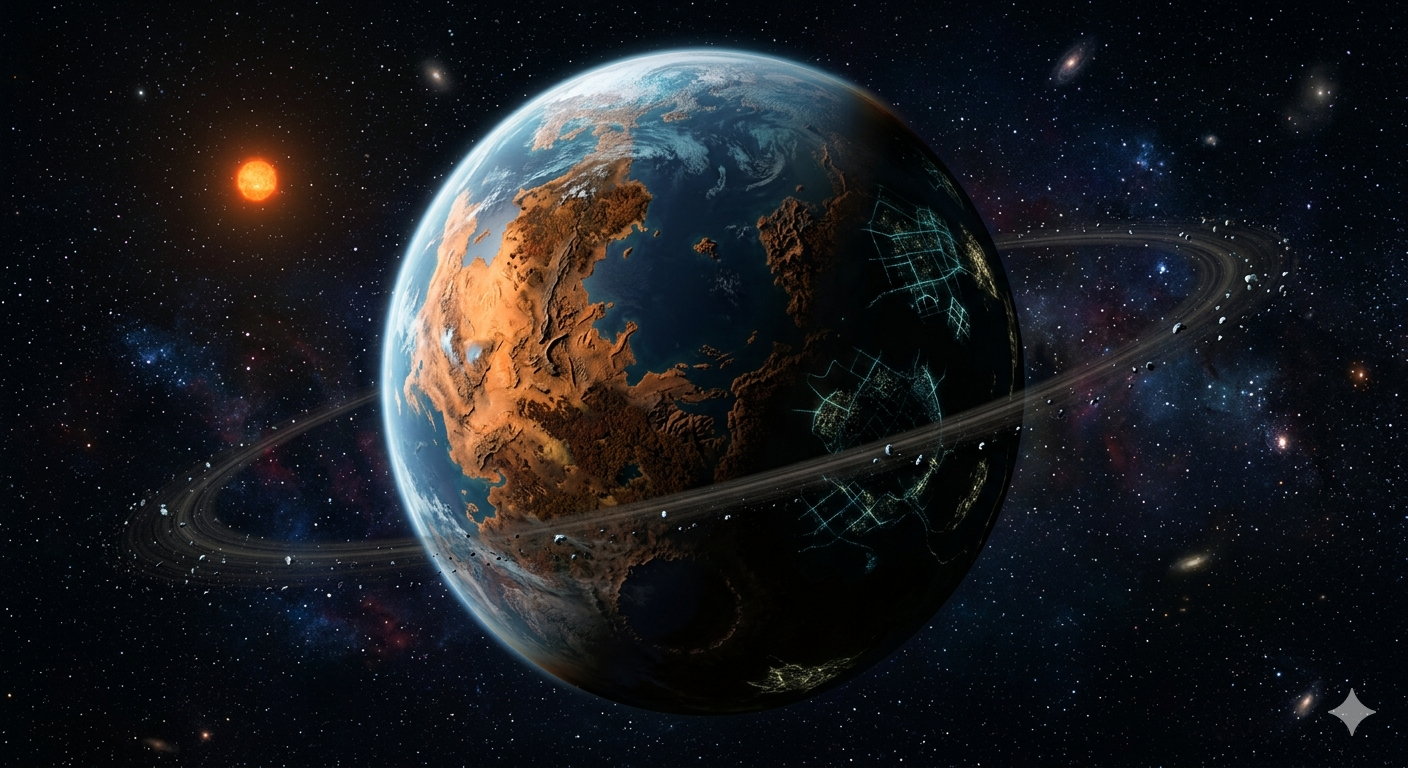
For decades, the search for extraterrestrial life has relied on a deceptively simple metric: the habitable zone. If a planet orbits its star at the right distance for liquid water to pool on its surface, we assume it sits in the celestial sweet spot. This assumption is cracking under the weight of new geological modeling. The brutal reality is that liquid water alone is insufficient. Without a functional, self-regulating carbon cycle, a planet is nothing more than a ticking time bomb.
The Mechanics of Planetary Failure
On Earth, we enjoy a temperate climate thanks to the carbonate-silicate cycle. It acts as a massive, planetary-scale thermostat. When the atmosphere gets too warm, increased rainfall accelerates the weathering of silicate rocks. This chemical process pulls carbon dioxide out of the air, converting it into carbonate minerals that eventually wash into the oceans and sink into the mantle through tectonic subduction. Volcanic eruptions then return that carbon to the atmosphere. It is a closed loop of exquisite precision. If you enjoyed this post, you should look at: this related article.
The problem arises when a planet starts with too little water. If a world is arid, the weathering engine stalls. Imagine a hypothetical planet, nearly identical to Earth in mass and orbital position, but possessing only ten percent of our ocean volume. Without sufficient rainfall to facilitate the chemical breakdown of surface rocks, the carbon dioxide exhaled by volcanoes accumulates unchecked. The thermostat breaks. The planet enters a runaway greenhouse state, trapping heat until the atmosphere becomes a furnace and the remaining surface water boils away into space.
Why Distance From a Star Is Not Enough
We have spent years prioritizing stellar distance as the primary indicator of potential habitability. We now know this is a dangerous simplification. A planet can be positioned perfectly within the habitable zone of a G-type or K-type star, yet remain utterly hostile. Habitability is not a location; it is a geochemical process. For another look on this development, check out the latest update from The Verge.
Consider the contrast between a thriving, water-rich world and an arid desert planet. On the former, the water cycle provides the solvent needed to strip carbon from the atmosphere. On the latter, the lack of a hydrological engine leaves carbon in the atmosphere, steadily thickening the greenhouse effect. This creates a feedback loop that renders the planet sterile. Recent computational models suggest that terrestrial planets require an initial surface water inventory of at least twenty to fifty percent of Earth’s ocean mass to sustain this critical balance over billions of years.
The Venus Precedent
Venus is the haunting reminder of what happens when this balance tips. While its proximity to the Sun clearly exacerbated its demise, planetary scientists increasingly suspect that its internal water budget was deficient from the beginning. If a planet starts its life with a water deficit, the carbon cycle never achieves the equilibrium required to prevent atmospheric saturation.
There is a common, incorrect assumption that if a planet is in the habitable zone, it will eventually develop the necessary conditions for life. The evidence suggests the opposite. The initial inventory of volatiles—water, carbon, nitrogen—determines the long-term viability of the world. A world that forms dry stays dry, and once the carbon builds up, it stays that way. There is no recovery mechanism for a planet that has lost its ability to regulate its own temperature.
Beyond the Habitable Zone
The search for life must shift its focus. Finding a rocky planet in a favorable orbit is merely the first step, not the final one. Astronomers are now tasked with the significantly harder work of identifying chemical and geological markers that suggest a functioning, long-term carbon cycle. This requires analyzing the composition of exoplanet atmospheres for signatures of outgassing and evidence of active geological processing.
This discovery places a hard limit on our expectations. It suggests that many of the worlds currently labeled as potentially habitable are actually dead zones. They possess the geography for life but lack the chemistry to sustain it. We are looking at a galaxy where the ingredients for life might be common, but the conditions required to keep those ingredients stable for geologic time are alarmingly rare.
The next generation of telescopes and observational techniques will not just hunt for planets; they will hunt for working thermostats. If we fail to find them, we must confront the possibility that Earth is not merely one of many, but a statistical outlier in a universe of frozen wastes and boiling deserts. The data is clear. Without enough water to drive the rocks, the cycle stops. And when the cycle stops, the planet dies.