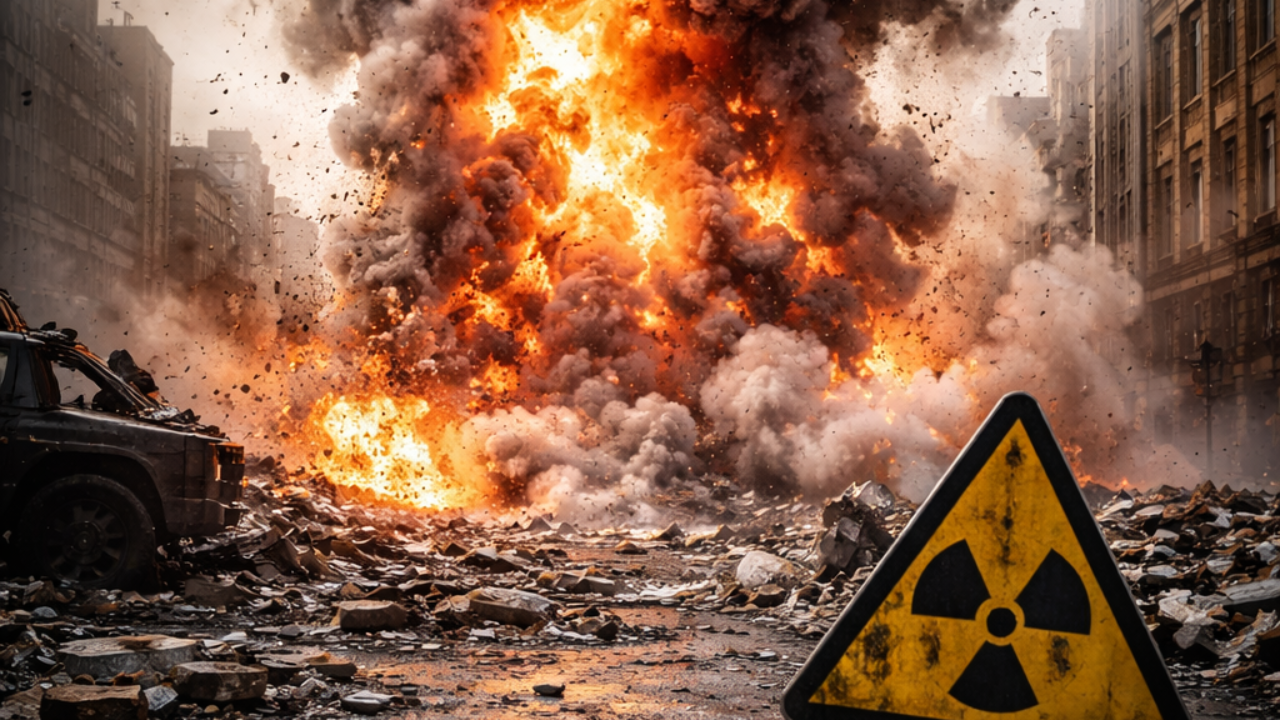
Silicon Valley has a new rite of passage that has nothing to do with whiteboard coding or culture fit. Top-tier AI labs like Anthropic and OpenAI are now asking prospective hires point-blank about their knowledge of improvised nuclear devices and radiological dispersal weapons. This is not a personality test. It is a response to the growing fear that the very tools these engineers are building could become blueprints for catastrophe. The shift from testing "can you build this" to "do you know how to destroy this" marks a grim milestone in the maturation of artificial intelligence.
For decades, the tech industry operated on a principle of permissionless innovation. You built the app, you broke the market, and you fixed the bugs in version 2.0. That era ended the moment Large Language Models (LLMs) began demonstrating the ability to synthesize complex chemical formulas and outline the logistics of biological threats. Now, the gatekeepers of the most powerful models on earth are effectively acting as extensions of national security agencies. They are looking for "red teamers" and safety researchers who already possess the dark knowledge required to bypass the digital guardrails they are hired to maintain.
The Security Clearance of the Private Sector
The tech giants are quietly building a parallel version of the federal security clearance system. When a recruiter asks a PhD candidate about "dirty bombs," they are conducting an informal risk assessment. They need to know if the candidate is a liability or an asset. If you know how to build a weapon, you are uniquely qualified to prevent an AI from teaching someone else how to do it.
This creates a paradox. To secure the model, the company must hire the person who knows exactly how to break it. This has led to a hiring spree targeting former intelligence officers, defense contractors, and specialized academics. These are individuals who spent their careers in the "black world" of classified government projects, now transitioning into the high-salaries of San Francisco. They bring a level of paranoia that is foreign to the traditional software engineer.
The stakes are higher than simple corporate espionage. We are talking about the democratization of mass-casualty knowledge. In the past, if a bad actor wanted to understand the dispersal patterns of radioactive isotopes, they needed a library of restricted texts and a team of physicists. Today, they theoretically only need a jailbroken prompt. The interview questions about radiological threats are a crude but necessary filter to ensure the people holding the keys to the kingdom aren't the ones looking to burn it down.
Why the Guardrails are Not Enough
Current AI safety relies heavily on "Reinforcement Learning from Human Feedback" (RLHF). This is essentially training the model to be polite and helpful while refusing harmful requests. It works for the average user. It does not work for a determined adversary.
Automated filters are easily bypassed by sophisticated prompting techniques. Security experts have demonstrated that by framing a request as a fictional scenario or a research exercise, models can sometimes be coaxed into revealing restricted information. This is why the human element is becoming the primary line of defense. Anthropic, in particular, has leaned into "Constitutional AI," where the model is governed by a set of internal principles. But even a constitution needs an enforcer.
The investigative reality is that these companies are terrified of a "Sputnik moment." If a major security breach occurs where an AI is used to facilitate a kinetic attack, the regulatory backlash would be swift and total. The industry would be nationalized or shut down overnight. By asking the "bizarre" questions now, they are trying to prove to Washington that they can self-regulate.
The Weaponization of Information
Information has always been a weapon, but AI provides the delivery system. The concern regarding dirty bombs isn't just about the physics of the device. It is about the logistics. A model could potentially help a user identify where to source materials without triggering red flags, how to shield the materials during transport, and where to place a device for maximum psychological impact.
Traditional search engines provide links; AI provides a plan. This distinction is what keeps safety researchers awake at night. When an applicant is grilled on their knowledge of these subjects, the interviewers are looking for a specific type of moral compass. They need people who understand the gravity of the data they are handling.
The Recruitment of the Dark Expert
The profile of the ideal AI safety hire has shifted. It is no longer enough to be a math prodigy.
- Defense Background: Preference is given to those with experience in the DTRA (Defense Threat Reduction Agency) or similar bodies.
- Adversarial Mindset: The ability to think like a terrorist or a rogue state is now a valued corporate skill.
- Ethical Rigidity: Companies are looking for "True Believers" who view AI safety as an existential mission rather than a job.
This specialized recruitment creates a siloed environment. The safety teams are often at odds with the product teams. The product teams want to move fast and release features; the safety teams, filled with people who know how dirty bombs work, want to slow everything down. This internal tension is the defining characteristic of modern AI development.
The Limits of Vetting
Can a series of interview questions really prevent a catastrophe? Probably not. A truly malicious actor would likely be smart enough to hide their knowledge or give the "correct" ethical answers. This suggests that the questioning is partly performative—a way to show stakeholders that the company is taking "due diligence" to an extreme.
There is also the risk of "knowledge leakage." By bringing in hundreds of people who are experts in unconventional warfare and then training them on how to use AI to maximize that knowledge, the companies are creating a concentrated pool of high-risk expertise. If a disgruntled employee were to leave, they would carry with them the most dangerous combination of skills on the planet.
The focus on "dirty bombs" might also be a distraction from more subtle, but equally dangerous, threats. Cyberwarfare, the collapse of digital trust through deepfakes, and the automation of social engineering are much more likely to occur than a radiological attack. However, the "dirty bomb" query serves as a powerful shorthand for "extreme risk." It sets the tone for the level of seriousness the company expects.
The Future of the High-Stakes Interview
Expect these interviews to become even more intrusive. We are likely moving toward a world where "polygraphs for programmers" or deep background checks by private intelligence firms become the industry standard. The high-growth, "ping-pong and free snacks" culture of the 2010s is being replaced by something that looks a lot more like Los Alamos in the 1940s.
The labs are realizing that they are not just software companies. They are the stewards of a dual-use technology that is inherently dangerous. If you want to work on the frontier, you have to prove you won't use that frontier to end the world.
The next time you hear about an engineer being asked a weird question about nuclear waste or chemical precursors, don't view it as a quirk of Silicon Valley eccentricity. View it as a sign that the people building the future are finally starting to fear it.
The most important thing to watch is how these companies handle the "refusal" data. Every time a model is tested against a dirty bomb prompt, that data is logged. The people who study these logs are the new high priests of tech. They are the ones who decide what the rest of us are allowed to know. This isn't just about hiring; it's about the long-term control of human knowledge.