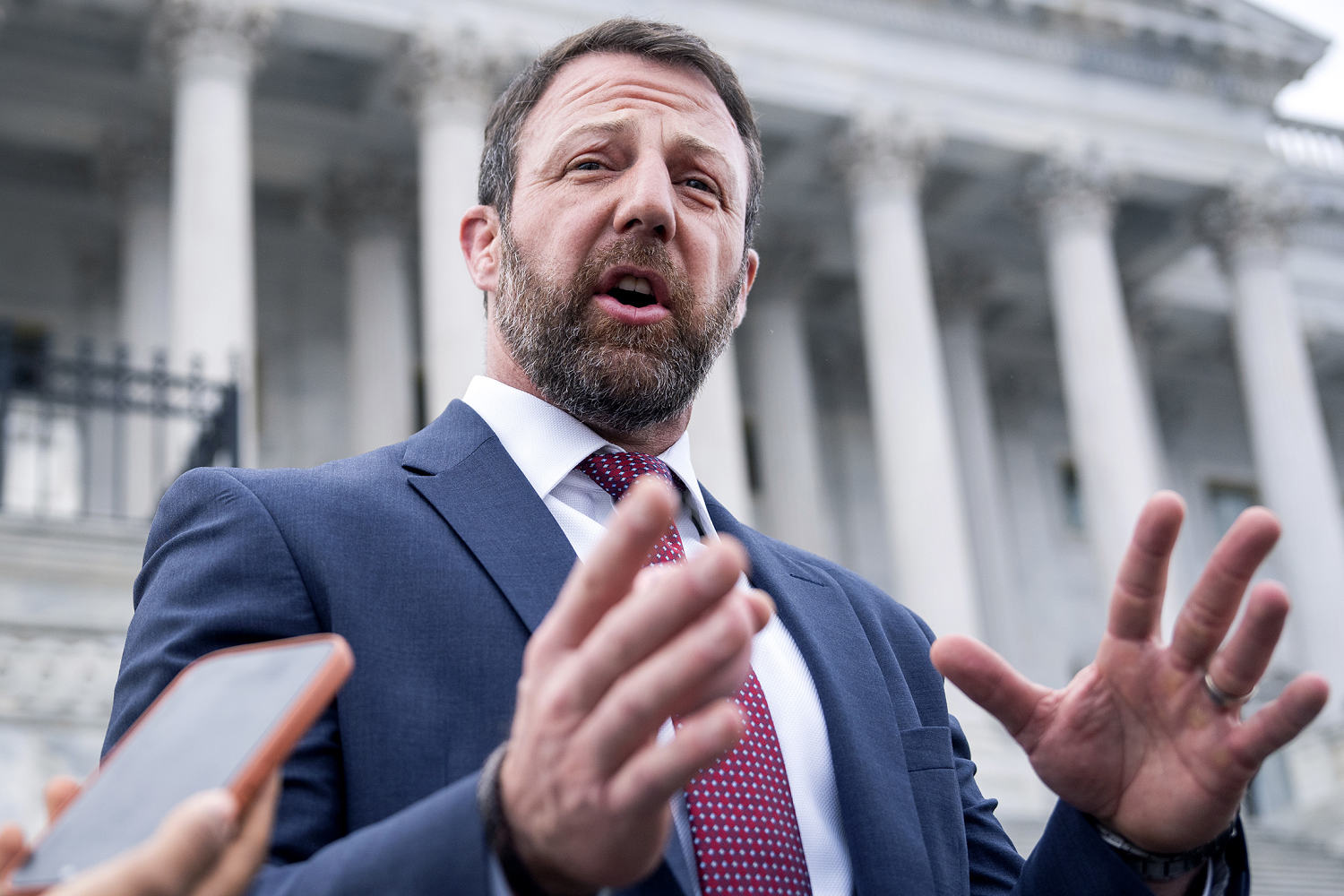
The narrow 8-7 vote that pushed Senator Markwayne Mullin one step closer to the helm of the Department of Homeland Security was not just a tally. It was a calculated fracture in the traditional battle lines of the United States Senate. By casting the deciding "aye" on Thursday, Senator John Fetterman did more than advance a nominee; he effectively neutralized a Republican-led mutiny and signaled a new, unpredictable era of coalition building. Fetterman’s move salvaged a nomination that was teetering on the edge of a humiliating defeat for the White House, coming just as a 34-day funding lapse has left the Department of Homeland Security (DHS) paralyzed and its workforce unpaid.
This is the wreckage of a confirmation process that saw the committee’s own chairman, Republican Rand Paul, turn into the nominee's fiercest prosecutor. The political geometry here is jarring. You have a progressive populist from Pennsylvania providing the lifeline for a "MAGA Warrior" from Oklahoma, while a libertarian-leaning Republican tries to burn the bridge from the other side. This isn't just about vetting a cabinet secretary. It is a raw display of how personal vendettas and the desperate need to "reopen" a shuttered agency can force the most unlikely of alliances.
The Republican Civil War on Display
The most striking visual of the week wasn't Mullin’s testimony, but the palpable animosity between him and Chairman Rand Paul. It is rare to see a committee chair move so aggressively to sink a nominee from their own party, but for Paul, the issue is deeply personal and rooted in a history of physical and verbal altercations.
At the heart of Paul’s opposition is a 2017 incident where the Kentucky Senator was tackled by a neighbor, resulting in broken ribs and subsequent surgeries. Mullin had previously commented that he "understood" why the neighbor did it—a statement Paul characterized as an endorsement of political violence. During the hearing, Paul didn't mince words, questioning whether a man who "applauds violence" is fit to lead a department with a massive law enforcement mandate.
Mullin’s defense was characteristic of his "former MMA fighter" persona. He didn't retreat. Instead, he accused Paul of being a "freaking snake" and suggested that Paul fights more with fellow Republicans than with the opposition. This was not the typical, polished cabinet-level back-and-forth. It was a street fight brought into the Dirksen Senate Office Building.
Why John Fetterman Crossed the Rubicon
While the GOP was busy cannibalizing itself, John Fetterman was playing a different game. His support for Mullin is being framed by his office as a pragmatic necessity, but it also solidifies his reputation as a "political maverick" who cares little for party orthodoxy.
Fetterman’s reasoning is two-fold:
- The Vacancy Crisis: The DHS has been without a permanent leader since Kristi Noem was forced out earlier this month. Fetterman argued that the "chaos" at the border and within the agency—compounded by the current funding lapse—requires a "steady hand" and a leader who can actually be confirmed.
- Personal Rapport: In a town built on transactional relationships, Fetterman pointed to a genuine, "constructive working relationship" with Mullin. He spoke of dinner plans and mutual respect, a rare commodity in 2026 Washington.
By voting yes, Fetterman gave Mullin the cover he needed to survive Rand Paul's "no." It was a lifeline that other Democrats, like Ranking Member Gary Peters, refused to extend, citing Mullin’s lack of administrative experience and his combative temperament.
The Ghost of Kristi Noem
Mullin’s path to this seat was paved by the spectacular collapse of his predecessor, Kristi Noem. Her tenure ended abruptly following a series of high-profile failures, including the deaths of three American citizens at the hands of federal agents and a botched immigration enforcement strategy that alienated even the most ardent border hawks.
President Trump’s selection of Mullin was a pivot toward a nominee who could theoretically bridge the gap between the MAGA base and the Senate establishment. Mullin has spent a decade in the House and three years in the Senate; he knows where the bodies are buried on Capitol Hill. However, his hearing revealed that while he may know the mechanics of Congress, he carries enough personal baggage to make him a target for both sides of the aisle.
The DHS is a sprawling behemoth, encompassing everything from the Secret Service to FEMA and the TSA. Critics argue that Mullin, a business owner and legislator, lacks the executive experience to manage a 260,000-person workforce. Mullin’s response to this has been a classic management trope: "I’m not going to be the smartest guy in any room... but I know how to get talent."
The Stakes of a 34 Day Funding Lapse
The backdrop to this political theater is a department in free-fall. The DHS funding lapse is now entering its second month. Border Patrol agents and TSA officers are working without paychecks. The "chaos" Fetterman referenced isn't just a talking point; it is a functional reality for the agency responsible for national security.
Mullin has signaled that he will fully back Trump’s aggressive immigration priorities, which remain the central sticking point in the budget standoff. This creates a paradox: the very policies Mullin is being confirmed to implement are the ones causing the financial starvation of the agency he hopes to lead.
The upcoming vote before the full Senate will be the final test. With Republicans holding a slim majority, the margin for error is non-existent. If Rand Paul maintains his "no" and Fetterman's defection doesn't inspire other Democrats to follow suit, Mullin's nomination could still hit a wall.
The "mountain, molehill stuff" regarding Mullin's classified trips—dismissed by Senator James Lankford as a minor whistleblower issue—could still be weaponized on the Senate floor. In an environment this toxic, even a molehill can be shaped into a barricade.
The Road Ahead for DHS
If confirmed, Mullin will inherit a department that is demoralized, underfunded, and under intense scrutiny. His primary challenge won't just be the border; it will be restoring the "trust" that Gary Peters claimed has been shattered. He will have to prove that a man known for his fighting spirit can transition into a diplomat capable of managing the internal politics of the world's largest homeland security organization.
The Fetterman-Mullin alliance may be a one-off, a fluke of personal friendship and situational necessity. Or, it could be the blueprint for how the Trump administration navigates a divided Senate—by finding the cracks in the Democratic facade and widening them with the promise of stability over partisan purity.
Would you like me to research the specific Senate floor schedule for the full confirmation vote or provide a breakdown of the DHS agencies currently most affected by the funding lapse?