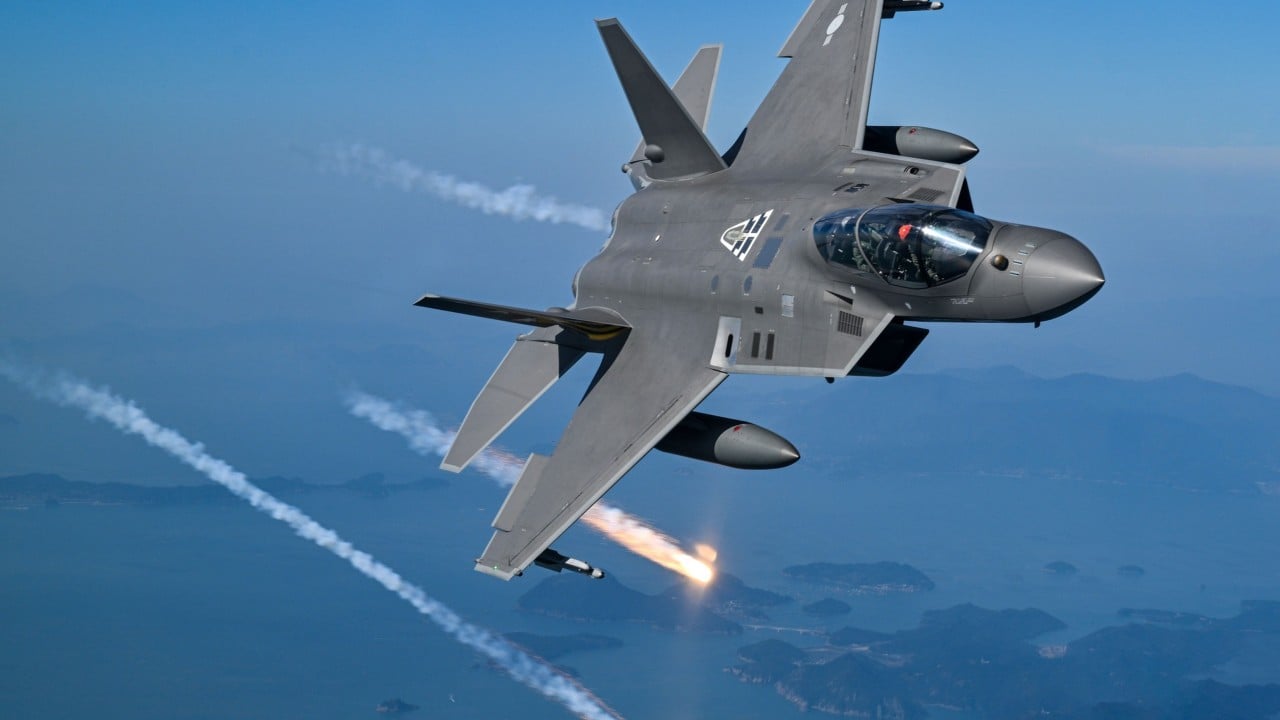
Can the South Korean KF-21 Boramae compete with the aerospace industries of the United States, China, and Europe? Yes, it can, but not through raw stealth or fifth-generation dominance. Instead, it relies on a pragmatic 4.5-generation approach that prioritizes rapid development and affordability. South Korea rolled out the first serial production model of the KF-21 Boramae at the Korea Aerospace Industries facility in Sacheon during March 2026. This milestone marks the conclusion of a 25-year development effort. The aircraft, designed to replace aging F-4 Phantom and KF-5 Tiger II jets, enters service with the Republic of Korea Air Force in late 2026. Rather than trying to match the F-35 Lightning II or the J-20 in absolute stealth, Seoul is targeting air forces that want advanced radar and electronic warfare capabilities without the massive financial burdens of Western platforms.
The First Rollout and The Reality of Production
The Sacheon factory floor hums with a quiet, industrial intensity. It is a space roughly the size of three soccer fields. Here, Korea Aerospace Industries assembles the supersonic Boramae. The facility uses automated systems to join forward and aft fuselage sections with an alignment precision within one-thousandth of a unit. You might also find this connected article insightful: The Geopolitics of Model Parity and Application Dominance.
President Lee Jae Myung stood on the stage in March 2026 to witness the first serial production KF-21 roll out under its own power. The aircraft, serial number 26-001, is a two-seat version. It represents more than two decades of research and development. It also signals a transformation for a nation that once relied entirely on foreign-built fighters.
The South Korean government plans to deploy forty Block I units starting in late 2026. These aircraft will handle air-to-air missions. They will carry a heavy payload of up to 7.7 tons of weaponry, including the European MBDA Meteor missile. The Boramae achieves Mach 1.8. It operates without afterburners. As discussed in detailed articles by Engadget, the implications are significant.
Yet, producing these aircraft at scale is a significant challenge. The initial production run requires KAI to ramp up operations significantly. The company intends to deliver twenty-seven aircraft during 2026, combining both the KF-21 and the FA-50 light combat aircraft. The company expects production to rise to thirty-one aircraft the following year and forty-seven by the year after that.
This rapid expansion requires a reliable, indigenous supply chain. Hanwha Aerospace and Hanwha Systems have spent years developing the active electronically scanned array radar and the electronic warfare suite. For years, the South Korean defense industry relied on imported parts. Today, the Boramae features domestic components for many of its critical systems.
The production hall has expanded to keep up with domestic orders. KAI intends to build the assembly line up to a capacity of more than fifty aircraft per year. This scale allows South Korea to fulfill both local air force requirements and potential export contracts.
The Evolution of the Boramae
The development philosophy behind the aircraft centers on a spiral approach. It is an evolutionary method that avoids the massive risks of building a fully mature, fifth-generation fighter from day one. Instead, the South Korean Agency for Defense Development and KAI chose a modular architecture.
The Block I configuration focuses on air defense and air superiority. It features semi-recessed missile attachments on the belly rather than internal weapons bays. This design choice reduces the radar cross-section compared to legacy fourth-generation fighters, though it does not provide the same low-observable signature as a true stealth aircraft.
The Block 2 variant will introduce air-to-ground capabilities. The manufacturer expects to deliver eighty Block 2 aircraft by 2032. This model will integrate a wider range of precision-guided munitions. The evolution will continue into the Block 3 variant, which is planned for 2040 and will include internal weapons bays and a domestically produced engine.
South Korea recently committed 3.4 billion dollars to develop an indigenous engine with a thrust of 106.75 kilonewtons. This engine project aims to end all reliance on foreign powerplants. It shows the long-term vision of the aerospace sector in Seoul.
The modular architecture means the airframe was built with future upgrades in mind from the beginning. There is pre-allocated space for an internal weapons bay and additional sensors. This stands in contrast to Western fighters built in the 1970s and 1980s, which have run out of physical space for new hardware.
The physical dimensions of the aircraft match the size of an F-35. The empty weight and the maximum takeoff weight reflect the requirements for an agile, twin-engine configuration. Designers chose the twin-engine layout to ensure high maneuverability and survivability in contested airspace.
The Partnership That Almost Fell Apart
The journey was not without major political turbulence. The project, initially known as the KFX program, began as a joint venture with Indonesia. Jakarta agreed to fund twenty percent of the development costs, roughly 1.2 billion dollars, in exchange for technology transfers and local production rights.
Over the years, Indonesia struggled to meet its financial obligations. The delays threatened to derail the entire program. Tensions escalated further when allegations surfaced regarding data security and the conduct of Indonesian engineers working at the Sacheon facility. Although investigations cleared those individuals of wrongdoing, the incident raised serious concerns within the South Korean defense establishment regarding the protection of sensitive intellectual property.
By 2025, the two governments renegotiated the agreement. Indonesia reduced its financial contribution. In exchange, the country receives a smaller share of the technology transfer and a lower number of production models. The new deal reflects a more pragmatic approach to international defense partnerships.
This situation reveals the risks of relying on foreign partners to fund domestic aerospace programs. South Korea had to absorb shortfalls in the development budget. The nation had to prove its own financial and engineering resilience. The ability to carry on without full Indonesian funding demonstrates the depth of the domestic defense industry.
The contract renegotiation meant that KAI had to adjust its long-term manufacturing forecasts. The initial plans assumed that Indonesia would build a large number of the variants domestically. Now, the Sacheon facility will bear the primary responsibility for producing the aircraft.
Competing Against Global Giants
The international fighter market is highly crowded and fiercely contested. The KF-21 enters a space dominated by American, Chinese, and European aerospace companies. The closest competitors are the Lockheed Martin F-35 Lightning II, the Eurofighter Typhoon, the French Dassault Rafale, and the Chinese Chengdu J-20.
Let us consider a hypothetical example to illustrate the financial realities. A small air force needs to replace its aging fleet of F-5s. It could purchase the F-35A. The purchase price of the aircraft, combined with the extreme maintenance and specialized infrastructure required, makes it an unrealistic option for smaller nations.
The KF-21 offers an alternative. It provides 4.5-generation capability at a fraction of the cost. The platform is designed to be affordable to operate and easy to maintain. This makes it attractive to countries in Southeast Asia and the Middle East that seek advanced sensors and networking but cannot afford the maintenance costs of a true stealth fighter.
China presents a different type of challenge. The Chinese defense industry produces the J-20 and offers export aircraft such as the JF-17. The Chinese offer low prices and rapid delivery times. However, potential buyers often face political complications when dealing with Beijing. South Korea presents a politically neutral option. The nation is a reliable democracy with a strong industrial base, but it is not a superpower seeking to impose strict geopolitical alignment.
The European options, such as the Rafale and the Eurofighter, are mature and combat-tested. But these platforms are expensive and production lines have long waiting lists. The KAI production line can scale up quickly to meet international demand without the years-long delays seen in European programs.
The market for 4.5-generation fighters is shifting as older fleets reach the end of their service lives. Air forces around the globe find themselves in a difficult position. They need modern aircraft to maintain readiness, but they cannot afford the expense of fifth-generation fighters. The KF-21 sits exactly in this operational space.
The True Strategic Value
The rise of the KF-21 represents a shift in the global balance of power. For decades, the Republic of Korea Air Force relied on imported American technology. The F-15K Slam Eagle and the KF-16 Fighting Falcon form the backbone of the current fleet. The new aircraft reduces this dependence.
The Boramae provides South Korea with an independent capability to maintain its airspace. In a potential conflict on the Korean Peninsula, having a domestic supply chain for parts and maintenance is a major strategic advantage. The country does not need to wait for foreign approval or spare parts from overseas suppliers to keep its fleet flying.
The presence of the fighter at the Sacheon facility also drew the attention of foreign delegations. The United Kingdom, Japan, Peru, and Canada sent diplomats to observe the manufacturing process. These visits show that the aerospace community recognizes the quality and efficiency of the South Korean production system.
The jet is not just an aircraft. It is a symbol of technological maturity. It proves that a nation without a centuries-old aerospace tradition can build a modern fighter from the ground up. The journey from wind-tunnel tests of the C107 design to the rollout of serial production unit 26-001 took only a fraction of the time required by traditional aerospace companies.
The Block 1 model is ready for service. The challenge now is to deliver the planned forty units on schedule by 2028. KAI must prove that its automated manufacturing process can maintain quality while scaling up to higher volumes. The next few years will test the supply chain and the maintenance systems.
The financial and technical commitments made by the South Korean government have reshaped the defense industrial base. The aerospace sector is now a major engine for economic growth and high-tech manufacturing. The Boramae is an example of what a dedicated state-backed enterprise can achieve when it focuses on incremental, practical engineering over theoretical perfection.
The Boramae sits on the tarmac, ready for its first operational flight. The engines are tested, the avionics are online, and the supply chain is operating. South Korea has established itself as an aerospace power.