The global energy supply chain is currently confronting a structural failure at its most sensitive node: the Strait of Hormuz. When the United States initiates a call for international maritime intervention, it is not merely responding to a spike in Brent Crude prices; it is attempting to subsidize the security of a global commons that the market can no longer price accurately. The current volatility is a direct function of three intersecting variables: the erosion of conventional deterrence, the asymmetric cost of maritime disruption, and the inelasticity of global oil demand.
The Mechanics of the Hormuz Bottleneck
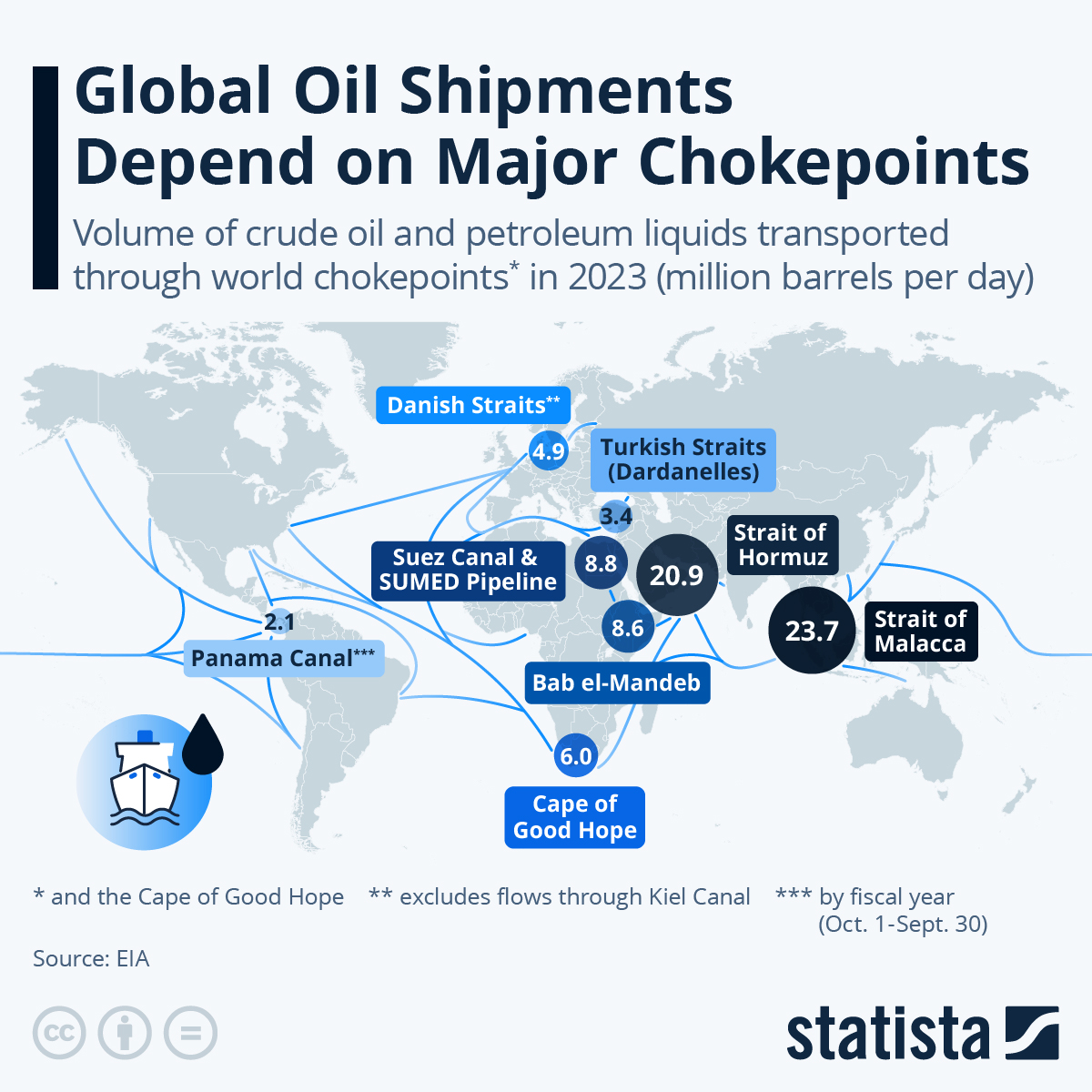
The Strait of Hormuz represents a unique geographic constraint where 21 miles of waterway—specifically the two-mile-wide shipping lanes in either direction—facilitate the passage of roughly 20% of the world's liquid petroleum consumption. To understand the current crisis, one must view the Strait not as a path, but as a high-pressure valve. When friction is introduced to this valve, the resulting price shocks are non-linear.
Energy markets operate on the margin. Because global spare capacity is thin, a perceived threat to even 5% of the daily 21 million barrels flowing through the Strait triggers speculative hoarding and a "risk premium" in insurance markets. This premium is currently being driven by the realization that maritime security is no longer a guaranteed public good provided by a single hegemon, but a contested variable.
The Asymmetry of Disruption
The strategic logic of the actors threatening the Strait relies on a favorable cost-exchange ratio. It costs an insurgent or a regional state actor approximately $50,000 to $100,000 to deploy a swarm of fast-attack craft or a loitering munition. Conversely, the operational cost for a carrier strike group or a multi-national task force to patrol the same area exceeds tens of millions of dollars per day.
This asymmetry creates a "Security Dilemma" for the United States and its allies:
- The Deployment Cost: Constant patrolling depletes naval readiness and diverts assets from other theaters, such as the Indo-Pacific.
- The Insurance Feedback Loop: Even with a naval presence, Lloyd’s Market Association often maintains "listed area" status for the Persian Gulf, keeping War Risk premiums high.
- The Escort Inefficiency: Moving tankers in convoys reduces the "ton-mile" efficiency of the global fleet, effectively shrinking the world’s shipping capacity without losing a single vessel.
The Three Pillars of International Intervention
The U.S. request for international assistance is a tactical shift designed to distribute these costs and restore a veneer of collective security. This strategy rests on three specific pillars.
Burden Sharing and Legitimacy
By involving a coalition—traditionally including the UK, Australia, and regional partners—the U.S. attempts to move the narrative from "Western interventionism" to "protection of global commerce." This is essential for navigating the United Nations Convention on the Law of the Sea (UNCLOS). While the U.S. has not ratified UNCLOS, it operates under its customary international law provisions. A multi-flagged fleet provides the legal cover necessary to conduct "Right of Innocent Passage" operations in territorial waters that would otherwise be contested.
Distributed Sensing Networks
Modern maritime security is no longer about the size of the cannon; it is about the density of the sensor net. An international coalition brings a diverse array of signals intelligence (SIGINT) and geospatial assets. Integrating French frigates, Japanese destroyers, and regional radar installations creates a "Persistent Intelligence" layer. This reduces the "Probability of Detection" for asymmetric threats like mine-laying vessels or semi-submersible drones which are difficult for high-altitude satellites to track in the cluttered environment of a busy shipping lane.
Economic Deterrence via Shared Risk
When China or India—major consumers of Persian Gulf oil—remain on the sidelines, they effectively "free-ride" on the security provided by the U.S. Navy. By demanding international participation, the U.S. is signaling that if the Strait closes, the economic pain will be distributed. The goal is to force major Asian economies to use their diplomatic leverage with regional agitators to de-escalate, rather than relying solely on American kinetic force.
The Cost Function of Maritime Escorts
To quantify the impact of the U.S. seeking help, we must look at the operational math of a naval escort. The "Protection Factor" of a merchant vessel is inversely proportional to the distance from its escort.
$$P_f = \frac{k}{D \cdot t}$$
In this simplified model, $P_f$ (Protection Factor) is determined by a constant ($k$) divided by the distance ($D$) from the nearest kinetic interceptor and the reaction time ($t$). When the U.S. operates alone, the value of $D$ increases as assets are spread thin across 250 miles of coastline. By adding just four to six additional international hulls, the average $D$ for any given tanker in the "High Risk Area" (HRA) drops by nearly 60%, significantly increasing the intercept probability for incoming threats.
However, this introduces a "Command and Control" (C2) bottleneck. Interoperability between different navies—using different encrypted radio frequencies and data links (e.g., Link 16 vs. Link 22)—creates a friction point. If the coalition cannot achieve a "Single Integrated Air Picture," the risk of friendly fire or missed intercepts increases.
Market Inelasticity and the "Fear Floor"
The surge in crude prices mentioned in current reports is rarely about a physical shortage of oil. It is about the "Fear Floor"—the price point below which the market will not drop as long as the threat of a "Total Blockade" exists.
The Ghost of 1984
During the "Tanker War" of the 1980s, over 500 ships were attacked. The market learned then that the Strait doesn't need to be physically blocked by sunken ships to be effectively closed. It only needs to be made "uninsurable." If the P&I Clubs (Protection and Indemnity) withdraw coverage, 90% of the world’s tanker fleet stops moving.
Current U.S. strategy is focused on preventing this "Insurance Blackout." By placing "gray hulls" (navy ships) alongside "white hulls" (commercial ships), the U.S. provides a physical guarantee that allows insurers to keep their risk models within acceptable bounds. This is a direct intervention into the financial pricing of energy.
Structural Vulnerabilities in the Strategic Petroleum Reserve (SPR)
A critical factor often missed in the analysis of the U.S. call for help is the current state of the Strategic Petroleum Reserve. Historically, the U.S. could use the SPR as a buffer to blunt the impact of a Hormuz disruption. However, following significant drawdowns in 2022 and 2023, the SPR’s ability to provide a sustained "supply shock absorber" is diminished.
This creates a "Duration Risk." The U.S. can handle a three-day closure of the Strait. It cannot easily handle a three-month disruption without severe domestic economic consequences. Therefore, the drive for international cooperation is an admission that the U.S. lacks the "Long-Term Persistence" to manage a prolonged blockade solo while maintaining its other global commitments.
The Regional Power Pivot
The success of any international effort depends on the stance of littoral states—specifically Oman and the UAE. Oman controls the "Musandam Peninsula," which overlooks the deepest parts of the Strait. If Oman remains strictly neutral or denies "basing and overflight" rights to the coalition, the operational efficacy of a maritime task force drops.
The U.S. is currently navigating a "Neutrality Trap." Regional players are hesitant to join a formal task force because they fear "Kinetic Contagion"—the risk that a skirmish at sea leads to missile strikes on their inland desalination plants or refineries. This leads to a preference for "soft" participation: sharing intelligence and port facilities rather than flying a coalition flag.
Tactical Reality vs. Diplomatic Posturing
While the headlines focus on "International Help," the tactical reality is that only a handful of navies possess the "Blue Water" capability to contribute meaningfully to high-intensity maritime security.
- Type 45 Destroyers (UK) or Horizon-class frigates (France/Italy) are essential for their advanced anti-air warfare (AAW) suites to counter drone swarms.
- Aegis-equipped vessels (Japan/South Korea) are necessary for ballistic missile defense (BMD).
- Coastal Minehunters are the most undervalued asset. If the Strait is seeded with "smart mines," the world's most advanced carriers become useless until the lanes are cleared.
The U.S. is prioritizing "Mine Countermeasures" (MCM) in its requests for international aid because this is a capability the U.S. Navy has chronically underfunded in favor of large-deck carriers.
The Logistical Friction of Multi-Nationalism
Every nation that joins the coalition brings a different "Rules of Engagement" (ROE) manual.
- Country A may only fire if fired upon.
- Country B may fire if they see a weapon being readied.
- Country C may only engage if a merchant vessel of their own flag is targeted.
This "ROE Patchwork" is the greatest weakness of the internationalized approach. An adversary can exploit these gaps by targeting vessels from countries with the most restrictive ROEs, effectively "wedging" the coalition. For the U.S., the strategic goal is not just more ships, but a "Unified ROE," which is diplomatically almost impossible to achieve.
The Forecast for Global Energy Security
The era of "Invisible Security" in the Strait of Hormuz has ended. We are entering a period where the cost of moving energy will include a permanent "Security Surcharge." Even if the current tensions de-escalate, the template for asymmetric disruption has been proven effective.
The strategic play for energy-dependent nations is no longer just "diversification of source," but "diversification of transit." This explains the sudden urgency in projects like the Habshan–Fujairah oil pipeline (bypassing the Strait via the UAE) and the expansion of the East-West Pipeline in Saudi Arabia. However, these pipelines can only handle about 6.5 million barrels per day—roughly 30% of the total volume currently passing through the Strait.
The Strait of Hormuz remains an irreplaceable geographic reality. The international community is not coming together out of a sense of altruism; they are responding to the systemic realization that the "Free Market" in energy is an illusion that only exists as long as the world's most dangerous chokehold remains uncontested.
Strategic actors must now move to formalize "Maritime Security Corridors" that operate independently of local territorial disputes. This involves the deployment of automated "Sensor Buoys" and the permanent stationing of MCM assets in the Gulf of Oman. Until the "Asymmetry of Cost" is reversed—making it more expensive to attack a ship than to defend it—the Strait of Hormuz will remain the primary "Kill Switch" of the global economy.