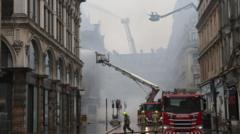
The headlines are screaming about a "fire near the station." They want you to believe that a blaze in a derelict building on Eglinton Street is an act of God that justifies paralyzing the economic heart of Scotland. It isn't. This isn't a story about a fire. It’s a story about the staggering fragility of a Victorian rail network managed by a risk-averse bureaucracy that views "safety" as a convenient shield against operational competence.
We have been conditioned to accept total systemic collapse every time a spark flies within a mile of a signal box. The "days of disruption" predicted for Glasgow Central aren't an inevitable consequence of heat or smoke. They are the result of a transportation philosophy that has no "fail-operational" mode.
The Myth of the Unavoidable Shutdown
When a fire breaks out near a major terminus, the standard operating procedure is to pull the plug. Stop the overhead lines. Lock the gates. Tell everyone to work from home. The public accepts this because they don’t see the underlying math.
Rail infrastructure in the UK is built on a "single point of failure" architecture. Unlike a modern data center or a distributed power grid, our rail system is incredibly brittle. A fire in a single building outside the station perimeter shouldn't be able to de-energize the entire West Coast Main Line's northern tip.
The industry calls it "caution." I call it a refusal to invest in localized isolation. If we had a modular power grid for the tracks, we could isolate the section directly adjacent to the fire and keep the other 80% of the station running. Instead, we treat the entire network like a string of old Christmas lights—one bulb pops, and the whole city goes dark.
The Cost of the "Safety First" Catchphrase
"Safety is our top priority" is the most expensive sentence in the English language. It’s the phrase used to shut down debate. But let’s look at the real data.
When you close Glasgow Central, you don’t remove risk. You redistribute it. You push thousands of people onto a motorway network (the M8) that is already over-capacity. You increase the density of commuters at smaller, ill-equipped stations like Paisley Gilmour Street or Shields Road. You force people into private vehicles, which, statistically, are far more dangerous than a train passing a controlled fire site at low speed.
By "saving" people from a localized fire that is already being handled by the Scottish Fire and Rescue Service, the rail authorities are actively creating a higher-risk environment elsewhere. It is a classic case of local optimization causing global failure.
The Ghost of Underinvestment
I have spent years looking at infrastructure logs. The reason a fire "near" a station causes "days" of disruption isn't the fire itself—it's the damage to the aging, sensitive signaling cables that haven't been shielded or buried deep enough.
Network Rail and its predecessors have spent decades patching up Victorian brickwork while the actual brains of the operation—the copper and fiber—sit in plastic troughs that melt if a cigarette is dropped nearby. If the infrastructure were resilient, a fire in an adjacent building would be a visual nuisance, not a catastrophic event.
We are paying for the sins of 1990s-era cost-cutting. Every time a station closes for three days because of an external event, it’s a confession that the network cannot handle the reality of an urban environment. Cities have fires. Buildings are old. If your railway can’t survive a neighboring fire, your railway isn't fit for purpose.
Why We Should Run the Trains Anyway
Imagine a scenario where we actually utilized the engineering talent we claim to have.
Modern rolling stock is built with fire-resistant materials. The tracks themselves are steel and stone. If the fire isn't on the tracks, the trains should be moving. Speed restrictions? Sure. Thermal monitoring? Absolutely. But a total blackout? That is the response of a management class that is terrified of a spreadsheet, not a flame.
The economic hit to Glasgow’s retail and service sector during these "disruption days" is measured in millions. Yet, that cost is never balanced against the "safety" decision. The decision-makers at ScotRail and Network Rail don't lose a penny when the station closes. The small business owner in the terminal does. The shift worker who loses four hours of pay does.
Stop Asking When It Opens and Start Asking Why It Closed
The "People Also Ask" sections on search engines are currently flooded with: "When will Glasgow Central reopen?"
That is the wrong question.
The question should be: "Why does my $200 season ticket not buy me a service that can bypass a single building fire?"
We have normalized incompetence. We see a picture of smoke and we nod obediently when the "Closed" sign goes up. We shouldn't. We should be demanding to see the contingency plans that were supposedly in place for exactly this scenario. If the contingency plan is "wait for the fire to go out and then spend 48 hours checking if a cable melted," then there is no plan. There is only a hope.
The Uncomfortable Truth About Risk
The truth is that running a railway in a 21st-century city requires a level of calculated risk that our current legal and corporate structures cannot stomach. It is easier to fail totally and blame "the fire" than it is to succeed partially and take responsibility for the nuance.
If we want a functional country, we have to stop letting minor external shocks dictate the flow of our lives. The closure of Glasgow Central isn't a tragedy of circumstances; it is a choice made by people who value their own lack of liability over your time, your money, and the city's vitality.
Fix the signaling. Shield the cables. Isolate the power. And for heaven's sake, keep the wheels turning.
Anything else is just an expensive excuse.
Stop accepting the "safety" narrative as an absolute truth. It's often just a lack of imagination wrapped in a high-vis vest.