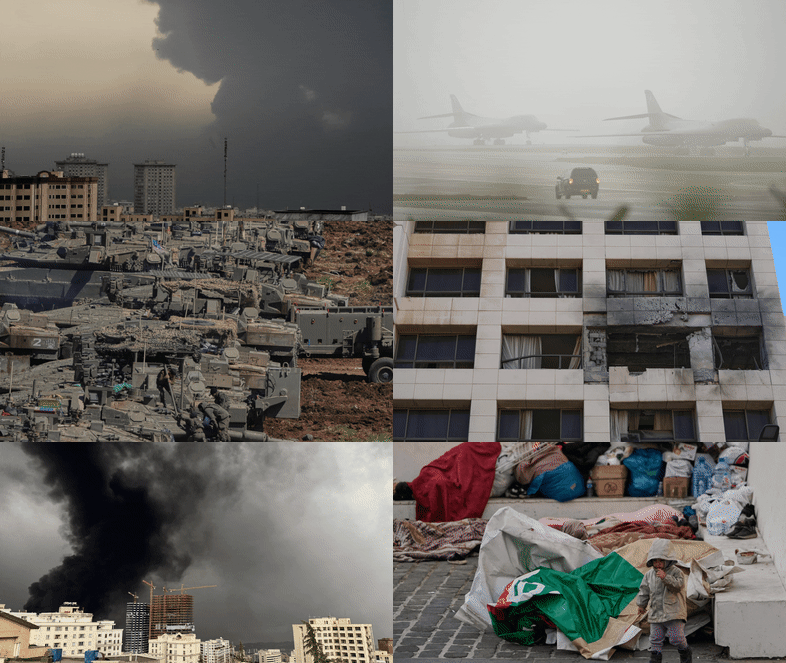
The outrage machine is predictable. A strike hits a school, the headlines scream about culpability, and politicians immediately retreat into their respective corners of denial or condemnation. When Donald Trump asserts that the United States "wasn't at fault" for a specific strike, the media response is a binary trap: you either believe he is shielding an ally or you believe he’s gaslighting the public.
Both sides are wrong.
The "fault" doesn't lie in a single command or a specific intelligence failure. It lies in the systemic obsolescence of our rules of engagement and the theater of modern precision warfare. We are obsessed with the smoking gun when we should be looking at the factory that built the gun, the software that aimed it, and the legal framework that justifies its pull.
The Myth of Clean Kinetic Warfare
The public has been sold a lie for thirty years: the myth of the "surgical strike." Since the first grainy footage of laser-guided bombs in the Gulf War, we’ve been conditioned to believe that war can be tidy. We talk about "precision-guided munitions" (PGMs) as if they are magic wands that only hit "bad guys."
They aren't.
The reality of kinetic warfare is that precision is a relative term. A $10,000$lb bomb delivered with a Circular Error Probable (CEP) of five meters is still a $10,000$lb bomb. If that bomb hits a command center located in a dense urban environment, physics dictates the outcome for the school next door. To argue about "fault" in this context is to ignore the fundamental nature of high-explosives.
I have seen intelligence analysts stare at satellite feeds for eighteen hours straight, trying to differentiate a rebel transport from a school bus. The margin for error isn't a "mistake"—it is a built-in feature of the system. When a leader says the U.S. isn't at fault, they are technically leaning on a chain of custody that spans five different countries and three different private contractors. By the time the trigger is pulled, "fault" has been diluted into a mist of bureaucratic deniability.
The Data Laundering Loophole
The competitor article focuses on the immediate political fallout. It misses the underlying mechanics of how these strikes happen. We are currently living through the "Laundering of Intent."
Here is how the cycle actually works:
- Shared Intelligence: The U.S. provides "situational awareness" to an ally.
- Autonomous Execution: The ally uses that data to program a strike.
- The Result: If it hits a high-value target, everyone takes credit. If it hits a school, the U.S. claims it only provided the "map," not the "destination."
This is the ultimate loophole. We provide the eyes, the ears, and the weapon, but we wash our hands of the finger on the trigger. To argue about whether the U.S. is "at fault" is to engage in a semantic debate that was settled in a boardroom years ago. The hardware is designed to shift liability as efficiently as it shifts shrapnel.
The Intelligence Trap: Why More Data Means More Death
The "People Also Ask" sections of the internet want to know: "How can we stop these mistakes?"
The uncomfortable answer: You can't.
We are currently suffering from an "information density paradox." We have more sensors, more drones, and more AI-driven signals intelligence than at any point in human history. Yet, this hasn't made warfare safer; it has only made it faster.
In the time it takes for a human to verify a target, the window of opportunity closes. To compensate, we rely on "pattern of life" algorithms. If a building shows a certain heat signature and a certain frequency of encrypted radio traffic, it gets flagged. If a school happens to be the location of a rogue signal, the algorithm doesn't care about the chalkboard inside.
When Trump or any other leader says we aren't at fault, they are essentially saying the algorithm followed the rules. And they are right. The rules are the problem.
The Economic Reality of "Accidents"
Let’s talk about the money. We don’t talk about the money enough because it feels "tasteless."
War is a commercial enterprise. Every strike is a data point for a defense contractor. If a PGM fails to hit its mark, that’s a bug report. If it hits its mark but causes "collateral damage," that’s a PR problem, not a technical one.
The U.S. defense industry relies on "battle-proven" tags to sell hardware to the rest of the world. Admitting fault in a school strike isn't just a political headache; it's a hit to the export value of the weapon system. We are incentivized to maintain a "no-fault" stance to protect the integrity of the product.
Stop Asking Who is to Blame
The media wants you to pick a side. They want you to be a "patriot" who defends the military’s honor or a "humanitarian" who decries the loss of life. Both positions are lazy.
The real question isn't "Who is at fault?" The real question is "Why do we still believe in the illusion of the clean war?"
We have created a world where war is mediated by screens and software, specifically designed to insulate the decision-makers from the consequences. When a school is hit, the system hasn't broken; it has functioned exactly as designed. It processed the data, calculated the risk-to-reward ratio, and delivered the payload.
If you want to dismantle the cycle, stop looking for a villain in a suit and start looking at the code. Stop demanding apologies and start demanding an end to the "data sharing" agreements that allow for plausible deniability.
The school strike wasn't a glitch. It was a calculation. And until we admit that our "precision" is just a marketing term for "acceptable loss," we are all complicit in the silence.
The next time a politician tells you the U.S. isn't at fault, believe them. They aren't at fault because the concept of "fault" has been engineered out of the modern war machine.
Accept the brutality of the system or stop funding it. There is no third option.