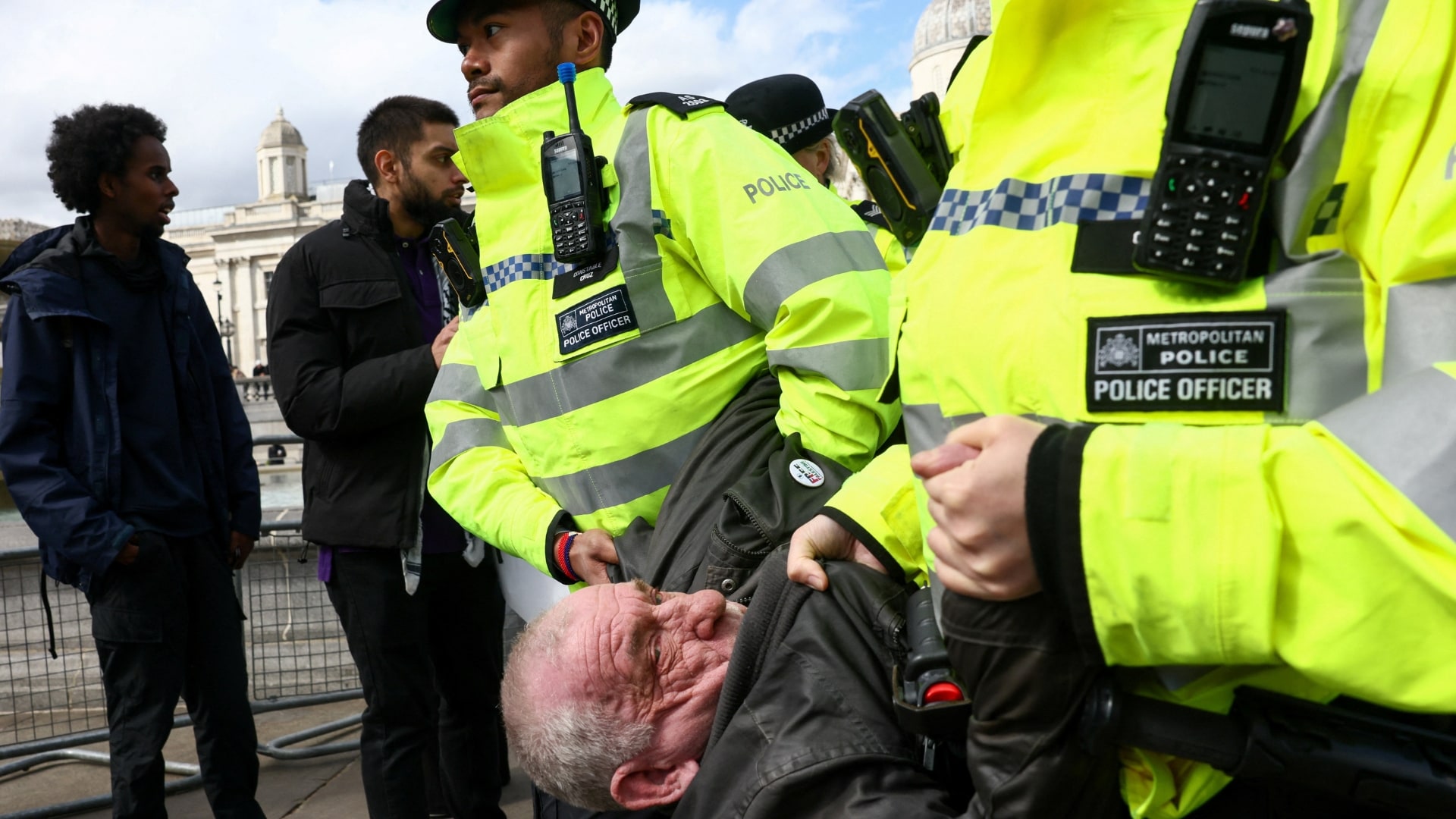
The air in London during a mass arrest doesn't smell like revolution. It smells like exhaust fumes, cheap coffee, and the metallic tang of hundreds of pairs of handcuffs clicking shut in rapid succession. On a Tuesday that should have belonged to the mundane rhythms of commuters and tourists, the city instead became a theater of friction. 523 people. It is a number that sits heavy on a spreadsheet, but on the pavement, it looks like a sea of zip-ties and neon vests.
For years, Palestine Action has operated on the fringes of the visible. They are the ones who scale factory roofs and drench walls in red paint, targeting the supply chains of arms manufacturers. They view themselves as the physical manifestation of a moral conscience. The state, however, sees them as a persistent puncture in the tire of public order. When the government moved to ban the group, the friction reached a flashpoint.
The sidewalk was a mosaic of boots. There was a young woman, perhaps twenty, her face pressed against the cold stone of a building on Whitehall. She wasn't shouting anymore. She was just breathing, her ribs expanding against the fabric of a worn denim jacket as a police officer tightened the plastic restraint around her wrists. To the Home Office, she is a statistic in a crackdown. To her mother, she is a daughter who skipped dinner to stand in the rain for a cause that feels more real than her degree.
The ban changed the math of dissent. Usually, a protest is a negotiation—a permitted route, a designated shouting zone, a polite agreement to be ignored. But when an organization is proscribed, the act of standing still becomes a criminal offense. The 523 individuals taken into custody weren't just protesting a policy; they were testing the new boundaries of what it means to belong to a "forbidden" idea.
Consider the logistics of silencing five hundred people in a single afternoon. It requires a massive redirection of human energy. Vans lined up like a funeral procession, engines idling, burning fuel while the city’s heart beat in a jagged, irregular rhythm. The police aren't villains in this story, nor are they heroes. They are the middle managers of a systemic collision. They are tired men and women with aching lower backs, processing paperwork for people they will forget by sunrise.
The "Action" in the group's name is what drew the ban. The government argued that the group’s tactics—sabotage, occupation, and the destruction of property—moved them out of the realm of political expression and into the territory of organized crime. But the fallout of that decision is rarely confined to the "criminals." It bleeds into the broader civic space. When the net is cast this wide, it catches everyone: the hardcore activists, the curious students, and the elderly man who just wanted to hold a sign because he remembers what the world looked like forty years ago.
The numbers are staggering when you break them down. 523 arrests. If each person spends only twelve hours in a cell, that is over six thousand hours of human life suspended in a gray room. It is thousands of phone calls to worried partners. It is hundreds of missed shifts at work and forgotten grocery lists. This is the invisible tax of the ban. We talk about the law in hushed, majestic tones, but the law is actually a series of small, inconvenient rooms and the sound of heavy doors locking.
Why does it matter? It matters because the distance between a "protest" and a "riot" is often defined by the person holding the gavel. By banning Palestine Action, the state didn't just stop people from climbing on roofs; it redefined the threshold of participation. It signaled that certain grievances are now too volatile to be voiced in the street.
The tension in London wasn't just about a specific conflict in a distant land. It was about the architecture of British democracy. If you remove the safety valve of visible, even disruptive, protest, the pressure doesn't simply vanish. It moves underground. It hardens.
As the sun began to dip behind the brutalist shadows of the city, the crowds thinned, but the silence that followed wasn't peaceful. It was a vacuum. The 523 were gone, ferried away to various stations across the capital, leaving behind nothing but dropped flyers and the occasional discarded glove.
The streets were wiped clean, yet the air remained thick with the unspoken question of what comes after the ban. When the law becomes a wall instead of a bridge, people don't stop walking. They just start looking for ways to go through the stone.
The city went back to its coffee and its commutes, but the memory of the clicking handcuffs lingered like a ringing in the ears after a loud noise. 523 lives shifted in a single afternoon. The buildings remained standing, the factories continued their work, and the red paint was eventually scrubbed from the walls. But the pavement remembers the weight of the bodies, and the law remembers how easy it was to clear the square.
The silence wasn't an end. It was a breath held too long.