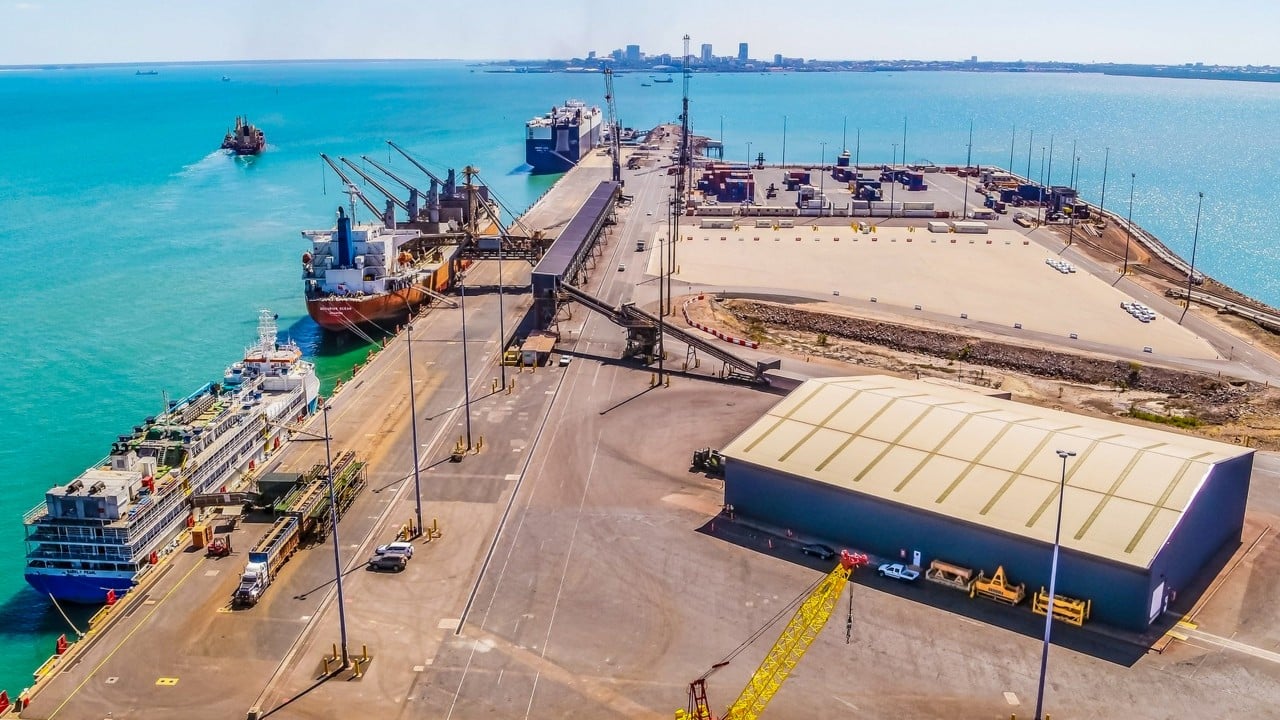
The lease of the Port of Darwin to Landbridge Group represents a critical failure in pricing the "sovereignty premium"—the cost associated with foreign control over dual-use infrastructure. While contemporary discourse frames the potential renewal or retention of this lease as a diplomatic olive branch between Beijing and Canberra, a cold-eyed analysis reveals that the port is no longer a simple commercial asset. It has become a variable in a high-stakes geopolitical optimization problem. To understand why China is fighting to keep the port, one must look past the surface-level trade statistics and examine the intersection of maritime logistics, intelligence gathering, and regional power projection.
The Tri-Lens Framework of Port Valuation
Conventional analysis often focuses on the $506 million price tag of the 99-year lease signed in 2015. This is a rudimentary metric. To accurately value the Port of Darwin in the current Indo-Pacific climate, we must apply three distinct lenses:
- The Logistics Throughput Lens: Darwin serves as the northern gateway for Australian commodities and a key node in the North-South corridor. Its value here is purely economic, measured in TEUs (Twenty-foot Equivalent Units) and bulk tonnage.
- The Intelligence-SIGINT Lens: Proximity to the Robertson Barracks and the Larrakeyah Defence Base grants the leaseholder a physical vantage point over Australian and U.S. military movements. Physical access to the harbor floor and telecommunications landing points offers opportunities for passive data collection that cannot be replicated from space.
- The Denied Access Lens: In a friction scenario, control over a primary deep-water port allows a foreign entity to complicate troop deployments, delay maintenance of allied vessels, and create "gray zone" administrative hurdles that degrade military readiness without triggering an overt act of war.
The Mechanics of Strategic Entrenchment
Landbridge Group’s presence in Darwin is not merely a commercial venture; it is a textbook example of "Strategic Entrenchment." By integrating into the local economy and becoming a primary employer and infrastructure provider, a foreign entity creates a high exit cost for the host government. The Australian government faces a binary choice with massive externalities:
- Forced Divestment: Triggering the "security" clauses to terminate the lease. This risks a massive retaliatory trade response from China, potentially dwarfing the $20 billion in sanctions previously seen on wine, barley, and coal.
- Managed Status Quo: Allowing the lease to continue while imposing draconian monitoring. This incurs a permanent "surveillance tax" on the Australian Defence Force (ADF), which must then assume that all non-encrypted communications and movements within the port precinct are compromised.
The friction in the Sino-Australian relationship stems from the fact that Australia’s security requirements are now fundamentally at odds with its historical trade-led growth model.
Quantification of the Sovereignty Premium
When the lease was signed, the sovereignty premium was calculated at near zero. The prevailing logic assumed that globalization had decoupled commercial infrastructure from national security concerns. We now know this was a miscalculation. The true cost of the Darwin lease must account for the following variables:
- The Hardened Infrastructure Offset: The cost of building redundant military-grade berthing facilities elsewhere because the primary port is deemed insecure for sensitive U.S. Navy assets.
- Diplomatic Elasticity: The degree to which Australia can align with AUKUS objectives without Landbridge-related friction serving as a catalyst for economic punishment.
- Counter-Intelligence Overheads: The specific budgetary allocation required for ASIO and the ADF to monitor port activity 24/7.
If these costs are annualized over the remaining 90 years of the lease, the "cheap" $506 million entry price becomes one of the most expensive infrastructure errors in Australian history.
The Belt and Road Narrative Architecture
Beijing’s desire to retain Darwin is partly driven by the need to protect the integrity of the Belt and Road Initiative (BRI). Darwin is a crucial southern anchor. If Australia successfully clawed back the port on national security grounds, it would create a global precedent.
Other nations—particularly those in Southeast Asia and the Pacific Islands—would have a logical and legal template for nationalizing or reclaiming BRI-funded infrastructure. For China, Darwin is the "Maginot Line" of maritime investment. If it falls to Western security pressures, the perceived risk of every other Chinese-operated port (from Hambantota to Piraeus) increases overnight.
Operational Limitations of Joint Use
The "Joint Use" model currently employed at Darwin—where commercial and military traffic share the same waters—is reaching its logical limit. As Australia integrates more advanced U.S. technology, such as the Virginia-class nuclear-powered submarines under AUKUS, the presence of a Chinese-owned operator in the same harbor becomes an operational impossibility.
Security protocols for nuclear-powered vessels require a "Sterile Zone" that extends beyond the physical pier. Managing this within a port where the landlord is a foreign-affiliated entity creates a constant risk of accidental or intentional intelligence leaks. The ADF is forced to operate under a "Contaminated Environment" protocol, which slows down every aspect of maritime logistics.
The Displacement Effect and Alternative Hubs
There is a growing realization that Darwin cannot be "fixed" while the lease remains in its current form. This has led to the exploration of the "Displacement Effect"—shifting high-value strategic activity away from the Darwin inner harbor to underdeveloped sites like Glyde Point.
However, building a new deep-water port is a multi-decade, multi-billion dollar undertaking. It also fails to solve the immediate problem: Landbridge remains in control of the existing, optimized infrastructure. This creates a "dual-hub" inefficiency where the government pays for new infrastructure while the old infrastructure continues to serve as a platform for foreign influence.
Economic Leverage vs. Strategic Autonomy
The argument that keeping the port "helps fragile relations" is a misinterpretation of leverage. In geopolitical negotiations, an asset is only a bargaining chip if both sides are willing to trade it. China has shown no inclination to trade the port for trade concessions; rather, it views the port as a permanent strategic gain.
Australia’s attempt to "stabilize" the relationship while the Darwin issue remains unresolved is an exercise in managing symptoms rather than the underlying pathology. The pathology is a structural mismatch between Australia's economic geography (tied to Asia) and its security architecture (tied to the United States).
The Risk of Nationalization Precedent
If Canberra moves to terminate the lease, it must navigate the "Investor-State Dispute Settlement" (ISDS) frameworks. A messy legal battle in international courts would signal to global investors that Australian infrastructure is subject to political whims.
To mitigate this, the government must codify a "Strategic Infrastructure Exception" that clearly defines which assets are subject to retroactive security reviews. Without this, the cost of capital for all foreign investment in Australia will rise, as investors bake in a "sovereignty risk" premium.
The Tactical Playbook for 2024-2030
The Australian government cannot simply wait for the lease to expire in 2114. The strategic environment is moving too fast. The most viable path forward involves a "Shadow Nationalization" strategy.
- Mandated Transparency Layers: Implementing a new regulatory layer that requires the port operator to provide real-time, un-mirrored access to all digital port management systems to the Australian Signals Directorate (ASD).
- Structural Carve-outs: Legally excising specific wharves and seabed areas from the lease for exclusive ADF/U.S. Navy use, effectively turning the port into a Swiss-cheese map of jurisdictions.
- The Buy-back Trap: Engaging a consortium of Australian superannuation funds to offer a "market rate" buyout. If Landbridge refuses a fair market offer, it confirms that the port's value to them is strategic/military rather than commercial, providing the Australian government with the political cover needed for a forced divestment on security grounds.
The Port of Darwin is no longer a gateway for trade; it is a sensor on the edge of a continent. Treating it as a mere commercial lease is a category error that Australia can no longer afford to make. The only logical endgame is the restoration of total sovereign control, regardless of the short-term diplomatic turbulence it may cause. Any other path is a managed decline of strategic autonomy in the Indo-Pacific.