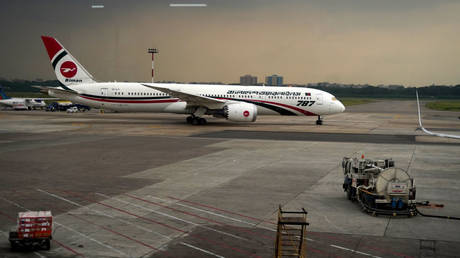
The Bangladesh Petroleum Corporation just handed the domestic aviation industry a death sentence. By hiking jet fuel prices by 80 percent in a single sweep, the state-run monopoly has effectively grounded the ambitions of every private carrier in the country. This isn't just a price adjustment. It is a tectonic shift that will force airlines to choose between insolvency or passing astronomical costs onto a middle class that is already buckling under record-high inflation. Within weeks, a one-way ticket from Dhaka to Chittagong will likely cost more than a flight to Kolkata or Bangkok, turning air travel into an exclusive luxury for the elite and the aid-worker class.
For decades, the aviation sector in Bangladesh has been treated as a piggy bank for the national exchequer rather than a strategic pillar of the economy. This latest move by the BPC, which manages the procurement and distribution of petroleum products through its subsidiary Padma Oil, follows a pattern of erratic pricing that bears little resemblance to global benchmarks. While international oil prices have fluctuated within a manageable band, the domestic hike suggests a desperate attempt to bridge a massive fiscal deficit at the expense of private enterprise.
The Monopoly Tax on Skyward Ambition
The math is brutal. Fuel accounts for nearly 40 to 45 percent of an airline's operating costs. When that single line item nearly doubles overnight, the shock ripples through every part of the business. Private carriers like US-Bangla and Air Astra are now operating in a reality where their profit margins have not just vanished—they have turned into a gaping void of red ink.
Unlike Biman Bangladesh Airlines, the state-owned national carrier that frequently benefits from government bailouts and preferential treatment, private players have no safety net. They are competing in a rigged game. When the BPC raises prices, Biman can often absorb the blow through "government-to-government" arrangements or direct subsidies. The private sector, meanwhile, is left to wither.
The core of the problem lies in the BPC's pricing formula. It is an opaque system. Industry insiders have long complained that the BPC benchmarks its prices against the high-end retail market rather than the bulk international rates that airlines in Singapore or Dubai enjoy. By the time the fuel reaches the wing of a Boeing 737 at Hazrat Shahjalal International Airport, it has been taxed, surcharged, and marked up to a level that makes Dhaka one of the most expensive refueling stops in Asia.
Why the BPC is Bleeding the Industry Dry
Why now? The answer is hidden in the country’s precarious foreign exchange reserves. For the past two years, the government has struggled to secure enough US dollars to pay for essential imports, including fuel. By hiking the price by 80 percent, the BPC isn't just trying to cover its costs; it is trying to suppress demand and recoup losses from years of mismanagement.
There is also the issue of the Eastern Refinery Limited, the country's only aging refinery. It lacks the capacity to meet modern aviation demands, forcing the government to import refined Jet A-1 fuel at a premium. Instead of investing in infrastructure to lower long-term costs, the state has chosen the path of least resistance: squeezing the end-user.
The Flight of Capital and Planes
We are about to witness a mass exodus. Regional connectivity, a primary goal of the "Smart Bangladesh" vision, is the first casualty. Smaller domestic routes like Dhaka-Barisal or Dhaka-Rajshahi were already struggling with low load factors. With ticket prices set to skyrocket, these routes will become ghost runs.
Airlines cannot simply park their planes and wait for the storm to pass. Leasing costs, maintenance cycles, and pilot salaries continue regardless of whether a plane is in the air. If the government does not introduce a sliding-scale subsidy or a dual-pricing tier for domestic carriers, we will see a repeat of the United Airways or Regent Airways collapses. These were not just failed businesses; they were warnings that the Bangladeshi market is allergic to high operating costs.
The International Fallout
It isn't just domestic travel that will suffer. International carriers look at fuel prices as a primary metric for route profitability. If Dhaka becomes a "fuel-expensive" hub, foreign airlines will simply carry enough fuel from their home bases to avoid refueling in Bangladesh—a practice known as "tankering."
Tankering is a nightmare for the local economy. It means the BPC loses the volume of sales it needs to sustain its operations, and the airport loses out on handling fees. Furthermore, when planes fly with excess fuel to avoid local prices, they are heavier, burn more carbon, and increase the wear and tear on the runways. It is an environmental and economic lose-lose situation born entirely out of short-sighted fiscal policy.
The Hidden Cost of the Grounded Fleet
When an airline fails in Bangladesh, it isn't just the shareholders who lose. It is the thousands of ground staff, engineers, and cabin crew who find themselves unemployed in a stagnant job market. It is the tourism industry in Cox’s Bazar that sees its hotel rooms sit empty because the cost of a flight from the capital has doubled.
The multiplier effect of aviation is well-documented. For every job created in the cockpit, six more are created in the wider economy. By crippling the airlines, the BPC is inadvertently sabotaging the hospitality, logistics, and export sectors. If a garments buyer from Europe cannot easily fly to a factory in Chittagong because of reduced flight frequencies or exorbitant costs, they will take their business to Vietnam or Cambodia.
A Broken Mechanism for a Modern Economy
The solution is not a mystery, but it requires political courage. First, the BPC must lose its monopoly on jet fuel distribution. Allowing private players to import and store their own fuel would introduce competition and drive prices down to parity with regional hubs like Bangkok or Colombo.
Second, the government must decouple the price of jet fuel from the need to plug general budget holes. Jet fuel should be viewed as a raw material for an essential service, not a sin tax item. A transparent, automated pricing formula—one that tracks the S&P Global Platts index without the arbitrary "administrative" markups—would allow airlines to hedge their risks and plan for the long term.
Without these changes, the 80 percent hike is merely the first act in a tragedy. The private aviation sector in Bangladesh has proven it can be resilient, but no business can survive a sudden doubling of its primary expense. The engines are sputtering, and the runway is running out.
Contact your local representative or the Ministry of Civil Aviation to demand a transparent review of the BPC’s pricing structure before the domestic fleet is permanently grounded.