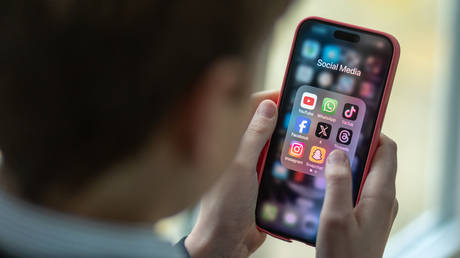
The blue light doesn’t just illuminate a bedroom at 2:00 AM; it rewires the silence. For a fourteen-year-old in a London suburb, that glow is the only bridge to a social world that never pauses for breath. If she puts the phone down, the conversation moves on without her. If she sleeps, she wakes up to a hundred micro-dramas she no longer has the context to understand. This is the "infinite scroll" of anxiety, a loop that has no natural exit ramp.
Britain has decided to build one.
The UK government is currently moving beyond the stage of polite recommendations. They are trialing something far more aggressive: statutory "digital curfews," mandatory time limits, and outright social media bans for children under certain age thresholds. It isn't just a policy tweak. It is an admission of a systemic failure. For a decade, we treated the internet like a library. We are finally realizing it’s more like a casino, and the kids are playing with a currency they can't afford to lose—their own neurochemistry.
The Ghost in the Classroom
Consider a student named Leo. Leo is hypothetical, but his symptoms are documented in every state school from Cornwall to Cumbria. Leo hasn't slept more than five hours a night since he turned twelve. His pre-frontal cortex, the part of the brain responsible for impulse control and long-term planning, is essentially being outmuscled by a multi-billion dollar algorithm designed to keep him clicking.
When the British government talks about "time limits," they aren't just being Victorian nannies. They are looking at the data of a generation that is physically present but mentally frayed. The pilot programs involve software-level integration that would effectively "black out" social media apps after 9:00 PM for users registered as minors.
The science is brutal. The blue light emitted by these devices suppresses melatonin, the hormone that tells our bodies it’s time to rest. When a government mandates a curfew, they are attempting to manually reset the biological clocks of millions of teenagers. It is a massive, nationwide experiment in forced collective rest.
The Architecture of Addiction
Why can’t Leo just put the phone down?
Because the apps are built to ensure he doesn't. Features like "streaks" on Snapchat or the "For You" page on TikTok utilize variable ratio reinforcement. It’s the same psychological trick used by slot machines. You don't know when the next "win" (a like, a comment, a funny video) is coming, so you keep pulling the lever.
The UK’s proposed bans for younger children—those under 13 or even 16 in some debated models—aim to delay this exposure until the brain is better equipped to handle the dopamine spikes. Critics argue this is an infringement on liberty. Supporters point to the rising rates of self-harm and clinical depression that track almost perfectly with the rise of the smartphone.
There is a visceral fear in the voices of parents who feel they have lost their children to a glass screen. They describe "digital zombies" who flare into sudden, uncharacteristic rage when the Wi-Fi is cut. This isn't a lack of discipline. It’s a withdrawal symptom.
Beyond the Screen
The curfew is only the beginning. The British pilot programs are also exploring "walled gardens"—social platforms designed specifically for minors that lack the toxic "beauty filters" and public-facing "like" counts that fuel body dysmorphia.
Imagine a version of the internet where your worth isn't quantified by a number under your photo.
This brings us to the hardest truth of the matter. If the government bans social media for kids at night, what fills the void? For years, the screen has been the babysitter, the entertainer, and the social club. Taking it away exposes the architectural loneliness of modern life. If we turn off the digital world, we have to make sure there is a physical world worth returning to.
Local councils involved in these trials are being pushed to reinvest in "third spaces"—youth clubs, late-night libraries, and sports centers. A ban without an alternative is just a vacuum. And vacuums always find a way to get filled, usually by something worse.
The Enforcement Paradox
How do you actually stop a tech-savvy thirteen-year-old from bypassing a ban?
The technical hurdles are immense. VPNs, fake birthdays, and secondary "burner" accounts are standard tools in a teenager's arsenal. The British government is leaning on "Age Verification" technology, which might include facial recognition or credit card checks.
This introduces a new, darker anxiety. To protect children from social media, are we handing their biometric data over to the very companies we don't trust? It’s a messy, uncomfortable trade-off. We are choosing between the privacy of the individual and the mental health of the collective.
The trials are proving that there is no "clean" solution. Every restriction creates a new friction. Yet, the consensus among UK policymakers is shifting toward the idea that some friction is better than the current free-fall.
The Sound of the Switch
There is a specific sound when a house goes quiet. Not the quiet of everyone being on their phones, which is a heavy, buzzing sort of silence. But the real quiet of a house where the devices are docked in the kitchen, and the bedrooms are actually for sleeping.
In the pilot areas where these curfews have been encouraged through local school-parent compacts, the initial reports are surprising. The kids are angry at first. They storm off. They sulk. But then, after a week or two, something shifts. They start reading books again. They talk to their siblings. They sleep until the sun comes up.
The stakes aren't just about "screen time." That’s a sterile, clinical phrase. The stakes are about the sovereignty of the human mind. We are watching a nation try to claw back the attention of its youth from the grip of an industry that treats attention as a commodity to be mined and sold.
Britain is essentially asking a radical question: Does a child have the right to be unreachable?
In an age of total connectivity, the most precious thing we can give a teenager is the permission to disappear. To be alone with their own thoughts without the weight of a thousand digital eyes watching them. The curfews and bans are a blunt instrument, yes. They are clumsy and difficult to police. But they represent a line in the sand.
As the sun sets over the Thames, and millions of screens across the Isles begin to dim under the weight of new laws, we are seeing the first tentative steps toward a different kind of future. It is a future where the day has an end, where the light has a limit, and where a child can finally close their eyes without wondering what they are missing.
The notifications can wait. The world, for the first time in a long time, is allowed to go dark.