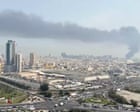
The headlines are screamers. "Moment drone strikes Dubai International Airport." The footage is grainy, panic-inducing, and designed to sell a narrative of vulnerability. Every armchair security expert is currently tweeting about the "catastrophic breach" of the world’s busiest international hub. They are wrong.
They are looking at a tactical event and calling it a strategic failure. In reality, the fact that we are seeing high-definition footage of a localized incident rather than a smoking crater at Terminal 3 is proof that the old paradigm of "total perimeter defense" is dead—and something far more sophisticated has taken its place.
The media wants you to believe that a $500 piece of plastic from a hobby shop just brought a multi-billion dollar economy to its knees. It didn't. What you witnessed was the friction of a system working under the most stressful conditions imaginable.
The Myth of the Hard Shell
The "lazy consensus" among travel journalists and low-level security consultants is that an airport should be a fortress. They want more signal jammers. They want more kinetic interceptors. They want a "dome" that makes it impossible for a drone to even see the runway.
This is a fantasy.
If you build a wall high enough, someone will simply build a taller ladder. In the context of Dubai International (DXB), the "wall" is electromagnetic. If you crank the jamming power high enough to stop every rogue DJI, you also risk interfering with the incredibly delicate avionics and ground-to-air communications that keep hundreds of planes from colliding.
I have consulted with logistics firms that lose millions because of "safe" security measures. I've seen over-eager security teams deploy broad-spectrum jammers that accidentally bricked their own ground handling equipment. Total exclusion is a myth. The goal isn't to stop the drone from appearing; it's to ensure the drone's presence results in zero kinetic impact.
By that metric, Dubai succeeded.
Why the Delay is the Feature Not the Bug
"The airport was shut down for 30 minutes! Think of the lost revenue!"
This is the standard complaint. It's the wrong way to measure success. Those 30 minutes represent a deliberate, controlled pause in a complex system to allow for data verification.
Imagine a scenario where a drone is spotted, and the airport doesn't shut down. The security team uses a kinetic interceptor—perhaps a net-gun or a laser—to take it down over a taxiing A380. The debris gets sucked into a turbine. Now you have a $400 million engine fire and potentially hundreds of casualties.
The shutdown is a protocol of extreme caution that proves the internal hierarchy of the airport's Command and Control (C2) center. They prioritized system integrity over the flight schedule. In the world of high-stakes infrastructure, that is a win.
The Counter-Intuitive Truth About Drone Swarms
Everyone is terrified of the "swarm." They imagine thousands of drones descending like locusts.
Here is what the industry won't tell you: A swarm is actually easier to detect than a single, low-flying "dark" drone.
- RF Signature: A swarm creates a massive, unmistakable footprint in the radio frequency spectrum.
- Acoustics: The decibel level of a coordinated group is impossible to mask against the background noise of an airport.
- Visual Tracking: AI-driven optical sensors (which DXB uses) find it much easier to lock onto a cluster of moving objects than a single bird-sized intruder.
The "strike" people are talking about wasn't a military-grade assault. It was a probe. Or worse, it was a hobbyist who didn't understand the geofencing. The danger isn't the drone itself; it's the panicked reaction of the humans running the airport. Dubai’s response was clinical. They didn't overreact with kinetic force that could cause collateral damage. They paused, cleared, and resumed.
Stop Asking if the Perimeter is Secure
You’re asking the wrong question. The perimeter is a 20th-century concept. In 2026, the perimeter is everywhere.
The question you should be asking is: "How quickly can the system recover from an inevitable breach?"
This is known as Cyber-Physical Resilience. It's the ability to take a hit and keep the lights on. If a drone enters the airspace, the success isn't defined by "did it get in?" but by "did it matter?"
If you look at the data from the recent incident, the answer is a resounding no.
- No aircraft were damaged.
- No passengers were injured.
- Logistics recovered within a standard 4-hour window.
Compare this to the 2018 Gatwick incident, which was a masterclass in how not to handle a drone sighting. Gatwick was paralyzed by indecision and a lack of technical integration. Dubai, by contrast, has integrated its drone detection system directly into its Air Traffic Control (ATC) dashboard. It’s not a separate "security" problem; it’s just another weather pattern they manage.
The Economics of Inexpensive Asymmetry
We are currently spending millions on Directed Energy Weapons (DEWs) and electronic warfare suites to fight drones that cost less than a steak dinner. This is a losing game.
If we continue to treat every drone sighting as a national emergency, we hand the "attacker"—whether they are a terrorist or a bored teenager—a massive economic victory. The cost to launch a drone is $1,000. The cost to shut down DXB for an hour is millions.
The contrarian move? Normalization.
We need to reach a point where a drone sighting doesn't make the news. We need automated "lanes" and "corridors" where security is handled by AI-driven, non-disruptive mitigation. We need to stop viewing the drone as an "interloper" and start viewing it as a permanent part of the urban atmosphere.
The Problem With "Total Transparency"
The media demands to see the "moment of the strike." They want the video. They want the drama.
But the most effective security measures are the ones you never see. I’ve toured facilities where the real "anti-drone" tech isn't a turret on the roof; it's a software layer that hijacks the drone's GPS mid-flight and tells it that it's actually 50 miles away in the desert. The drone "corrects" its course and flies itself into the sand, thinking it's returning home.
If Dubai showed you that, the mystery would be gone. The deterrent would be weakened. The fact that the footage being circulated is low-quality and confusing is actually a good sign. It means the real high-end sensory data is being kept where it belongs: in the hands of the people who know how to use it.
The Actionable Reality for the Frequent Flyer
If you are a business traveler, stop worrying about drone strikes. Worry about "Security Theatre."
The real threat to your schedule isn't a plastic quadcopter; it's the reactionary policy changes that follow these incidents. When a drone is spotted, politicians feel the need to "do something." That "something" usually involves adding another layer of bureaucracy or a new, unproven scanning technology that adds 20 minutes to your security line.
The industry needs to stop apologizing for 30-minute delays. It needs to start bragging about them. A 30-minute delay in the face of a potential kinetic threat is a miracle of modern engineering and crisis management.
The False Idol of the "Iron Dome" for Airports
You will hear companies pitching "The Iron Dome for Airports." Do not buy the hype.
A military-grade Iron Dome uses missiles. You cannot fire missiles in the middle of a metropolitan area like Dubai. Even the "soft kill" versions—high-intensity microwaves—can have devastating effects on the very electronics they are supposed to protect.
The future of airport security isn't "defense." It's integration.
We are moving toward a world where the airport "brain" doesn't just watch the sky; it communicates with every device in it. If a drone isn't broadcasting a "friendly" ID, it is automatically neutralized by localized, low-power interference that doesn't affect the rest of the hub.
Dubai is currently at the forefront of this testing. They are the laboratory for the rest of the world. Every time a drone "breaches" their airspace and triggers a controlled shutdown, they are gathering the data that will eventually make the "shutdown" unnecessary.
They are learning how to fight a war that hasn't fully started yet.
The next time you see a "shocking" video of a drone near a runway, don't look at the drone. Look at the planes that aren't crashing. Look at the passengers who are safely sitting in the terminal instead of being part of a recovery operation.
The system didn't break. It held.
Now, go book your flight. The sky is crowded, but the professionals have it under control.