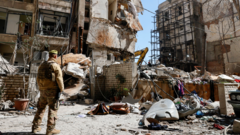
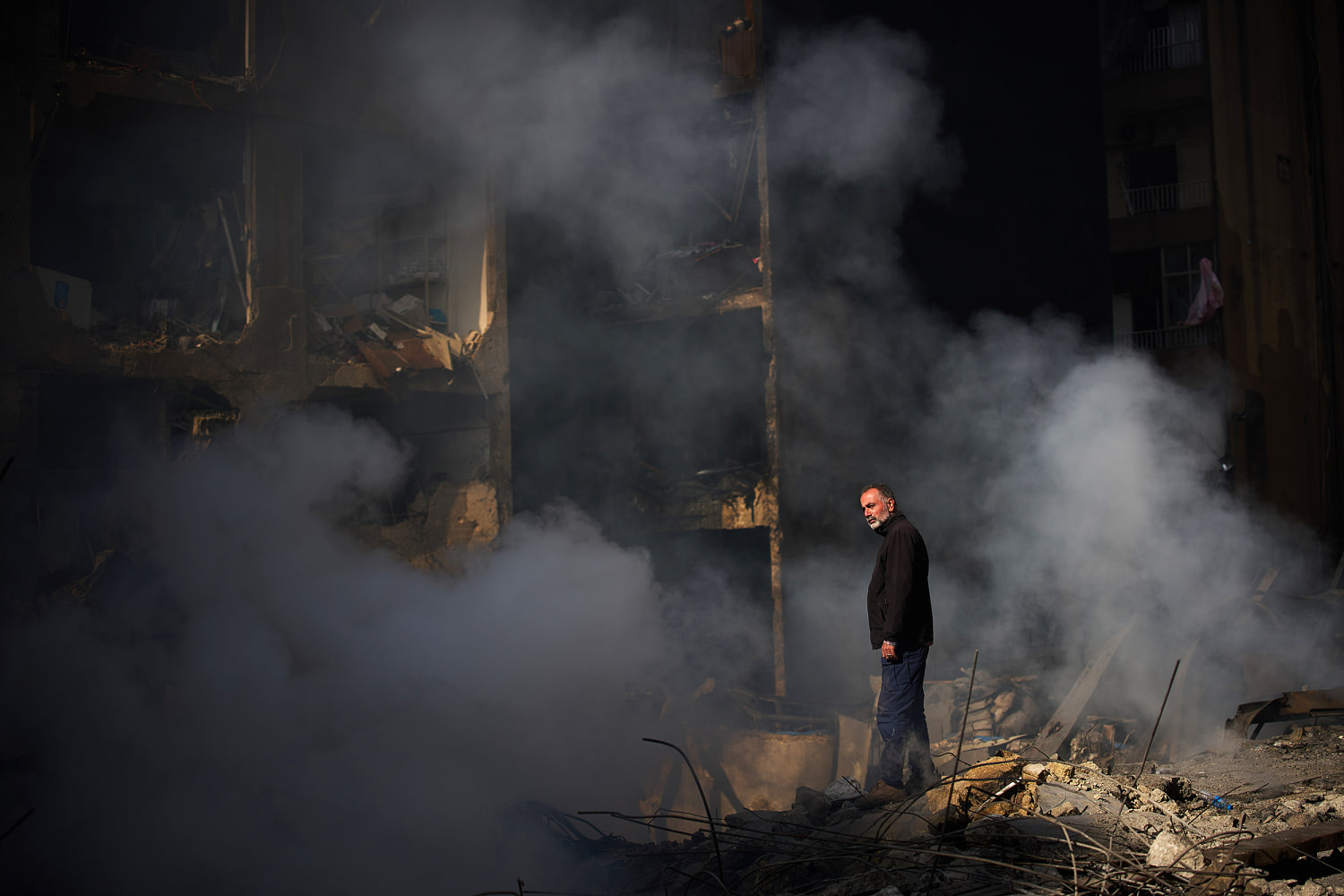
The silence in Beirut is never truly silent. It is a thick, artificial quiet, the kind that follows a sound so loud it resets the human ear. It is the sound of a city holding its breath, waiting for the dust to decide where it wants to land. When the Israeli barrage hits, the earth doesn't just shake; it ripples. Concrete, once the sturdy skeleton of a family’s life, turns into a fine, grey powder that coats the throat and stings the eyes.
Amine stands on the corner of a street that, ten minutes ago, had a bakery. Now, there is only a gap. A jagged, smoking tooth pulled from the jaw of the neighborhood. He isn't looking for the bread he came to buy. He is looking for the baker’s son, a boy who liked to mimic the way Amine walked.
He is looking for a ghost.
The Weight of a Falling Sky
War is often described in the cold language of ballistics and casualty counts. We hear about "precision strikes" and "missile yields," terms designed to make the chaotic destruction of a human life feel like a calculated math problem. But math doesn't account for the smell. It doesn't tell you about the scent of pulverized limestone mixed with scorched electrical wiring and the metallic tang of blood.
When a building collapses under the weight of modern ordnance, it doesn't just fall down. It implodes. It pancakes. Every floor crushes the one beneath it until the history of three generations is compressed into a pile of rubble no higher than a garden wall. In the aftermath of the recent strikes across Lebanon, the search for the missing has become a frantic, manual labor of love and despair.
Think of it as a race against the air. Underneath those slabs of grey stone, pockets of oxygen are shrinking. For those trapped, the world has narrowed to the size of their own chest. Every breath is a negotiation with the debris. Above them, volunteers and neighbors claw at the earth with broken fingernails because the heavy machinery cannot reach the narrow alleyways, or because the fuel to run the excavators has long since run dry.
The stakes are invisible until they are agonizingly loud. A muffled shout from beneath a beam. A scratch against a pipe. These are the sounds that keep men like Amine digging until their hands bleed.
The Geography of Loss
The geography of Lebanon is being rewritten by fire. From the southern border villages to the dense, pulsing arteries of Beirut’s suburbs, the map is being dotted with "impact zones." But to the people living there, these aren't zones. They are kitchens. They are bedrooms where children were doing homework. They are the small, mundane stages where life was supposed to happen.
Consider the logistics of a single strike. One missile can displace five hundred people in three seconds. Those who survive are suddenly thrust into a nomadic existence, carrying their lives in plastic bags. They move from the south toward the north, seeking a safety that feels increasingly like a myth.
The roads are clogged with cars carrying mattresses strapped to the roofs—the universal flag of the refugee. These mattresses are a bitter irony; they represent the comfort of a home that no longer exists, carried into a future where there is nowhere to sleep.
The international community watches through the lens of a drone, seeing the heat signatures and the grey plumes of smoke. But the view from the ground is different. It is a view of a woman sitting on a plastic chair in the middle of a rubble-strewn street, clutching a house key to a door that has no frame. She stays because leaving feels like an admission that the missing are truly gone.
The Mechanics of Survival
We often wonder how a society continues to function when the sky is falling. The answer is that it doesn't function—it endures. It’s a subtle distinction. Functioning implies a system of logic and order. Enduring is a raw, animal instinct.
In Lebanon, the "system" is a patchwork of exhausted hospitals and overstretched civil defense teams. Doctors work thirty-hour shifts, their white coats stained with the dust of the city. They treat injuries that shouldn't exist in a civilized world: "crush syndrome," where the toxins from compressed muscles flood the bloodstream once a person is finally pulled from the ruins.
It is a cruel paradox. The moment of rescue can sometimes be the moment of greatest danger.
The logic of the barrage is to degrade infrastructure and target militants, but the reality is a blunt instrument. When you drop a hammer on a hive to kill a wasp, you break the hive. The honey is lost. The structure is ruined. The collateral cost is the collective trauma of a million people who now flinch at the sound of a slamming door or a low-flying plane.
The Search Without End
As the sun sets over the Mediterranean, the orange glow masks the fires for a brief moment. The search for the missing doesn't stop, but it changes character. In the dark, the flashlights come out. Tiny, flickering beams of hope dancing over acres of broken stone.
Amine is still there. He has found a shoe. It is a small, blue sneaker, barely the size of his palm. He brushes the dust off it with his thumb, a gesture of tenderness that feels out of place in a war zone.
The statistics will eventually catch up. The numbers will be tallied in a report. "One hundred missing," "Five hundred injured," "A thousand displaced." But these numbers are hollow vessels. They don't hold the weight of the blue sneaker. They don't capture the way Amine’s voice cracks when he calls out a name into a hole in the ground.
The real story isn't in the explosion. It’s in the silence that follows. It’s in the agonizing wait for a phone call that may never come, or the sound of a shovel hitting something that isn't stone.
The world moves on to the next headline, the next crisis, the next "breaking" alert. But in the quiet streets of Lebanon, the dust is still settling. It settles on the clothes of the mourners, on the faces of the weary, and on the ruins of a life that was once as vibrant and loud as the city itself.
Amine puts the sneaker in his pocket. He stands up, wipes his brow, and picks up a jagged piece of concrete. He moves it to the side. Then he picks up another.
He keeps digging because, in a world of falling skies, the only thing left to do is try to find the people who were beneath them.