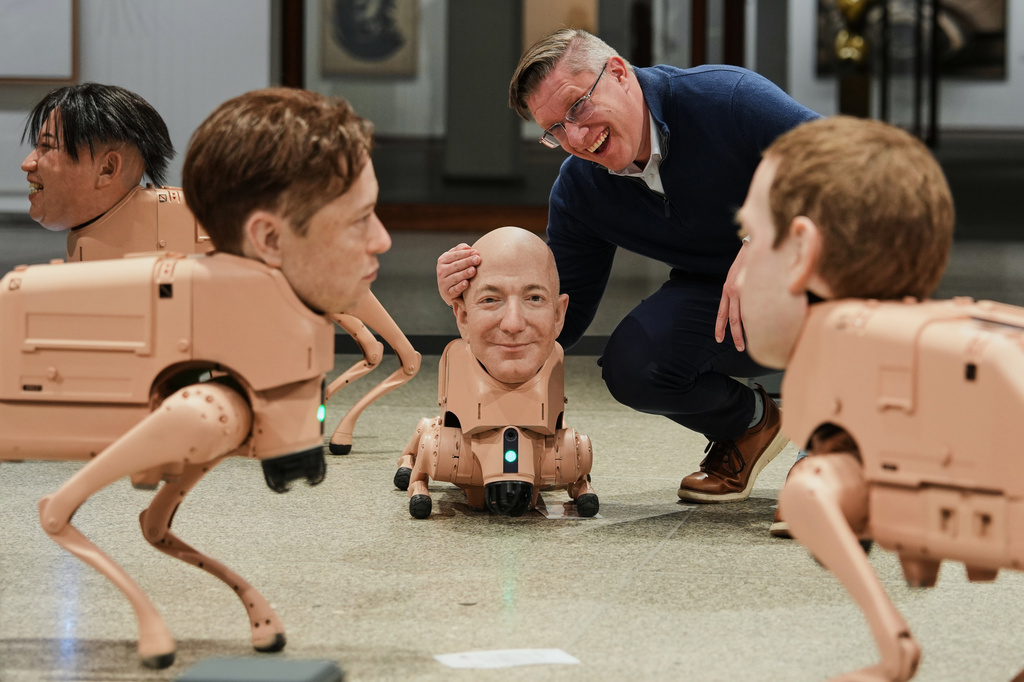
Silicon Valley has a weird obsession with its own ego, and the art world just found a way to literally put it on four legs. If you walked into the right gallery recently, you weren't greeted by a quiet docent or a minimalist painting. Instead, you found yourself staring down two mechanical beasts—yellow, metallic, and topped with the uncannily realistic heads of Elon Musk and Mark Zuckerberg.
These aren't just toys. They’re high-end robotic dogs, likely the Unitree or Boston Dynamics models that cost more than a mid-sized sedan, modified to carry the weight of tech's biggest rivalries. It’s a literal manifestation of the "tech bro" arms race. Seeing a Zuckerberg-headed robot trot toward you with that vacant, digital stare is enough to make anyone rethink their social media presence.
Why the Tech Elite Are Becoming Performance Art
Art has always mocked the powerful. In the past, we had caricatures in newspapers or statues in town squares. Today, we have autonomous machines. The exhibition, which went viral for its jarring imagery, captures the current cultural anxiety about who's actually running the show.
Elon Musk and Mark Zuckerberg aren't just CEOs anymore. They're symbols of two different, yet equally terrifying, versions of the future. Musk represents the frantic, chaotic drive toward Mars and neural implants. Zuckerberg represents the curated, somewhat stiff transition into a virtual metaverse. By slapping their likenesses onto robot dogs, the artist strips away the polished PR and leaves us with something primal. These things are hunters. They’re programmed to follow, to adapt, and to eventually outpace us.
The Engineering Behind the Satire
Making a robot dog walk is hard. Making it look like a billionaire while it does it is a specific kind of genius. The tech used here relies on sophisticated stabilization algorithms. These machines use LIDAR and depth sensors to navigate the gallery floor, avoiding walls and—more importantly—avoiding the expensive shoes of the art collectors watching them.
What Makes These Robots Tick
- Autonomous Navigation: They don't need a guy with a remote. They map the room in real-time.
- Custom 3D Modeling: The heads aren't just masks; they're weighted to ensure the robot doesn't tip over during a "playful" gallop.
- Battery Life Constraints: Performance art has a schedule. These bots usually run for about 45 to 90 minutes before they need a "nap" at a charging station.
The choice of the dog form factor is intentional. Dogs are supposed to be man's best friend. But when they have the face of a man who controls your data or your satellite internet, the relationship feels a lot more lopsided. It’s a comment on our own subservience. We feed these platforms our time and attention, and in return, the algorithms pat us on the head.
A Cage Match Without the Cage
Remember when Musk and Zuckerberg actually talked about fighting in a cage? The internet went into a frenzy. It was peak absurdity. While that physical fight never happened in a Las Vegas octagon, it’s happening every day in the world of AI and social dominance.
This gallery installation brings that "cage match" to a physical space. Watching the Musk-bot and the Zuck-bot circle each other is a perfect metaphor for the current state of the tech industry. They aren't necessarily attacking; they're just occupying the same space, vying for the same "eyes" in the room. It’s awkward. It’s jerky. It’s expensive. Honestly, it’s the most honest representation of Big Tech we’ve seen in years.
The Creepiness Factor Is the Point
There’s a concept called the Uncanny Valley. It’s that feeling of revulsion when something looks almost human, but not quite. Most people feel it when looking at Zuckerberg’s avatar in the metaverse. Applying that to a four-legged robot doubles the effect.
The movement of these robots is fluid yet mechanical. They can climb stairs, roll over, and right themselves if they’re pushed. Seeing that physical resilience combined with a human face triggers a fight-or-flight response. That’s exactly what the artist wants. They want you to feel uncomfortable. If you aren't a little bit worried about the intersection of robotics and massive corporate influence, you probably haven't been paying attention to the news lately.
Beyond the Viral Clip
Social media loves a 10-second clip of a robot dog doing a dance. But the actual experience of being in the room with these things is different. There’s the whirring of the motors. The clacking of plastic "paws" on the hard gallery floor. The way the sensors "look" at you as you pass.
It raises a question most of us avoid: how much of our lives are we willing to let these "dogs" manage? We use their tools to talk to our families, run our businesses, and get our news. We’ve invited the robot dogs into our homes, and we’ve given them the keys to the pantry.
Spotting the Real Trend
This isn't an isolated event. We're seeing a massive surge in "Activist Tech Art." Artists are no longer satisfied with oil on canvas. They’re using the very tools developed by DARPA and Silicon Valley to criticize the people who funded them.
- Data Privacy Art: Installations that track visitors and project their private data on the walls.
- AI Satire: Programs that generate fake corporate apologies for disasters that haven't happened yet.
- Robotic Protest: Using autonomous drones or dogs to occupy spaces where humans aren't allowed.
The Musk and Zuckerberg robot dogs are just the loudest version of this movement. They’re a billboard for the weirdness of 2026.
The Logistics of Robotic Art
If you’re thinking about how someone pulls this off, it’s not just an art degree. It’s a team of engineers. They have to worry about torque, center of gravity, and heat dissipation. If the Zuckerberg head is too heavy, the motors in the "neck" will burn out within an hour. There’s a literal weight to these personalities.
The cost is also a factor. A single high-end quadruped robot can run you anywhere from $10,000 to $75,000. Add in the custom fabrication of the heads and the programming required to give them "personalities," and you’re looking at a six-figure art project. It’s an expensive way to tell a joke, but in a world where these two men control billions, it’s perhaps the only way to get their attention.
Watching the Watchers
The most interesting part of the gallery isn't the robots. It’s the people watching them. Half the crowd is laughing, taking selfies with the Musk-dog. The other half looks genuinely disturbed.
It’s a mirror. If you see it as a funny meme, you’re likely optimistic about where tech is heading. If you see it as a dystopian nightmare, you’re probably looking for a way to delete your accounts and move to the woods. Both reactions are valid. Both reactions are exactly what the artist intended to provoke.
Don't expect the tech giants to comment on it. They’re too busy building the real versions of these things. While we’re laughing at the art, the actual technology is getting faster, smarter, and more integrated into our infrastructure.
If you want to understand the power dynamics of the next decade, stop looking at stock charts for a second. Go find a video of these robot dogs. Watch how they move. Watch how they don't care about the obstacles in their way. Then look at the faces attached to them. It’s not science fiction anymore. It’s just a Tuesday in a modern art gallery.
Go check out local tech-art fusion exhibits in your city. Most major metros now have "media labs" or "creative tech" spaces that host similar work. If you're in New York or London, look for galleries specializing in post-internet art. It’s the best way to see the future before it sees you.