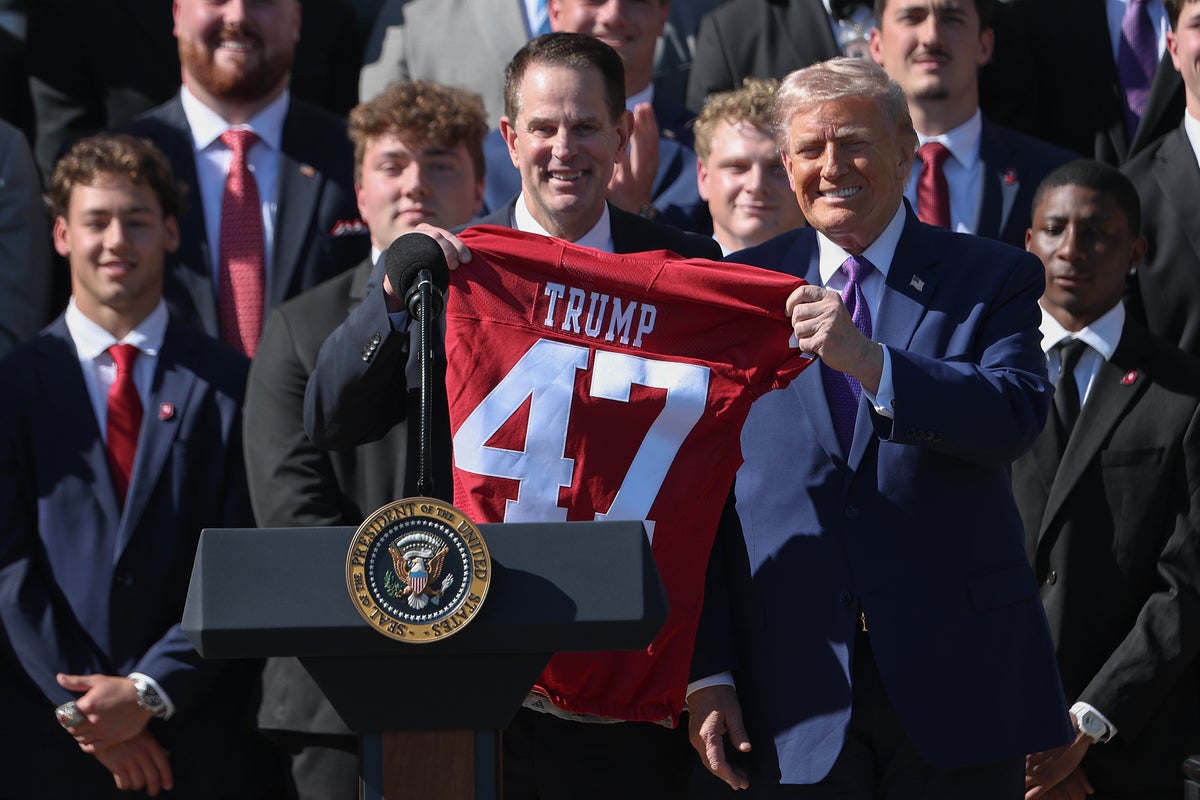
The air in the Rose Garden usually carries the scent of clipped boxwood and the heavy, humid weight of history. It is a place where young men, recently minted as legends on grass and turf, stand behind a podium and try to look comfortable in suits that cost more than their childhood homes. They usually grin. They usually hold up jerseys. They usually play the part.
But sometimes, the story isn't about who is standing on the manicured lawn. It is about the person who stayed home. If you found value in this article, you should check out: this related article.
Nick Bosa was the name on everyone’s lips leading up to the 2019 NFL Draft. He was a force of nature at Ohio State, a defensive end built with the precision of a Swiss watch and the power of a freight train. He was also a lightning rod. Before he ever took a professional snap for the San Francisco 49ers, his digital footprint had already mapped out a political minefield. He had liked posts featuring controversial hashtags; he had criticized public figures; he had signaled, in the way 21st-century athletes do, exactly where he stood.
Then came the invitation. For another perspective on this story, check out the recent update from Bleacher Report.
The Weight of the Invitation
When a championship team or a top draft pick is summoned to 1600 Pennsylvania Avenue, it is framed as a non-partisan honor. That is the myth we tell ourselves. In reality, it is a high-stakes poker game where the currency is public image. For Donald Trump, Bosa wasn't just a football player. He was a symbol. He was a talented, outspoken young man who seemed to mirror the "Make America Great Again" ethos.
The President didn’t just like Bosa; he championed him. He took to social media to congratulate him on being drafted, urging him to "stay true to yourself." It was a public embrace that most rookies, struggling to navigate the transition from college dorms to multi-million dollar contracts, would find dizzying.
Imagine the locker room. Imagine the silence that falls when a player has to decide between his personal convictions, his public brand, and the optics of the most powerful office in the world. Bosa found himself in a peculiar vacuum. He was the "star fan" according to the Commander-in-Chief, yet when the moment of physical presence arrived, the seat remained empty.
The Public Insistence
Donald Trump has always leaned into the narrative of the loyalist. To him, Bosa wasn't just a draft pick; he was a "big fan." This wasn't a casual observation. It was an insistence. Even when Bosa declined to attend a high-profile event at the White House, the narrative from the Oval Office didn't shift toward rejection. Instead, it doubled down on the bond.
There is a specific kind of tension that arises when a powerful figure claims you as their own. It creates a silhouette that the individual must either step into or walk away from. By insisting on Bosa’s fandom despite his absence, Trump was performing a classic move in the playbook of public relations: he was defining the relationship before Bosa could.
Why does this matter? Because in the modern era, the athlete’s body is a political battlefield. Every "like," every retweet, and every absence is scrutinized for a deeper meaning. When Bosa skipped the event, the "why" became a Rorschach test for the American public. To his detractors, it was a missed opportunity to face the music. To his supporters, it was a tactical retreat to focus on the game. To the President, it was a non-event that didn't change the underlying "truth" of their mutual admiration.
The Invisible Stakes of the Locker Room
We often forget that while these headlines scream on cable news, the subjects of the stories are living in a world of film rooms and ice baths. For a rookie like Bosa, the stakes weren't just about a tweet from the President. They were about the guys sitting next to him in the San Francisco locker room.
The NFL is a melting pot of backgrounds, religions, and political leanings. It is a workplace where you are judged by your "get-off" speed and your ability to collapse a pocket, not your voting record. However, when the President of the United States repeatedly singles you out as a "huge fan," it brings the outside world crashing through the heavy double doors of the facility.
Bosa had already scrubbed his social media accounts before the draft, a move his agents likely insisted upon to "de-risk" his profile. It was an admission that the persona he built as a teenager wasn't the one he could afford to carry as a professional. This tension—the friction between who a man is in private and who the world insists he must be—is where the real story lives.
The Silence of the Star
Absence is a loud noise in Washington. When a star athlete skips the White House, the media usually hunts for a manifesto. They want a reason. They want a "Statement with a capital S."
Bosa didn't give them one.
He stayed in the lane of the professional. He allowed the President's insistence to hang in the air, neither fully embracing it nor publicly rebuking it in a way that would ignite a fresh cycle of outrage. It was a masterclass in the "no-comment" era of sports. By saying nothing, he let everyone else fill in the blanks.
Trump’s insistence that Bosa was a fan, even in the face of a snub, speaks to a broader cultural phenomenon. We are obsessed with claiming people. We want to know which "team" everyone is on, and not just the one with the helmet and pads. We want to know if they belong to us or to them.
The Reality of the Field
Late in the season, when the jerseys are stained with grass and the air is cold enough to see your breath, the White House event feels like a lifetime ago. The "star fan" narrative fades. What remains is the player.
Bosa lived up to the hype. He moved with a violent elegance that justified every headline, every draft grade, and every presidential tweet. He became a cornerstone of a defense that terrified quarterbacks across the league. In the end, the game has a way of swallowing the politics whole.
But the image of the empty chair persists. It reminds us that even for the most physically dominant among us, there are forces that cannot be blocked or tackled. There are invitations that carry the weight of an entire nation’s divisions, and sometimes, the most powerful move a man can make is simply not to show up.
The President kept talking. The cameras kept rolling. The tweets kept flying. And out on the field, beneath the blinding lights and the roar of thousands, Nick Bosa kept playing, a man caught between the person he was and the symbol everyone else wanted him to be.
The lights eventually dim on every administration and every career. The Rose Garden sees new faces every spring. But the question of who we are when the most powerful person in the world calls our name—and whether we answer—is the ghost that haunts every locker room in America.