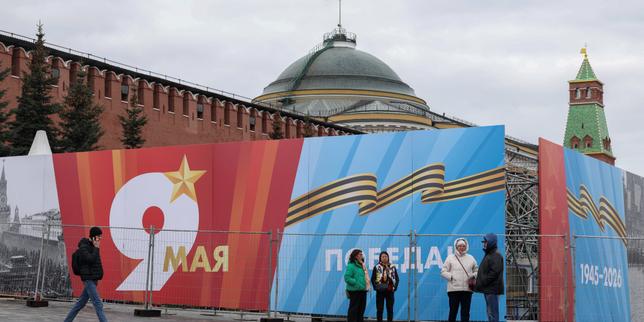
The cobblestones of Red Square are designed to tremble. For decades, the ritual was predictable: the synchronized thunder of heavy boots, the oily scent of diesel, and the bone-shaking roar of T-90 tanks grinding past the Kremlin walls. It is a theater of steel meant to project an image of an immovable, eternal power. But this May, the silence between the drumbeats felt heavier than the machinery itself.
The air was thin. The crowds were sparse. And for the second year in a row, the legendary armored columns that once defined Russian military might were nowhere to be seen.
What we witnessed wasn't just a parade. It was a visual admission of a new, terrifying reality in modern warfare. The grand display of 1945 nostalgia has been held hostage by a piece of plastic and circuitry no larger than a shoebox.
The Ghost in the Sky
To understand the tension in Moscow, you have to look away from the soldiers and toward the rooftops. Sniper teams usually scan for assassins, but today, electronic warfare units are scanning for signals. They are hunting for the hum of a drone.
The Ukrainian conflict has inverted the hierarchy of the battlefield. A multi-million-dollar tank, draped in reactive armor and history, is now vulnerable to a $500 First Person View (FPV) drone piloted by a teenager in a basement in Kyiv. This isn't a metaphor. It is a tactical crisis that has forced the Kremlin to shrink its most sacred public holiday into a "format réduit"—a reduced format.
Security wasn't just tight; it was paranoid. In the weeks leading up to the event, GPS signals across Moscow began to flicker and fail. Food delivery apps glitched, mapping software placed drivers in the middle of the Moscow River, and digital compasses spun aimlessly. This "spoofing" is a desperate electronic shroud, an attempt to blind the satellite-guided brains of incoming Ukrainian long-range UAVs.
When a state has to disable its own city's navigation systems just to hold a parade, the message of "strength" starts to fray at the edges.
The Loneliness of a Single Tank
History usually moves in cycles, but sometimes it stalls.
Consider the T-34. It is the icon of the Great Patriotic War, the machine that broke the back of the Wehrmacht. In any other year, it would be the lead actor in a cast of hundreds of modern successors. This year, it stood nearly alone. Watching a solitary, vintage tank rattle across the vast expanse of Red Square is like watching a single candle flicker in a darkened cathedral. It highlights the void.
Where are the others? The answer lies in the mud of the Donbas and the graveyards of Vuhledar. The attrition rate of Russian armor has reached levels that defy standard military logic. When the frontline is a meat grinder for metal, you don't park your best assets on a ceremonial plaza for a photo op. You can't afford the optics of a drone strike happening live on state television, turning a symbol of victory into a viral video of a turret-toss.
The Invisible Frontline
The fear isn't just about physical destruction. It's about the puncture of a myth.
The Victory Day parade is the glue of the modern Russian identity. It is the moment where the sacrifices of the past are leveraged to justify the ambitions of the present. By scaling back the celebrations—canceling the "Immortal Regiment" marches where citizens carry portraits of their ancestors—the state is admitting that it can no longer guarantee the safety of its own people in the heart of the capital.
The "Immortal Regiment" was always the human soul of May 9th. It was a sea of faces, a bridge between the living and the dead. But a crowd of thousands is a target. A collection of mourning families is a liability in the age of the "aerodynamic threat."
So, the marches were moved online. The physical world, it seems, has become too dangerous for the state’s own narrative to inhabit.
A Geometry of Fear
The technical shift here is profound. We are seeing the sunset of the "Broad Front" era and the dawn of "Precision Chaos."
In previous eras, to threaten a parade in Moscow, an enemy needed a bomber wing or an army. Now, they just need a favorable wind and a hobbyist's remote control. Ukraine has demonstrated an uncanny ability to strike deep—hitting oil refineries, airbases, and even the Kremlin dome itself last year.
These drones are the ultimate asymmetric equalizer. They don't need to win a war of attrition; they only need to win a war of nerves. By forcing the Russian Ministry of Defense to scrap the flypasts—the spectacular aerial displays of Su-35s and Mig-31s—the drones have already won a psychological victory without firing a single shot. The sky, once a canvas for Russian pride, is now a source of constant, neck-straining anxiety.
The Stakes of Silence
There is a specific kind of quiet that follows a scaled-back celebration. It’s the sound of questions being asked in whispers.
Muscovites stood behind steel barriers, watching the shortened procession of Tigr and Iskander-M mobile launchers. The hardware that did appear was largely wheeled, not tracked. It was faster, easier to move, and less of a logistical nightmare. But it lacked the gravity of the heavy divisions.
One might argue that the reduction is a sign of pragmatism. Why waste fuel and risk lives for a show? But in the world of geopolitics, the show is the substance. When the curtains are pulled back and the stage is half-empty, the audience begins to wonder if the lead actor still remembers his lines.
The "invisible stakes" here involve the social contract. For years, the trade-off offered to the Russian public was simple: stay out of politics, and the state will provide a sense of redirected glory and domestic stability. But when the drones arrive and the parades shrink, the stability vanishes. The war, which was supposed to be a "special operation" happening elsewhere, has finally come home to the Red Square cobblestones.
The New Architecture of Power
We are moving into an era where the size of a military is no longer measured by the length of its columns on a street. Instead, it is measured by the invisibility of its signals and the resilience of its sensors.
The empty spaces in this year’s parade were filled with electronic warfare (EW) trucks—drab, boxy vehicles bristling with antennas. They are the new vanguard. They don't look heroic. They don't inspire poems. They simply scream white noise into the ether, hoping to drown out the digital commands of an incoming suicide bot.
This is the aesthetic of modern conflict: ugly, hidden, and deeply defensive.
The grand myth of the unstoppable Russian steamroller has been replaced by the reality of the electronic shield. It is a reactive posture, one that prioritizes survival over spectacle. For a regime that feeds on the imagery of the offensive, this is a bitter pill to swallow.
The Last Echo
As the last of the soldiers marched away and the barricades were dismantled, the square didn't feel like the site of a triumph. It felt like a bunker with the roof taken off.
The drones have changed the physics of the holiday. They have turned the wide-open spaces of Russian history into a series of vulnerabilities. Every gap in the formation was a reminder of a tank lost in a treeline in Avdiivka. Every canceled flight was a nod to the sophistication of Western-supplied and Ukrainian-built tech.
The cobblestones stopped trembling much earlier this year. The silence returned to the Kremlin walls, but it wasn't the silence of peace. It was the hushed, breathless waiting of a city that knows the sky is no longer theirs alone. The parade is shorter now because the world has become smaller, faster, and much more dangerous for those who rely on the shadows of the past to hide the cracks of the present.
The T-34 chugged alone into the distance, a relic of a war won with blood and iron, leaving behind a square haunted by the high-pitched whine of a future it cannot control.