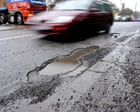
Driving in Britain doesn't feel like a first-world experience anymore. It feels like a high-stakes game of Tetris where the blocks are deep, jagged craters and the prize is not blowing out your suspension. We’ve reached a breaking point. The latest data from the Asphalt Industry Alliance (AIA) confirms what your rattling dashboard has been telling you for months. The cost to fix the local road network in England and Wales has officially spiraled to a record £16.3 billion. If you factor in the broader requirements across the entire network, that figure sits at a staggering £18.6 billion.
That’s not just a big number. It’s a systemic failure. We are watching the literal foundation of our economy—the roads that carry our food, our ambulances, and our families—crumble in real-time. This isn’t about a few patches of bad weather. It’s about decades of short-term thinking and a funding model that’s basically a sticking奏 plaster on a broken leg. Also making headlines recently: Finland Is Not Keeping Calm And The West Is Misreading The Silence.
The math behind the misery
Let’s look at what that £18.6 billion actually means. To clear this backlog today, local authorities would need to spend an amount roughly equivalent to the entire annual budget of some small countries. The AIA’s Annual Local Authority Road Maintenance (ALARM) report is the gold standard for this data, and the 2024-2025 figures are grim.
In the last year alone, the "catch-up" cost increased by 16%. Think about that. Even as councils claim they're working harder, the hole is getting deeper. It’s a losing battle. The average budget shortfall for a local authority in England is now £8.2 million. In London, it’s even worse, and in Wales, the numbers are terrifying. We aren't just failing to improve; we're failing to stand still. Further details into this topic are explored by NBC News.
You might hear politicians talk about "record investment." Don't buy it. When inflation in construction materials is running hot and the base level of decay is this high, a few extra million pounds is like throwing a cup of water at a house fire. The reality is that the proportion of local roads in "good" condition has dropped significantly. We're now looking at a situation where one in every nine miles of local road is likely to fail within the next twelve months.
Why your car insurance is skyrocketing
You’ve probably noticed your premium went up. Part of that is the cost of parts and labor, sure. But a massive, under-discussed factor is the sheer volume of pothole-related claims. When you hit a crater at 30mph, you aren't just looking at a flat tire. You’re looking at cracked alloys, snapped coil springs, and ruined shock absorbers.
Insurance companies aren't charities. They pass those costs directly back to you. Data from the RAC shows that breakdowns linked to poor road surfaces have hit their highest levels since 2006. We’re paying a "pothole tax" every single day, whether it’s through direct repairs or the invisible creep of insurance hikes.
The physics of road failure
Water is the enemy. It gets into small cracks in the asphalt. Then it freezes, expands, and pushes the road apart. When it thaws, you’re left with a void. A heavy SUV drives over that void and—crunch—you have a pothole.
Because councils are strapped for cash, they often use "reactive maintenance." That’s fancy talk for waiting until a hole is dangerous and then sending a guy with a bucket of cold-mix bitumen to stomp on it. It lasts a few weeks. Rain washes it out. The cycle repeats. It’s the most expensive way to manage a road network because it never actually fixes the underlying structure.
The regional divide in road quality
It’s a postcode lottery out there. If you live in an area with a proactive council and a slightly better budget, your commute might be bearable. If you’re in a rural county or a cash-strapped northern borough, you’re basically off-roading.
The ALARM report highlights that the "pothole gap" between the best and worst-maintained areas is widening. Some councils are now so far behind that they’d need 30 years of sustained, high-level funding just to get their roads back to a "reasonable" state. We don't have 30 years. The roads will be gravel by then.
A failure of central government strategy
The Department for Transport (DfT) recently reallocated funds from the scrapped northern leg of HS2 toward road maintenance. On paper, £8.3 billion over 11 years sounds great. In practice? It’s a drop in the bucket compared to an £18.6 billion backlog that’s growing every day.
The problem is the lack of a long-term, ring-fenced funding settlement. Councils can’t plan five years ahead if they don't know what their budget looks like next year. They end up buying expensive, short-term fixes instead of investing in long-life resurfacing that would actually save money over a decade. It’s the "poor man’s tax" on a national scale.
What actually works for road repair
If we want to fix this, we have to stop patching and start renewing.
- Preventative resurfacing: Applying sealants to roads before they crack. It costs pennies compared to the pounds required to fix a hole.
- Warm-mix asphalt: It’s more durable and has a lower carbon footprint than the traditional stuff.
- Automated repair tech: Companies are testing AI-powered vans that spot cracks before they become holes. It’s smart, but it requires upfront investment that most councils can't afford.
Honestly, the tech exists. The expertise exists. The only thing missing is a government that treats road maintenance as essential infrastructure rather than an optional luxury.
How to protect yourself and your wallet
You can't fix the roads yourself, but you can stop being a victim of them. First, check your tires every week. Under-inflated tires are far more likely to suffer sidewall damage when hitting a pothole edge. Second, increase your following distance. If you’re tailgating the car in front, you won't see the crater they just drove over until it's too late for you to swerve.
If you do hit a hole and damage your car, document everything. Take photos of the hole (use a 50p coin for scale if it’s safe), take photos of the damage, and get a professional repair quote. You can claim against the council under Section 58 of the Highways Act 1980. They’ll try to dodge it by saying they didn't know the hole was there, but if the road hasn't been inspected recently, they’re liable.
Report every single pothole you see. Use apps like StreetFix or the official council portals. If they don’t know about it, they have a legal shield. If you report it and they don’t fix it, that shield disappears.
The £18.6 billion figure is a national embarrassment. It represents a country that has forgotten how to maintain the basics. We need to move past the "emergency patch" era and demand a decade-long investment plan that treats our roads with the respect they deserve. Until then, keep your eyes on the tarmac and your hands firm on the wheel. It’s going to be a bumpy decade.