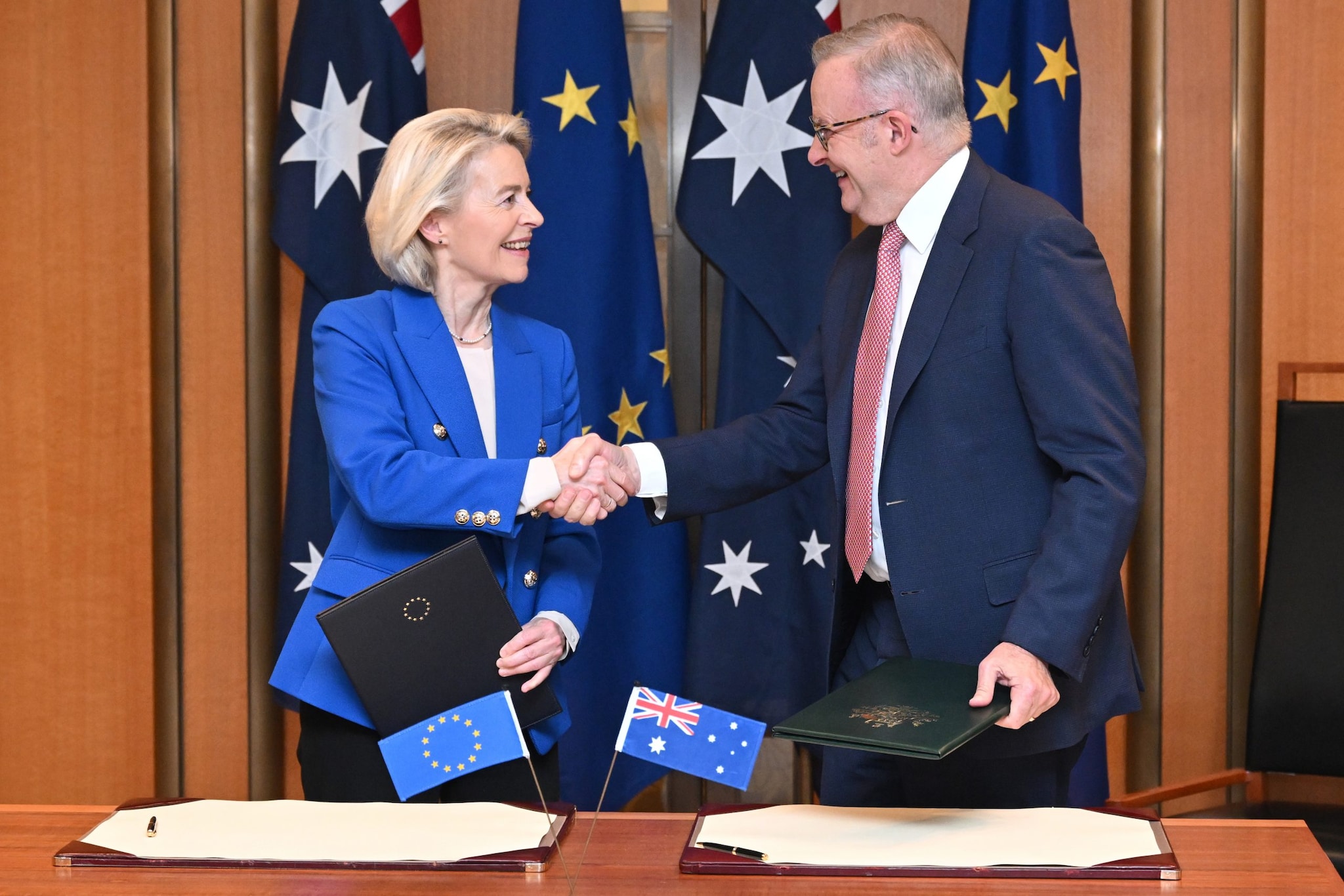
The ink is barely dry on the press releases, and the professional optimistic class is already popping champagne. "A landmark Free Trade Agreement!" they cry. "A new era of Indo-Pacific security!" they shout from the rooftops of Brussels and Canberra.
They are wrong.
This isn't a breakthrough. It’s a choreographed face-saving exercise designed to mask the fact that the European Union and Australia are fundamentally incompatible partners attempting to solve 21st-century security problems with 19th-century trade logic. I’ve watched these trade delegations for fifteen years. They follow a predictable script: three years of bickering over beef quotas, six months of "stalled" negotiations for dramatic effect, and a final, hollowed-out agreement that prioritizes optics over economic reality.
If you think this deal secures supply chains or builds a credible defense wall against regional hegemony, you aren't paying attention to the math.
The Agricultural Albatross
The "lazy consensus" suggests that trade deals are win-win scenarios where comparative advantage reigns supreme. In the real world, the EU’s Common Agricultural Policy (CAP) is a protectionist fortress that no amount of Australian charm can breach.
Australia wanted "meaningful" access for its beef, sheep meat, and sugar. What did they get? Peanuts disguised as quotas. The European agricultural lobby, particularly the French and Irish contingents, treats Australian wagyu like a biological weapon.
The reality is that Australia is an energy and protein superpower, while the EU is a regulatory superpower. You cannot trade rules for ribeyes. By capping Australian exports to protect inefficient European farms, the EU has ensured this FTA remains a peripheral economic event. For Australia, the "win" here is so marginal that it barely offsets the shipping costs and the bureaucratic nightmare of complying with the EU’s Carbon Border Adjustment Mechanism (CBAM).
The Defense Partnership is a Paper Tiger
The announcement of a "new defense partnership" alongside the FTA is the ultimate distraction. It’s a classic PR pivot. When the economic numbers don't add up, talk about "shared values" and "regional stability."
Let’s be brutally honest about the hardware. Australia is now an AUKUS nation. Its defense DNA is being rewritten by American and British technology. The European defense industry—splintered, slow, and perpetually arguing over sovereign vs. collective interests—has very little to offer a country that is currently betting its entire national survival on nuclear-powered submarines and long-range US sensors.
What is the EU actually bringing to the Indo-Pacific? A few "freedom of navigation" transits by a lone German frigate? A sternly worded statement from the European External Action Service?
Imagine a scenario where a maritime blockade actually occurs in the South China Sea. Does anyone truly believe the EU will risk its massive trade relationship with Beijing to defend Australian trade routes? To believe that is to ignore the last decade of European foreign policy. The EU treats the Indo-Pacific as a market; the US treats it as a theater of war. Australia is stuck in the middle, signing "partnerships" with a bloc that can't even agree on its own internal defense integration.
The Critical Minerals Myth
The deal’s defenders point to critical minerals as the "game-changing" (a term I loathe) element. They argue that Europe needs Australia’s lithium, cobalt, and rare earths to fuel its green transition and break dependence on China.
Here is the inconvenient truth: Europe is too slow to build the processing infrastructure, and Australia is tired of being the world's "quarry."
- The Investment Gap: European mining companies are risk-averse. They want the minerals, but they don't want to invest the billions required for downstream processing in Western Australia or Queensland.
- The Regulatory Chokehold: The EU’s ESG requirements are so stringent that they effectively penalize Australian miners for the very act of extraction.
- The Price War: China already owns the processing tail. Australia can dig the rocks up, but if the refinement happens in Ningbo, the "strategic autonomy" the EU craves is a total fantasy.
I’ve seen this play out in the boardroom. European OEMs (Original Equipment Manufacturers) talk a big game about "ethical sourcing," then immediately sign the cheapest contract available—which usually leads right back to the entities this FTA is supposed to circumvent.
Stop Asking if the Deal is "Good"
The "People Also Ask" section of your brain is likely wondering: "Will this lower prices for consumers?" or "Does this create jobs?"
You’re asking the wrong questions. The right question is: "Does this deal reflect the reality of 2026, or is it a ghost of 2010?"
The answer is the latter. This FTA is a relic of "Globalism 1.0"—the belief that signing a piece of paper and lowering a few tariffs on wine and car parts solves structural geopolitical shifts. It doesn't.
If Australia wanted a real strategic pivot, it would stop chasing the European mirage and double down on the "Quad" (USA, India, Japan, Australia) with aggressive, raw-resource-for-high-tech swaps. Instead, Canberra is wasting diplomatic capital on a bloc that views "Geopolitical Europe" as a catchy slogan rather than a military reality.
The Brutal Reality of "Shared Values"
We hear a lot about "shared values" in these negotiations. It’s the ultimate fallback for a weak deal. Democracy, rule of law, human rights—it all sounds great over a gala dinner in Brussels.
But trade isn't built on values; it's built on logistics, demand, and the ability to project power. The EU is a declining demographic bloc with stagnant growth. Australia is a commodity-rich nation in the world's most volatile growth zone.
By tying its wagon to the EU’s regulatory regime, Australia isn't "diversifying" its trade; it's importing European stagnation. Every time Australia agrees to "align" with EU standards on digital privacy, carbon pricing, or labor laws, it adds a layer of friction to its more important relationships in Southeast Asia.
The "Geopolitical" Defense Delusion
Let’s dismantle the defense partnership one more time. The EU wants to be a "security actor" in Asia. But security requires more than just "dialogue." It requires:
- Massive industrial capacity to surge production (which Europe currently lacks).
- A unified command structure (which Europe doesn't have).
- The will to sustain casualties far from home (which Europe has zero appetite for).
Australia’s pivot to the EU is a hedge that won't pay out when the market crashes. When the "big one" happens in the Pacific, Canberra will be looking toward Pearl Harbor, not Brussels. This partnership is the equivalent of buying a fire insurance policy from a company that doesn't own a single fire truck.
The Actionable Truth
If you are an investor or a policy-maker, ignore the headlines.
- Watch the Quotas, Not the Headlines: If the beef and sheep meat quotas haven't increased by at least 500%, the deal is an economic failure for Australia.
- Follow the Processing: Don't look at mining permits. Look at where the refineries are being built. If they aren't being built in Australia with European capital, the "critical minerals" section of the FTA is fluff.
- Acknowledge the Friction: Expect more trade disputes, not fewer. The EU’s penchant for "extraterritorial regulation" (forcing its laws on other countries) will inevitably clash with Australia’s sovereignty.
The EU and Australia have signed a document that makes them feel better about their growing isolation in a world dominated by raw power and hard interests. It’s a security blanket made of red tape.
Stop celebrating the signature and start preparing for the inevitable realization that this "partnership" is an inch deep and a mile wide.
Go find a real trade map. You’ll see that the distance between Brussels and Canberra isn't just measured in miles—it's measured in the terminal lack of a shared reality.