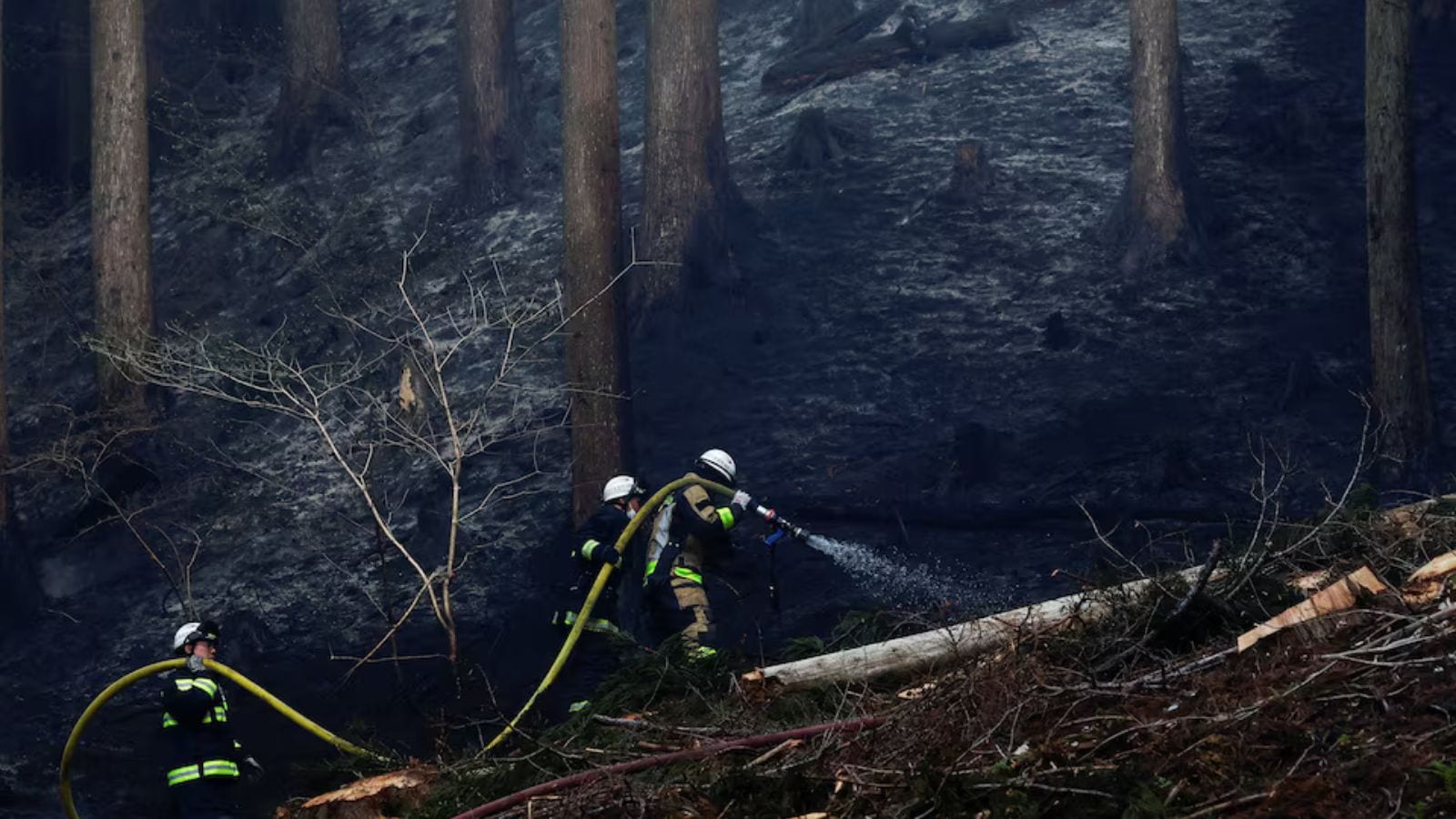
The inferno currently tearing through the mountains of Otsuchi is not merely a natural disaster. It is a systemic failure of policy and land management that has been decades in the making. While 1,000 firefighters struggle to contain the flames and 3,000 residents flee their homes in the Iwate Prefecture, the narrative being pushed is one of "unprecedented" weather conditions. This is a convenient shield for officials. The reality is that the Otsuchi fire represents a collision between Japan's shrinking rural population and a forestry model that has turned the nation's hillsides into a tinderbox.
Japan is currently facing a wildfire crisis centered on the town of Otsuchi, where high winds and unseasonably dry conditions have allowed a blaze to leap across steep, cedar-clogged terrain. The immediate priority is life safety, but the underlying cause is the abandonment of the "Satoyama" system—the traditional mosaic of managed forests and farmland. Without the constant thinning of trees and clearing of underbrush once performed by local communities, these forests have become dense, monocultural stands of timber that accelerate fire spread rather than slowing it down.
The Conifer Problem and the Death of Biodiversity
To understand why Otsuchi is burning with such intensity, one must look back to the post-war reconstruction era. During the 1950s and 60s, the Japanese government engaged in massive afforestation projects. They replaced diverse, native broadleaf forests with fast-growing conifers, primarily Japanese Cedar (Sugi) and Cypress (Hinoki). The goal was economic self-sufficiency in timber.
It worked, until it didn't.
When the global timber market opened up, cheap imports from Southeast Asia and North America flooded the country. Domestic forestry became unprofitable. Small-scale loggers vanished. The result was millions of hectares of densely packed conifer plantations left to grow unchecked. These trees are high in resin and planted so closely together that they create a continuous fuel bed. In a natural forest, gaps between trees and a mix of species act as speed bumps for fire. In the monocultures surrounding Otsuchi, the fire moves through the canopy like a wave.
The lack of management also means the forest floor is thick with "duff"—layers of needles and dead branches that haven't been cleared in thirty years. When a spark hits this material during a dry spell, the fire burns deep into the soil. This makes it incredibly difficult for ground crews to extinguish, as the fire can smolder underground and resurface days later, long after the main front has passed.
The Topographic Trap and Tactical Limitations
Otsuchi's geography is a nightmare for traditional firefighting. The town is squeezed between the Pacific Ocean and the steep mountains of the Kitakami Range. These slopes are often inaccessible to heavy machinery. In the United States or Australia, wildfire suppression relies heavily on bulldozers creating "break lines" to starve the fire of fuel. In the vertical terrain of Iwate, you cannot easily drive a bulldozer up a 40-degree incline covered in tangled cedar.
This leaves the burden on aerial support and manual labor. However, Japan’s aerial firefighting fleet is largely composed of municipal helicopters designed for urban fires or search and rescue, rather than the massive "Super Scooper" planes or heavy tankers used elsewhere. The helicopters currently hovering over Otsuchi carry relatively small buckets. By the time they fly to the coast, fill up, and return to the ridgeline, the heat from the blaze has often evaporated the moisture from the previous drop.
Ground crews, meanwhile, are facing exhaustion. The Japanese firefighting force relies heavily on volunteers—the shobodan. As the rural population ages, the average age of these volunteers has climbed into the 60s and 70s. Expecting retirees to hike up steep, smoke-choked ravines to dig fire lines by hand is not a sustainable strategy. The fire isn't just outrunning the water; it’s outrunning the demographics of the region.
The Climate Myth and the Management Reality
Public officials often point to climate change as the sole culprit. While it is true that spring windows are becoming drier and "Foehn winds"—hot, dry winds that spill over mountains—are becoming more volatile, this is only half the story. Climate change provides the spark, but the state of the forest provides the fuel.
We see a similar pattern in the Mediterranean and the American West. When humans stop active management of the land, the land resets itself through fire. In Japan, this is particularly tragic because the country has a history of high-precision land care. The abandonment of rural areas, known as kaso, has left a vacuum. Without people to graze livestock, harvest firewood, or maintain access roads, the wilderness has become a liability.
The Hidden Risk of Abandoned Homes
As 3,000 people evacuate Otsuchi, another danger emerges: "Akiya," or abandoned houses. These structures are scattered throughout the hillsides. Built often with traditional wood and paper materials, and surrounded by overgrown vegetation, they act as "spot fire" magnets. When embers from the main forest fire land on the dry thatch or wooden decks of an abandoned home, the building ignites instantly. This creates a secondary fire front within the town limits, forcing firefighters to divert resources from the forest to save the standing neighborhood.
Modernizing the Response through Technology
If the human element of forestry is disappearing, technology must fill the gap. Japan is a world leader in robotics and sensor tech, yet the application of these tools in wildfire management has been sluggish.
The use of long-range thermal drones could provide real-time mapping of fire perimeters through thick smoke, allowing commanders to deploy crews with surgical precision. Currently, much of the intelligence in these rural fires is gathered by visual observation from helicopters, which is limited by wind and visibility. Furthermore, the introduction of automated "fire-bots"—tracked vehicles capable of laying down high-pressure foam in terrain too dangerous for humans—could change the math of suppression in the Kitakami mountains.
But technology is a reactive measure. The proactive solution requires a radical shift in how Japan views its mountains.
Moving Toward a Resilient Forest
The disaster in Otsuchi should serve as a wake-up call for a national "Thinned Forest" initiative. The government needs to subsidize the removal of excess conifer biomass, even if it isn't profitable as timber. This biomass can be diverted to wood-pellet power plants, creating a local circular economy that incentivizes forest maintenance.
We also need to discuss "green breaks." By strategically replanting strips of broadleaf trees—which have higher water content in their leaves and are naturally more fire-resistant—among the cedar plantations, we can create natural barriers. This isn't just about ecology; it’s about infrastructure. A forest is a piece of national infrastructure just as much as a highway or a dam. If it is not maintained, it eventually breaks.
The Economic Aftermath
The cost of the Otsuchi fire will extend far beyond the immediate damage to property. The loss of topsoil on these steep slopes means that the next heavy rain—likely during the summer typhoon season—will bring a high risk of mudslides. Without tree roots to hold the earth and a canopy to break the fall of the rain, the charred mountainsides are primed for collapse.
This "cascading disaster" model is something the Iwate Prefecture is intimately familiar with following the 2011 tsunami. The region is in a constant state of rebuilding. To continue ignoring the forest management crisis is to ensure that the rebuilding never truly ends.
The smoke hanging over the Pacific today is a signal. It tells us that the old way of "planting and forgetting" is over. We can either pay the price now through controlled thinning and rural reinvestment, or we can pay it later in ash and evacuation orders. The 1,000 firefighters in Otsuchi are doing their job with incredible bravery, but they are fighting a fire that was fueled by decades of silence in Tokyo’s policy halls.
Direct investment in the revitalization of the Satoyama landscape is the only way to ensure that "3,000 flee" does not become a recurring headline in the Japanese spring.
Stop treating the mountains as a backdrop and start treating them as a responsibility.