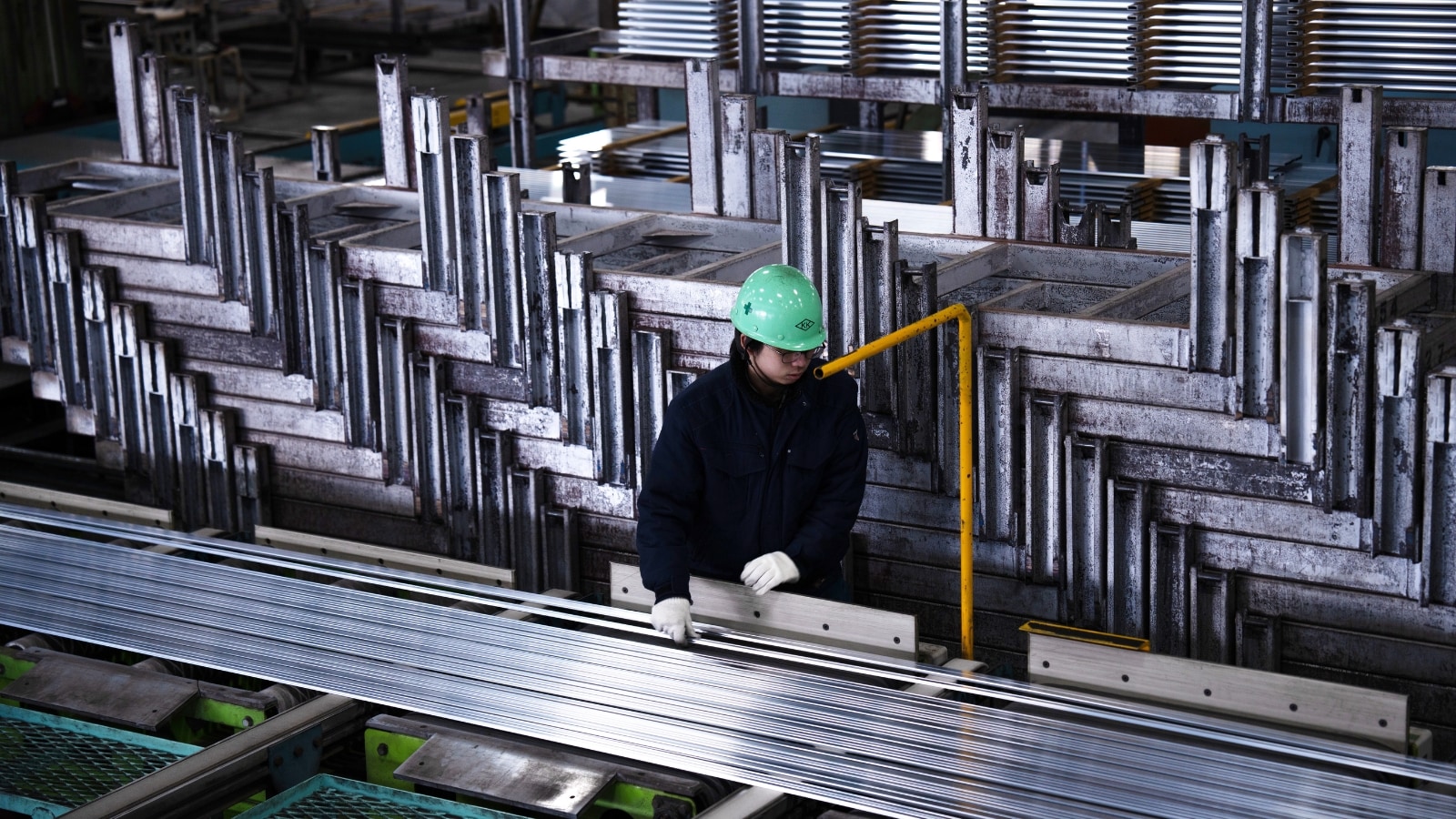
The air in Mon Valley doesn’t just carry the scent of sulfur and hard work; it carries the weight of memory. For generations, the rhythm of life in towns like Braddock and Clairton was dictated by the breath of the blast furnace. When the stacks roared, the grocery stores stayed full. When the orange glow hit the clouds at night, parents knew their kids’ college tuitions were secure. But for a long time now, that breath has been shallow. The steel industry, once the undisputed backbone of American titanism, has spent decades bracing for a winter that never quite seems to end.
Now, a $14 billion proposition from across the Pacific has turned the Monongahela River into a theater of high-stakes tension. Nippon Steel’s bid to acquire U.S. Steel isn't just a corporate transaction or a line item on a balance sheet. It is a collision of heritage and survival. To the analysts in Manhattan, it’s a strategic consolidation. To a third-generation steelworker standing on a porch in Pennsylvania, it’s a question of whether the fire stays lit or the town goes dark.
The Ghost of the Open Hearth
To understand why a Japanese company buying an American icon feels like a seismic event, you have to look at the rust. Not just the physical oxidation on the girders, but the psychological rust of being told your industry is a relic. U.S. Steel was the first billion-dollar company in history. It built the Empire State Building. It built the San Francisco-Oakland Bay Bridge. It was the "Corporation."
Yet, over the last few years, the narrative around U.S. Steel has felt more like a slow retreat. While modern "mini-mills" used electric arc furnaces to melt scrap and move fast, the legacy integrated mills—the ones that make steel from scratch using iron ore and coal—struggled to keep pace. The investment needed to modernize these cathedrals of industry is staggering. We aren't talking about millions. We are talking about billions of dollars just to stay relevant.
Consider a hypothetical worker named Elias. Elias is fifty-two. His hands are mapped with the scars of three decades in the mill. He remembers when the company felt invincible. Lately, he’s spent more time worrying about the "idling" of plants than the quality of the pour. For men like Elias, the news of a buyout doesn't trigger a lecture on globalism. It triggers a calculation: Does this mean my son gets a job at the mill, or does it mean the gates are locked for good in five years?
The Promise in the Pocketbook
The numbers coming out of the Nippon deal are designed to answer Elias's question with a resounding "stay." Nippon Steel hasn't just offered to buy the shares; they’ve pledged a $1.4 billion injection of capital into the aging U.S. Steel facilities. More recently, that figure has been bolstered by promises of no layoffs through at least 2026 and a specific focus on the very blast furnace plants that many feared were on the chopping block.
Money is the most honest language in the industrial world. When a company commits to spending billions on a specific site, they are pinning themselves to that geography. You don't upgrade a hot strip mill if you plan on abandoning it next summer. The investment suggests a shift from managed decline to a push for dominance. Nippon wants the U.S. market, and they want the high-end automotive steel that only these massive integrated mills can produce when they are running at peak efficiency.
This isn't just about keeping the lights on. It’s about the "hiring boost" that has been teased in recent reports. If these mills become the most technologically advanced versions of themselves, they don't just retain the current workforce—they require a new generation of technicians, engineers, and operators. The stakes are the survival of the middle class in the Rust Belt.
The Invisible Friction
If the deal is such a lifeline, why the friction? Why has it become a political lightning rod, drawing fire from both sides of the aisle? The resistance is rooted in a deep, bone-deep suspicion of "elsewhere."
The United Steelworkers (USW) union has been vocal, not necessarily because they hate the idea of investment, but because they fear the loss of leverage. When the owner is an American company based in Pittsburgh, there is a sense of shared soil. When the owner is thousands of miles away, even in an allied nation like Japan, that connection feels frayed. There is a fear that the "no layoff" pledges are temporary bandages on a wound that will eventually require amputation.
Then there is the matter of national security. Steel is the skeleton of a nation. We use it for tanks, for bridges, for the energy grid. The argument against the deal often centers on the idea that the U.S. must maintain a domestic-owned capacity to produce its own skeleton. But the counter-argument is just as sharp: Is it more "secure" to have a struggling, underfunded American-owned company, or a thriving, world-class mill owned by a close democratic ally?
The Chemistry of Modernity
Transitioning a mill from the 20th century to the 21st is an act of industrial alchemy. It involves more than just swapping out old parts. It requires a fundamental change in how energy is consumed and how carbon is managed.
$$Fe_2O_3 + 3CO \rightarrow 2Fe + 3CO_2$$
This basic chemical reduction is the heart of the blast furnace. It’s a process that has remained largely unchanged for a century, but it is carbon-intensive. To survive in a world that is rapidly decarbonizing, U.S. Steel needs to innovate. Nippon Steel is a global leader in "Green Steel" technology. They are experimenting with hydrogen injection to replace coke, a move that could theoretically turn a steel mill from a climate liability into a high-tech marvel.
Imagine the Mon Valley not as a graveyard of 1970s technology, but as the hub of the world’s first carbon-neutral heavy industry. That is the "journey" being sold here. It’s a vision where the grit remains, but the grime is engineered away. For a community that has spent forty years being told they are the problem, being told they are the solution is a powerful narrative shift.
The Weight of the Decision
We often talk about the economy as if it’s a weather system—something that just happens to us. But the U.S. Steel story reminds us that the economy is actually a series of choices made by people in rooms. Some of those rooms are glass-walled offices in Tokyo or Pittsburgh; others are union halls with linoleum floors and stale coffee.
The tragedy of the American industrial story has often been the "slow bleed." It’s the plant that doesn't close today, but simply stops hiring. It’s the maintenance that gets deferred. It’s the "efficiency" that results in one person doing the job of three until they break.
The Nippon deal represents a break from that slow bleed. It is a massive, jarring, controversial "shot in the arm." It forces us to ask what we actually value. Do we value the name on the deed, or do we value the smoke—or perhaps the clean steam—coming out of the stacks?
The Human Toll of Hesitation
While the lawyers argue and the politicians posture, the people in the mills wait. Uncertainty is its own kind of exhaustion. Every week the deal is delayed by regulatory reviews or political pushback is another week that a young person in Gary, Indiana, or Monessen, Pennsylvania, decides to look for a career in a different field because steel feels too precarious.
If the deal collapses, what is the "Plan B"? The cold facts suggest that U.S. Steel may not have the capital to modernize on its own. A rejection of this investment might feel like a victory for national pride in the short term, but if it leads to the eventual shuttering of the Great Lakes Works or the Mon Valley Works, that pride will be a cold comfort.
The real story isn't about two companies merging. It’s about whether we believe that making things—heavy, hot, essential things—still has a place in the American soul. It's about whether we can trust an old friend to help us rebuild a house we can no longer afford to fix.
The furnace is a demanding god. It requires constant feeding, constant heat, and constant attention. If you let it go cold, it is incredibly difficult to restart. The bricks crack. The soul of the machine withers. Right now, the fire is still burning, but it’s hungry. The decision on the horizon isn't just about who owns the match; it’s about who is willing to buy the fuel.
The men and women who walk through those gates at 6:00 AM don't care about the exchange rate of the Yen. They care about the heat on their faces and the steady thrum of the machinery. They care about the fact that when they work, the world gets built. As the sun sets over the river, reflecting off the corrugated metal of the mills, the glow isn't just a sign of production. It’s a signal fire. It says: We are still here. We are still making the world. Please, just don't let the fire go out.