The coffee in a deep-sea submersible pilot’s mug doesn't ripple. There is no wind five miles down. There is no weather. There is only the hum of the scrubbers and the terrifying, silent weight of the Pacific Ocean trying to find a single microscopic flaw in the titanium hull. If you were to step outside, the pressure would not just crush you; it would turn the air in your lungs into a white-hot spark before your bones even had a chance to snap. You would cease to be a biological entity and become a chemical smear in the dark.
We often talk about the "Five Deeps" as if they are a collection of geographic trophies scattered across the globe. We imagine them as separate scars on the Earth’s crust, lonely outposts of the abyss. But look at a bathymetric map and a strange pattern emerges. Earth is a massive planet, yet if you want to visit the five deepest points on its surface, you don't need a passport for every continent. You only need to navigate the blue expanse of the Pacific.
Every single one of the five deepest trenches on Earth resides within the Pacific basin. It is a geological monopoly that feels almost unfair. To understand why, you have to stop thinking of the ocean floor as a static floor and start seeing it as a conveyor belt made of cold, heavy stone.
The Weight of the Old World
Consider a hypothetical explorer named Elias. Elias isn't looking for gold or shipwrecks; he is looking for the "Oldest Cold." He knows that the Atlantic Ocean is a teenager. It is still growing, pushing the Americas and Europe apart with the fresh, hot enthusiasm of volcanic ridges. But the Pacific? The Pacific is the ancient, weary grandfather of the seas.
The Pacific floor is old. Because it has had hundreds of millions of years to cool, it has become dense. It is heavy. When the massive Pacific plate grinds against the lighter continental plates of Asia or the smaller oceanic plates of the Philippine Sea, it doesn't just nudge them. It surrenders. It dives.
This process is called subduction. Imagine a heavy velvet curtain being pulled under a door. As the Pacific plate sinks into the mantle, it creates a V-shaped gouge that reaches down into the Hadal zone—the region of the ocean named after Hades, the god of the underworld.
1. The Mariana Trench: The Horizon of the Impossible
At 35,876 feet, the Challenger Deep within the Mariana Trench is the undisputed heavy-weight. If you dropped Mount Everest into it, the peak would still be over a mile underwater. For a long time, we thought this place was a desert of dust and silence. We were wrong.
When the Trieste first touched down in 1960, Jacques Piccard and Don Walsh saw a flatfish. Scientists at the surface were baffled. How could life exist where the pressure is eight tons per square inch? That’s the equivalent of having an elephant stand on your thumb, then stacking fifty more elephants on top of that one.
The Mariana isn't just a hole; it's a cathedral of the extreme. The life there doesn't have "bones" in the way we do; they use unsaturated fats to keep their cell membranes fluid, preventing them from turning into solid wax under the weight of the world. They are ghosts made of jelly and sheer biological defiance.
2. The Tonga Trench: The Race for the Silver Medal
Tucked in the southwest Pacific, the Tonga Trench is the Mariana’s frantic younger sibling. It reaches a depth of roughly 35,702 feet at a spot called the Horizon Deep. It is nearly as deep as the Mariana, but it feels different. It is more active, more volatile.
The plates here move faster than almost anywhere else on Earth. While your fingernails grow at a certain pace, the Tonga Trench is swallowing the seabed at nearly double that speed. It is a place of constant, microscopic tremors. If the Mariana is a silent tomb, Tonga is a construction site where the foundations of the Earth are being dismantled in real-time.
3. The Philippine Trench: The Fault in the Armor
Further west lies the Philippine Trench, dropping to 34,580 feet. It is a narrow, jagged slit in the ocean floor. Sailors for centuries crossed these waters unaware that just a few miles beneath their wooden hulls, the world simply... ended.
The Philippine Trench is a reminder of the human stakes involved in geology. Unlike the remote Mariana, this trench sits precariously close to inhabited coastlines. The subduction here isn't just a scientific curiosity; it is a coiled spring. When that spring snaps, the resulting tsunamis rewrite the history of nations. We look at the depth and see beauty; the people living on the Philippine archipelago look at the depth and see a sleeping giant.
4. The Kuril-Kamchatka Trench: The Cold Frontier
Stretching from the Kuril Islands to the Kamchatka Peninsula, this trench hits 34,449 feet. Here, the water isn't just heavy; it is freezing. The currents flowing down from the Arctic make this one of the most nutrient-rich deep-sea environments on the planet.
In the upper layers, the fishing is legendary. But as you descend, the life becomes alien. We have found amphipods—shrimp-like creatures—the size of dinner plates at these depths. In the sunlit world, they would be tiny. In the Kuril-Kamchatka, they grow into giants of the dark. It is a biological paradox: the harsher the environment, the more specialized and strange the survivors become.
5. The Kermadec Trench: The Long Shadow
The Kermadec Trench is the southern extension of the Tonga system, reaching 32,963 feet. It is part of a 2,000-mile-long scar that runs from New Zealand toward the equator.
Exploring the Kermadec is a lesson in humility. In 2012, a research vessel sent a remotely operated vehicle (ROV) down into its depths. They found swarms of "supergiant" amphipods, creatures that hadn't been seen for decades. It proved that we don't actually know our own planet. We have mapped the surface of Mars with more precision than we have mapped the Kermadec. We are a terrestrial species that lives on the 30% of the planet that isn't underwater, acting as if we own the place, while the other 70% remains an impenetrable mystery.
The Pacific Monopoly
Why does the Pacific own all five? Why isn't there a 35,000-foot hole in the Atlantic or the Indian Ocean?
The answer is the "Ring of Fire." The Pacific is shrinking. Every year, the Pacific Ocean gets a few centimeters smaller as its edges are tucked underneath the surrounding continents. It is a dying ocean, but in its death throes, it creates the most dramatic topography in existence. The Atlantic is a growing belly; the Pacific is a collapsing lung.
We tend to think of the "deep" as a single, uniform place. But each of these five trenches is a unique island of isolation. Because they are separated by thousands of miles of "shallow" abyssal plains, the creatures at the bottom of the Mariana are effectively on a different planet than those in the Kermadec. They cannot migrate. They cannot meet. They are evolving in total silos of darkness.
The Invisible Stakes
Why should we care about five holes in the bottom of a distant ocean?
Because the trenches are the Earth's ultimate recycling bins. When we dump carbon into the atmosphere, much of it is absorbed by the ocean. Eventually, the organic matter—dead plankton, fish carcasses, even the runoff from our cities—settles into these trenches. They are the "carbon sinks" of last resort. The sediment at the bottom of the Philippine Trench holds secrets about the Earth’s climate from millions of years ago, locked away by the sheer pressure.
But we are beginning to stain even these sanctuaries.
In recent expeditions to the Mariana, researchers found plastic fibers inside the stomachs of creatures living seven miles down. We reached the bottom of the world with our trash before we reached it with our own eyes. There is something profoundly haunting about the idea of a candy wrapper drifting through the eternal dark, settling on a seabed that hasn't seen the sun since the dawn of the dinosaurs.
The Final Descent
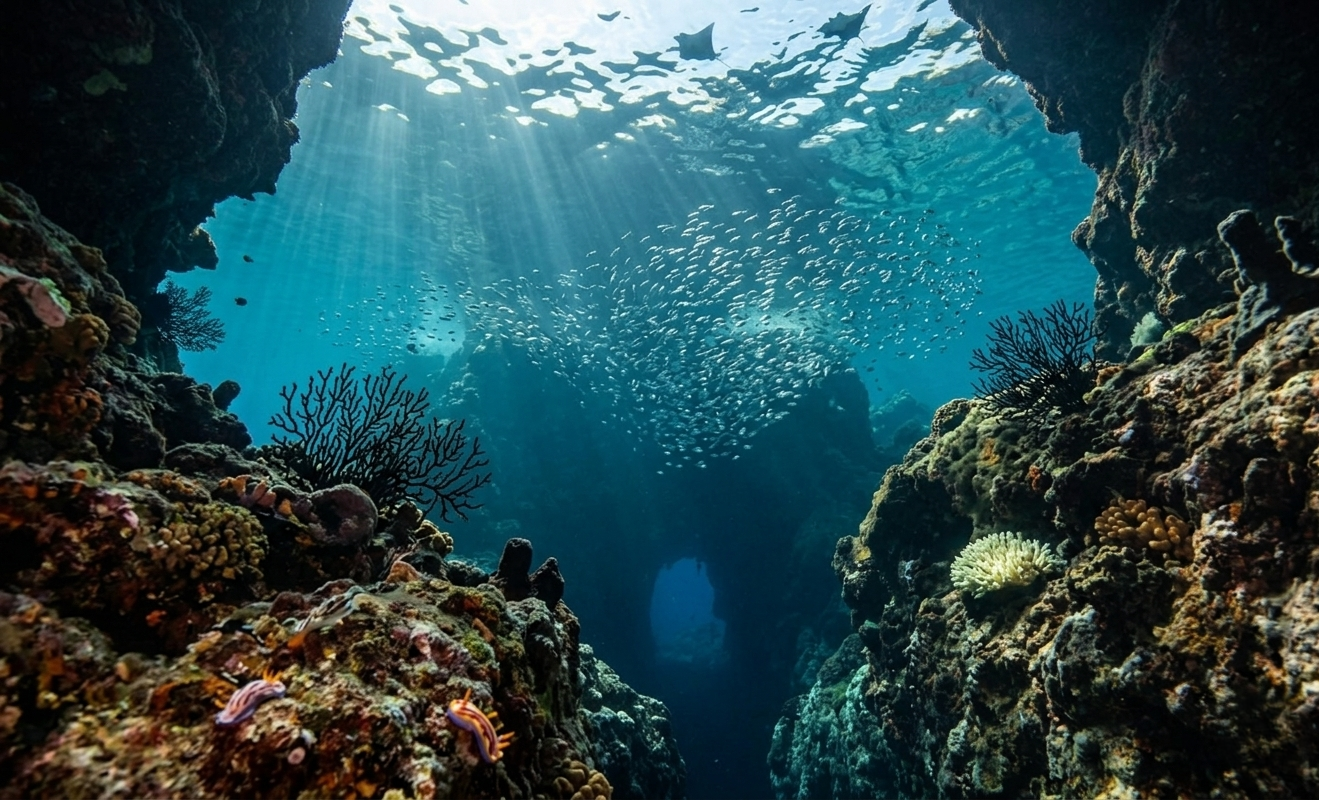
If you were to sit in a submersible like the Limiting Factor, descending into any of these five pits, you would witness a transition of color that stays with you forever. The bright turquoise of the surface fades to a bruised royal blue. Then a deep, ink-like indigo. At 3,000 feet, the last photon of sunlight dies.
From there, it’s a two-hour fall through the "Midnight Zone." You see sparks of bioluminescence—living fireworks triggered by the motion of your hull. It is a fragile, lonely light.
When you finally reach the bottom of the Tonga or the Mariana, you aren't just at the bottom of the sea. You are at the edge of the tectonic conveyor belt. You are standing at the point where the surface of the Earth is being recycled back into the molten heart of the planet.
We call them trenches, but they are actually portals. They are the only places where we can glimpse the true scale of the Earth's engine. We look down into them and feel small, not just because of the depth, but because of the silence. It is a silence that has persisted for eons, indifferent to the rise and fall of empires, the invention of the steam engine, or the frantic buzzing of the internet.
The Pacific keeps its secrets in these five deep pockets. We are only just beginning to learn how to listen to the crushing weight of the truth they hold.
The water stays still. The pressure remains constant. The conveyor belt moves on, an inch at a time, swallowing the world to make it new again.