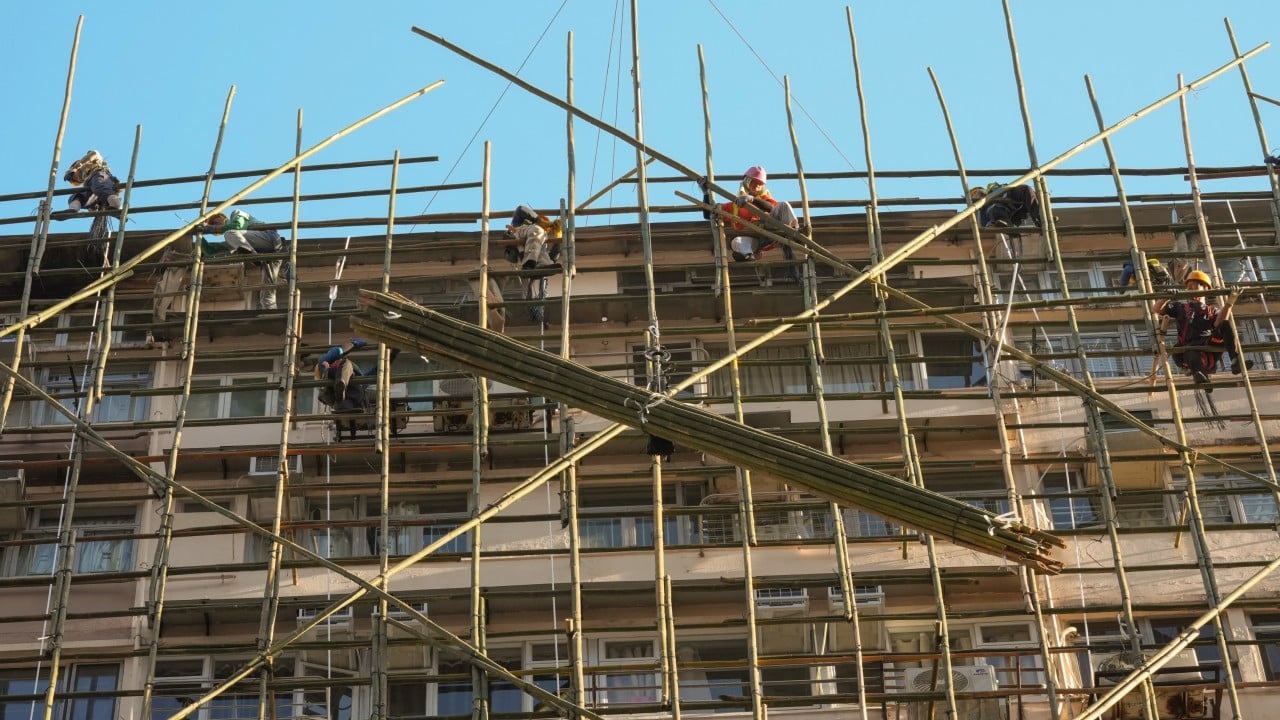
The air in Tai Po still carried the acrid, metallic tang of melted plastic and charred wood. It is a smell that clings to the back of the throat, a persistent reminder of how quickly a neighborhood’s peace can evaporate into a black plume of smoke. Just days after a massive blaze ripped through the district, sending residents scrambling for safety and firefighters into the mouth of a furnace, a single image began to circulate. It wasn't a photo of a hero or a victim. It was a photo of a man in a yellow hard hat, perched on bamboo scaffolding, casually lighting a cigarette.
He sat there, suspended between the sky and the street, seemingly oblivious to the irony of his actions. To him, it was likely just a break—a brief reprieve from the back-breaking labor of Hong Kong’s construction industry. But to a city still reeling from the sight of orange flames licking the sky, that tiny spark at the end of his cigarette felt like a betrayal.
Safety isn't just a set of rules printed in a handbook. It is a social contract. When we live in a city as dense as this one, where buildings lean against one another like exhausted commuters on the MTR, the negligence of one person becomes the vulnerability of a thousand.
The Ghost of the Fire
To understand why a single smoker on a ledge triggered such visceral fury, you have to look at what happened forty-eight hours prior. Fire is a living thing. It breathes, it hungers, and in the cramped quarters of an industrial or residential block, it moves with a terrifying, liquid speed. When the Tai Po fire broke out, it wasn't just a news headline. It was the sound of glass shattering from heat. It was the sight of elderly residents being carried down stairwells by men half their age.
When the smoke finally cleared, the community was left in a state of high-alert fragility. In the psychology of a disaster, the period immediately following the event is marked by "hyper-vigilance." Every smell of burning toast, every flicker of an unregulated light, and certainly every open flame becomes a potential catalyst for a repeat of the trauma.
Then came the man on the scaffolding.
He represents a specific kind of "invisible stake." On a construction site, the risks are already astronomical. You have flammable solvents, sawdust, nylon safety netting that—despite being treated—can catch under the right conditions, and the ever-present wind tunnels created by high-rise canyons. A cigarette butt flicked from a height of twenty stories doesn't just fall; it drifts. It finds its way into crevices, into trash bins, or onto the dry fabric of a neighbor's drying laundry.
The Anatomy of an Oversight
Let’s step into the boots of that laborer for a moment. This isn't to excuse the behavior, but to understand the systemic failure.
Imagine it is 32 degrees Celsius with 90 percent humidity. You have been hauling materials since 7:00 AM. Your muscles are screaming, and the heat coming off the concrete is a physical weight. The "smoking area" is likely ten floors down and across a busy site. To go there is to lose twenty minutes of your break. So, you stay on the bamboo. You light up. You think, "It’s just one cigarette. I'm careful."
This is the "Normalization of Deviance." It is a term used by NASA to describe how people grow so accustomed to a small risk that they stop seeing it as a risk at all. The first time you smoke on the scaffolding and nothing happens, you feel a little guilty. The hundredth time you do it, it’s just part of the job.
But the "careful" smoker is a myth. Fire does not care about your intentions. It only cares about fuel and oxygen.
The public anger wasn't just about the fire risk, though. It was about the perceived lack of respect. In a city where space is the most precious commodity, the act of smoking in a hazardous area is seen as a claim that your personal convenience is more important than the collective safety of the block. It is a visual representation of a breakdown in the "Lion Rock Spirit"—that old Hong Kong ethos of pulling together to build something better.
The Cost of a Second’s Indulgence
When we talk about workplace safety, we often focus on the worker's life. We talk about harnesses, helmets, and boots. We forget that in an urban environment, the "workplace" overlaps with people's living rooms.
Consider the financial and emotional ripples of a fire caused by such negligence.
- The Displacement: Families forced into temporary shelters, losing heirlooms that no insurance check can replace.
- The Economic Toll: Small businesses shuttered for weeks due to smoke damage or structural inspections.
- The Psychological Scarring: Children who become afraid of the dark or the smell of a barbecue.
The laborer on the scaffolding likely didn't think of himself as a villain. He saw himself as a tired man having a smoke. But the camera lens changed the context. It stripped away his individual exhaustion and replaced it with his role as a guardian of public safety.
Beyond the Hard Hat
The outrage directed at this one individual also points toward a larger, more uncomfortable truth about oversight. Where were the site foremen? What are the protocols for fire safety in a city that is constantly under renovation?
Standard industry practice dictates strict "Hot Work" permits and designated smoking zones. Yet, anyone who walks the streets of Sham Shui Po, Mong Kok, or Tai Po and looks up can see the reality. We see the rules being bent in the name of efficiency or simple human weariness.
The viral photo acted as a mirror. It forced the construction industry to look at its culture of "Chabuduo"—the idea that something is "good enough." In a high-risk environment, "good enough" is the precursor to catastrophe.
We live in an age of instant accountability. Every window is a potential camera. Every passerby is a witness. For the man in the yellow hard hat, the flick of his lighter was a private moment that became a public scandal. But for the rest of us, it serves as a chilling reminder of how thin the line is between a normal Tuesday and a local tragedy.
Safety is often invisible. We only notice it when it fails. We don't celebrate the thousands of construction sites that go a year without a fire; we only mourn the one that burns. The anger in Tai Po wasn't just about a cigarette. It was the collective scream of a community that realized their lives were being held in the calloused, indifferent hands of a man who thought a five-minute break was worth the risk of a city block.
The man finished his cigarette and, presumably, went back to work. Below him, the charred remains of a building stood as a silent witness. The embers he dropped may have gone out this time, but the trust he burned will take much longer to rebuild.
The true weight of that cigarette wasn't in the tobacco or the filter. It was in the silence of the neighborhood after the sirens stopped, waiting to see if the next spark would be the one that didn't go out.