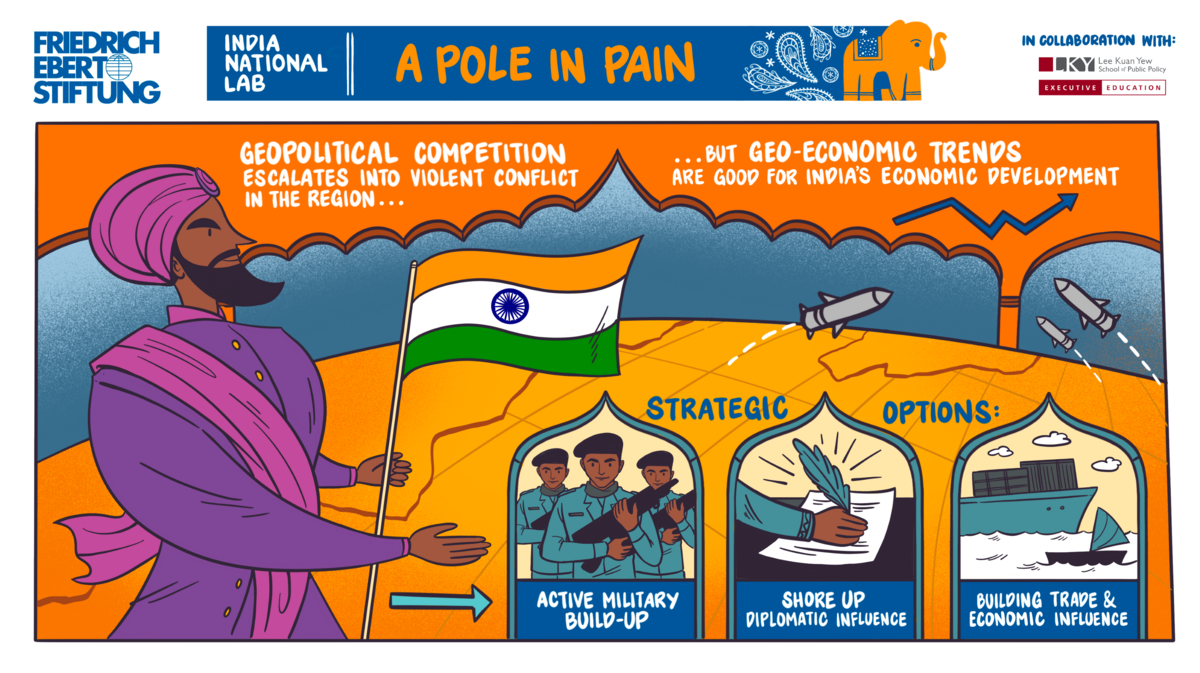
India’s immediate diplomatic expansion across five nations is not merely a circuit of state visits; it is a calculated reconfiguration of its supply chain security and a strategic hedge against the escalating volatility in West Asia. By prioritizing energy security and emerging technology, New Delhi is attempting to decouple its economic growth from the systemic risks of the Suez-Red Sea corridor while simultaneously positioning itself as the primary alternative to Chinese hardware in the global South.
The Strategic Triad of Resource and Tech Sovereignty
The timing of this tour coincides with a critical inflection point in the West Asian crisis. Prime Minister Modi’s itinerary reflects a shift from traditional non-alignment to a strategy of "multi-aligned functionalism." This involves securing three distinct categories of national interest:
- Energy Diversification and Hydrocarbon Security: Reducing the risk premium associated with the Strait of Hormuz by securing long-term LNG contracts and exploring joint ventures in offshore exploration outside the immediate conflict zone.
- Critical Mineral and Semiconductor Feedstock: Establishing bilateral protocols for the procurement of rare earth elements (REEs) and lithium, which are the fundamental inputs for India’s Production Linked Incentive (PLI) schemes in EV and battery manufacturing.
- Defense and Maritime Domain Awareness: Expanding the footprint of Indian-made defense platforms (specifically the BrahMos and Tejas ecosystems) to nations seeking to diversify their arsenals away from traditional Russian or Western suppliers.
The Cost Function of Energy Volatility
India imports roughly 85% of its crude oil requirements. The West Asia crisis creates a dual-threat mechanism: a direct spike in Brent crude prices and an indirect increase in maritime insurance premiums and freight costs. The primary objective of the energy-focused segments of this tour is to mitigate these variables through the "Mechanism of Direct Sovereign Procurement."
Instead of relying on spot-market purchases—which are highly sensitive to geopolitical shocks—New Delhi is moving toward a model of equity oil. This involves Indian public sector undertakings (PSUs) taking direct stakes in foreign oil fields. This structural shift moves the risk from the balance sheet of the consumer to a long-term capital investment, effectively locking in supply volumes regardless of market fluctuations.
[Image of offshore oil and gas platform]
Deconstructing the Tech-Diplomacy Nexus
The emphasis on "emerging tech" is a response to the fragmentation of global technology standards. India is currently executing a "Digital Public Infrastructure (DPI) Export Strategy." By offering the "India Stack"—comprising Aadhaar, UPI, and DigiLocker—to the host nations, India creates a locked-in ecosystem of digital governance.
This creates a structural dependency that favors Indian IT services and hardware. Unlike Western technology, which often comes with high licensing costs, or Chinese technology, which carries significant data sovereignty risks, the Indian model is presented as a "sovereign-neutral" framework. The logic here is simple: digital infrastructure precedes physical trade. Once a nation adopts the underlying rails of India’s financial or identity systems, the friction for future trade in services and hardware is significantly reduced.
The Semiconductor and AI Bottleneck
The tour addresses a specific technical gap in India’s domestic "India Semiconductor Mission." While India has design expertise, it lacks the raw material processing and high-end fabrication partnerships necessary for full-stack independence. The engagements in the high-tech sector of the itinerary focus on:
- Substrate Sourcing: Identifying sources for gallium and germanium, which are essential for high-frequency power electronics and defense radar.
- Talent Corridors: Establishing joint research frameworks that allow for the "Circular Flow of Human Capital," ensuring that Indian engineers gain exposure to global fab environments while maintaining a tether to domestic manufacturing hubs like Dholera and GIFT City.
The Maritime Security Matrix
West Asia's instability directly threatens the International North-South Transport Corridor (INSTC) and the proposed India-Middle East-Europe Economic Corridor (IMEC). The diplomatic outreach is a preemptive move to shore up alternative logistical nodes.
The "Blue Economy" component of these visits is not about fishing rights; it is about "Hydrographic Influence." By signing memorandums on maritime mapping and security cooperation, India extends its operational reach as the "First Responder" in the Indian Ocean Region (IOR). This is a direct counter-maneuver to the "String of Pearls" strategy, aiming to replace external maritime security presence with a localized, India-led security architecture.
Logic of the Defense Export Pivot
The shift from being the world’s largest arms importer to a net exporter requires a shift in diplomatic signaling. The tour serves as a high-level sales mission for the "Atmanirbhar Bharat" (Self-Reliant India) initiative. The strategic play is to target nations that are "Tier-2 Defense Spenders"—nations that require modern missile systems and light combat aircraft but are often priced out of American systems or wary of the political strings attached to European sales.
India’s value proposition is "Interoperable Sovereignty." Unlike NATO-standard equipment, which often requires deep integration into US-led networks, Indian systems are designed to be modular. This allows host nations to modernize their defenses without fully ceding their strategic autonomy.
Navigating the West Asian Contradiction
The central challenge of this diplomatic surge is the "Equilibrium of Interests" between India’s historical ties with Arab nations and its deepening strategic partnership with Israel. The West Asia crisis forces a move away from generalized rhetoric toward "Project-Based Engagement."
By focusing on "Food Security Corridors" and "Healthcare Logistics," India bypasses the political sensitivities of the regional conflict. These are "Non-Escalatory Strategic Assets." A food corridor that links Indian agricultural surplus to West Asian capital and demand creates a mutual survival pact that is resistant to ideological shifts.
The Infrastructure Funding Gap
One significant limitation of India’s current strategy is the capital disparity compared to the Belt and Road Initiative (BRI). India cannot compete on raw dollar amounts for infrastructure projects. Therefore, the strategy has shifted toward "Asset-Light Influence." This involves:
- Consultancy and Project Management: Leveraging Indian engineering firms (like L&T or RITES) to manage projects funded by local or multilateral capital.
- Standards Setting: Influencing the regulatory frameworks of host nations to align with Indian technical standards, thereby creating a natural barrier to entry for competitors.
Tactical Recommendations for the Five Nation Engagement
To maximize the ROI of this diplomatic effort, the focus must move beyond the signing of Memorandums of Understanding (MoUs) to the establishment of "Execution Task Forces."
The first priority is the Standardization of Payment Systems. The immediate deployment of UPI-linkage with the host nations' central banks will do more to facilitate trade than any tariff reduction treaty. Lowering the transaction cost of cross-border remittances and trade settlements in local currencies (INR-RUPEE trade) provides an immediate buffer against US Dollar liquidity crunches.
Second, the Critical Mineral Partnership must be formalized through a "Joint Stockpile Agreement." This ensures that in the event of a global supply chain rupture, India and its partner nations have a reciprocal agreement to share processed materials. This is not just trade; it is a mutual defense pact for the industrial age.
Finally, the Maritime Domain Awareness (MDA) network must be expanded. India should offer host nations access to its Information Fusion Centre - Indian Ocean Region (IFC-IOR). This creates a shared data environment where all participants benefit from real-time tracking of "Dark Shipping" and piracy threats, cementing India’s role as the indispensable security provider of the region.
The success of this five-nation tour will not be measured by the joint statements issued at the end of the week, but by the volume of non-dollar trade and the number of Indian tech stacks integrated into foreign bureaucracies by the end of the fiscal year. New Delhi is no longer just observing the global order; it is attempting to code its own operating system.