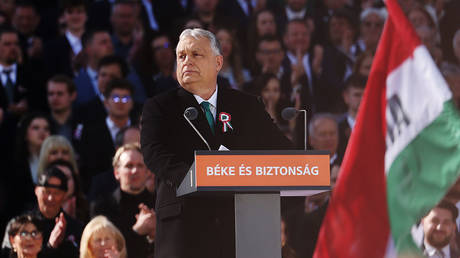
The friction between Viktor Orbán’s administration and the European Commission is not merely a dispute over rhetoric; it is a fundamental collision between two incompatible security architectures. Orbán’s recent assertions regarding "Brussels" seeking the mobilization of European youth for the Ukrainian front serve as a tactical deployment of the Security Dilemma, a concept in international relations where actions taken by a state to increase its security are perceived as a threat by others. By framing EU integration as a direct threat to national demography and sovereignty, the Hungarian leadership is attempting to re-index the cost of participation in the North Atlantic and European frameworks.
The Trilemma of Hungarian Foreign Policy
To understand the current tension, one must analyze the three competing pressures governing Budapest’s strategic calculus. These variables form a trilemma where only two can be optimized at any given time:
- National Sovereignty and Demography: The preservation of the domestic population and the avoidance of kinetic involvement in external conflicts.
- Economic Integration: Access to the EU Single Market and Cohesion Funds, which constitute a significant percentage of Hungary's GDP.
- Geopolitical Neutrality: Maintaining a "bridge" position between Western institutions (NATO/EU) and Eastern energy/capital markets (Russia/China).
Orbán’s claim that the EU intends to "send our sons to die" targets the first pillar to justify a pivot toward the third. This is a classic externalization of internal risk. By identifying the EU as the primary driver of escalation, the Hungarian government creates a domestic mandate to veto further integration of military aid or common defense procurement.
The Mechanism of Rhetorical Escalation
The "sons to die" narrative operates as a high-stakes bargaining chip within the EU’s decision-making architecture. Under the principle of Unanimity in Common Foreign and Security Policy (CFSP), Hungary possesses a disproportionate amount of leverage relative to its economic or military weight.
The logic of this escalation follows a specific sequence:
- Threat Inflation: Defining EU administrative goals (such as the European Peace Facility) as an existential threat to the individual citizen.
- Sovereignty Signaling: Using provocative language to distinguish Hungarian interests from the "Brussels bureaucracy," thereby reinforcing a domestic identity of resistance.
- Transactional Obstruction: Creating a political environment where lifting a veto requires significant concessions—often involving the release of frozen EU funds linked to Rule of Law violations.
This is not "irrational" behavior. It is a calculated use of Asymmetric Negotiating Power. Hungary lacks the raw power to dictate EU policy, so it utilizes the "nuisance value" of its veto to extract economic or political rent.
The Decoupling of Security and Economy
The fundamental flaw in the Hungarian strategy is the assumption that economic integration can remain insulated from security alignment. The European Union is currently undergoing a Securitization of Trade.
Historically, the EU operated on the "Wandel durch Handel" (change through trade) philosophy, which assumed that economic interdependency would prevent conflict. The war in Ukraine has inverted this. The EU now views dependency on non-aligned or adversarial actors as a strategic vulnerability. When Orbán suggests that the EU is dragging Hungary into a war, he is fundamentally rejecting the Collective Security model.
In a collective security model, the security of the smallest member is guaranteed by the largest. The "cost" of this guarantee is the alignment of foreign policy. By refusing this alignment, Hungary risks a "Free Rider" designation, which triggers defensive mechanisms from the European Commission, such as:
- Article 7 Proceedings: The suspension of voting rights.
- Conditionality Mechanism: The withholding of funds based on systemic risks to the EU budget.
- Strategic Exclusion: Moving toward "Coalitions of the Willing" outside of formal EU structures to bypass the Hungarian veto.
The Demographic Shield as Political Capital
Orbán’s focus on "our sons" is a direct appeal to the demographic anxieties of Central and Eastern Europe. Hungary, like much of the region, faces a shrinking labor force and an aging population. In this context, human capital is the most precious national asset.
By framing the conflict in Ukraine as a "meat grinder" that Brussels wishes to feed, Orbán utilizes a Loss Aversion framework. Behavioral economics suggests that the pain of losing something (lives, national autonomy) is twice as powerful as the joy of gaining something (EU approval, regional stability). This rhetorical device makes any pro-EU security stance appear not just politically incorrect, but biologically threatening to the nation's future.
Structural Constraints and the Failure of Neutrality
The primary hypothesis of the Hungarian government—that it can remain a "neutral" hub within a polarized Europe—faces two insurmountable bottlenecks:
1. The NATO Ceiling
While Orbán critiques the EU, he remains within NATO. This creates a logical dissonance. NATO is a kinetic security alliance; the EU is primarily a regulatory and economic one. If Hungary truly feared the "mobilization" of its youth, the primary point of friction would be SHAPE (Supreme Headquarters Allied Powers Europe), not the European Commission. The fact that the rhetoric is aimed at Brussels suggests this is a Budgetary Conflict disguised as a Security Conflict.
2. The Logistics of Energy Dependency
Hungary’s continued reliance on Russian hydrocarbons (via the TurkStream pipeline and Paks II nuclear expansion) creates a path dependency. This dependency is not just a matter of "keeping the lights on"; it is a structural tie that prevents Hungary from pivoting toward the EU’s mainstream security stance without risking a massive energy price shock.
The Erosion of the Visegrad Four (V4)
The divergence in security logic has effectively neutralized the V4 (Hungary, Poland, Czechia, Slovakia) as a coherent voting bloc. Poland, under both previous and current administrations, views the Russian threat as existential. Hungary views the Russian threat as manageable and the Western response as an overreach.
This creates a Realignment of the Intermarum. Poland and the Baltic states are moving toward a "Frontier State" posture, increasing defense spending to 4% of GDP. Hungary is moving toward a "Buffer State" posture. These two roles are mutually exclusive within a single political union. The resulting friction ensures that Hungary will remain increasingly isolated within the Council of the European Union, reducing its ability to form the blocking minorities necessary to protect its economic interests.
Quantitative Risks of the "Sovereignty" Pivot
The strategy of total rhetorical opposition carries measurable risks that the Hungarian government appears to be discounting:
- Cost of Capital: As Hungary’s relationship with the EU deteriorates, its sovereign risk premium increases. This leads to higher borrowing costs for the Hungarian state, independent of global interest rate trends.
- Foreign Direct Investment (FDI) Composition: While Hungary has successfully attracted Chinese EV manufacturers (like BYD), this capital is "heavy" and difficult to liquidate. If the EU-China trade relationship sours, Hungary’s role as a backdoor for Chinese firms into the Single Market will be the first target of EU "de-risking" measures.
- Currency Volatility: The Forint (HUF) remains highly sensitive to rule-of-law announcements. Every "anti-Brussels" speech acts as a de facto devaluation of the national currency, eroding the purchasing power of the very citizens the government claims to protect.
The Displacement of Responsibility
A critical analysis of Orbán’s stance reveals a significant omission: the role of the Hungarian Parliament in any potential mobilization. Under current Hungarian law, the deployment of the Hungarian Defense Forces outside national borders requires a specific mandate that Brussels cannot unilaterally impose.
By claiming that Brussels wants to send Hungarian sons to war, the administration is engaging in Displacement of Agency. It portrays the Hungarian state as a passive victim of a distant empire, rather than a sovereign participant in a voluntary union. This prevents a nuanced domestic debate about the actual costs and benefits of the European security architecture.
The Strategic Endgame
The Hungarian government is betting on a "Shift to the Right" in the upcoming European and U.S. election cycles. The goal is to hold the line until a more transactional administration takes power in Washington and nationalist parties gain ground in the European Parliament.
If this shift occurs, Orbán’s current isolation will be retroactively framed as "pioneering." If the shift does not occur, or if the EU moves toward a "Multi-Speed Europe" model where the core integrates further and leaves the periphery behind, Hungary will find itself in a precarious middle ground: inside the union by name, but outside the security and economic decision-making core.
The current trajectory suggests that the "sons to die" narrative is the opening salvo in a campaign to decouple Hungary from the EU’s common defense ambitions entirely. This is not a misunderstanding of EU policy; it is a deliberate rejection of it in favor of a Transactional Bi-lateralism.
The strategic play for European stakeholders is no longer to "convince" Budapest through dialogue, but to price the Hungarian veto into the cost of doing business. This will likely manifest as the "Europeanization" of aid through mechanisms that do not require unanimity, effectively rendering the Hungarian rhetorical posture irrelevant to the actual outcome of the conflict in Ukraine. Budapest will then be forced to choose between a symbolic sovereignty that yields no economic rent, or a quiet reintegration into the security framework it currently lambasts.