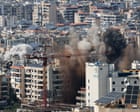
The probability of a durable ceasefire in the Middle East is currently inversely proportional to the escalation in secondary theaters of conflict. While diplomatic efforts focus on the immediate borders of Gaza, the operational reality has shifted toward a multi-front attrition model involving the Israeli Defense Forces (IDF) in Lebanon and Iranian maritime interdiction in the Persian Gulf. This creates a strategic bottleneck: localized peace deals cannot hold when the regional security architecture is being actively dismantled. The survival of a ceasefire depends on three interdependent variables: the IDF’s kinetic threshold in Lebanon, the Iranian "Tanker War" 2.0 as a leverage mechanism, and the collapse of the mediation-incentive structure.
The Lebanese Front: Kinetic Thresholds and Buffer Zone Mechanics
Military operations in Lebanon represent a shift from counter-insurgency to territorial denial. The IDF’s objective is the enforcement of a de facto security zone north of the Blue Line, predicated on the failure of UN Resolution 1701. The current escalation follows a specific escalatory ladder:
- Degradation of Command and Control: The systematic elimination of mid-to-high level Hezbollah leadership designed to induce organizational paralysis.
- Infrastructure Attrition: Targeting weapons storage facilities within civilian population centers to force a mass displacement, creating a political cost for the Lebanese government.
- The Buffer Enforcement: Preparing for or executing ground incursions to push Hezbollah’s anti-tank guided missile (ATGM) teams beyond the 7-10 kilometer range, which is the effective strike distance for Israeli border communities.
The logic of the Israeli cabinet is driven by the internal pressure of approximately 60,000 displaced citizens. Until these individuals can return to the north without the threat of direct-fire weapons, the IDF maintains a mandate for escalation. This creates a "Security Dilemma" where any Hezbollah pullback is viewed as a tactical retreat for regrouping, rather than a commitment to peace, prompting further Israeli strikes to prevent that regrouping.
Maritime Interdiction: The Iranian Oil Tanker Leverage
Concurrent with the northern front escalation, Iran has reactivated its maritime leverage in the Strait of Hormuz. The seizure or blockage of oil tankers serves as a non-kinetic signaling device intended to raise the global economic cost of supporting Israeli military objectives. This is not a random act of aggression but a calculated application of the "Cost Function of Global Trade."
The Strait of Hormuz acts as a choke point for roughly 20-30% of the world’s total consumption of petroleum liquids. When Iran blocks or harasses tankers, it triggers a predictable sequence in global markets:
- Insurance Premiums: War risk insurance for shipping vessels in the Persian Gulf spikes, adding millions in operational costs per transit.
- Supply Chain Latency: Tankers are rerouted or delayed, creating temporary shortages that drive up Brent Crude prices.
- Diplomatic Pressure: Iran uses these economic ripples to force European and Asian energy importers to pressure the United States into restraining Israeli military actions.
By linking the security of the Lebanese border to the security of global energy flows, Tehran creates a "Nested Conflict" where a ceasefire in one area is impossible without concessions in another. The blockage of tankers is a direct response to the perceived imbalance of power on the ground; as Hezbollah faces tactical setbacks, Iran increases the pressure on the global commons to restore a strategic equilibrium.
The Failure of the Mediation-Incentive Structure
The standard model for Middle East mediation relies on a "Carrot and Stick" framework that has become decoupled from the current reality. Traditionally, the U.S. and regional partners like Qatar and Egypt offer reconstruction aid (the carrot) and the threat of diplomatic isolation (the stick). This structure is failing for two reasons.
First, the Incentive Asymmetry between state and non-state actors is at an all-time high. A sovereign state like Israel calculates risk based on long-term national viability and international standing. Non-state actors like Hezbollah or the Houthis calculate risk based on ideological persistence and the maintenance of their "Resistance" brand. Economic aid or diplomatic recognition holds little value for a group whose primary utility is perpetual conflict.
Second, the Information Gap in mediation is widening. Negotiators are often working with outdated intelligence regarding the internal red lines of the combatants. For example, while mediators may believe a cessation of hostilities in Gaza will lead to a Lebanese de-escalation, Hezbollah has increasingly decoupled its "Support Front" from Gaza’s specific outcomes, tying its actions instead to broader Iranian regional goals.
The Logistics of Attrition: Why Ceasefires Dissolve
Ceasefires in this region frequently collapse because they are negotiated as "stops" rather than "solutions." An analytical breakdown of these failures reveals a recurring pattern:
- The Rearmament Window: Both sides use a temporary lull to replenish munitions and rotate exhausted personnel. If the ceasefire does not include a verifiable monitoring mechanism for weapon smuggling—specifically across the Syrian-Lebanese border—the peace is merely a tactical pause.
- The "Spoilers" Effect: Smaller, less disciplined factions or splinter groups within the broader coalitions often launch "nuisance" attacks (rocket fire or drone launches) to provoke a response. Under current ROE (Rules of Engagement), even a minor provocation often triggers a disproportionate retaliatory cycle.
- Economic Decoupling: In previous decades, trade and labor movement between Israel and its neighbors provided a stabilizing economic floor. The current total severance of these ties means there is no "Peace Dividend" for the average participant, removing the domestic appetite for restraint.
Strategic Forecast: The Shift Toward Managed Instability
The data suggests that a comprehensive regional ceasefire is an unrealistic short-term goal. Instead, the region is moving toward a state of "Managed Instability." This involves a series of high-intensity, localized skirmishes that stop just short of total regional war.
For Israel, the priority is the "Mowing the Grass" strategy on a larger scale—periodically degrading the capabilities of Lebanon-based threats to buy 2-5 years of relative quiet. For Iran, the strategy is "Strategic Depth," ensuring that conflict remains on Israel’s borders rather than its own, using the tanker seizures as a pressure valve to prevent a full-scale assault on its domestic infrastructure.
The most likely trajectory is not a signed peace treaty but a "Functional Stalemate." This occurs when the cost of further escalation exceeds the perceived benefits for both sides. However, the margin for error is razor-thin. A single miscalculation—such as a strike on a high-value energy facility in the Gulf or a mass-casualty event in a major civilian center—would collapse the stalemate and force a transition from managed instability to a direct, uncontained regional conflict.
The strategic play for external actors is no longer the pursuit of a grand bargain, but the reinforcement of specific "red lines" through naval presence in the Gulf and the provision of advanced air defense systems to stabilize the attrition rates. Security will be found not in the absence of conflict, but in the containment of its geography.