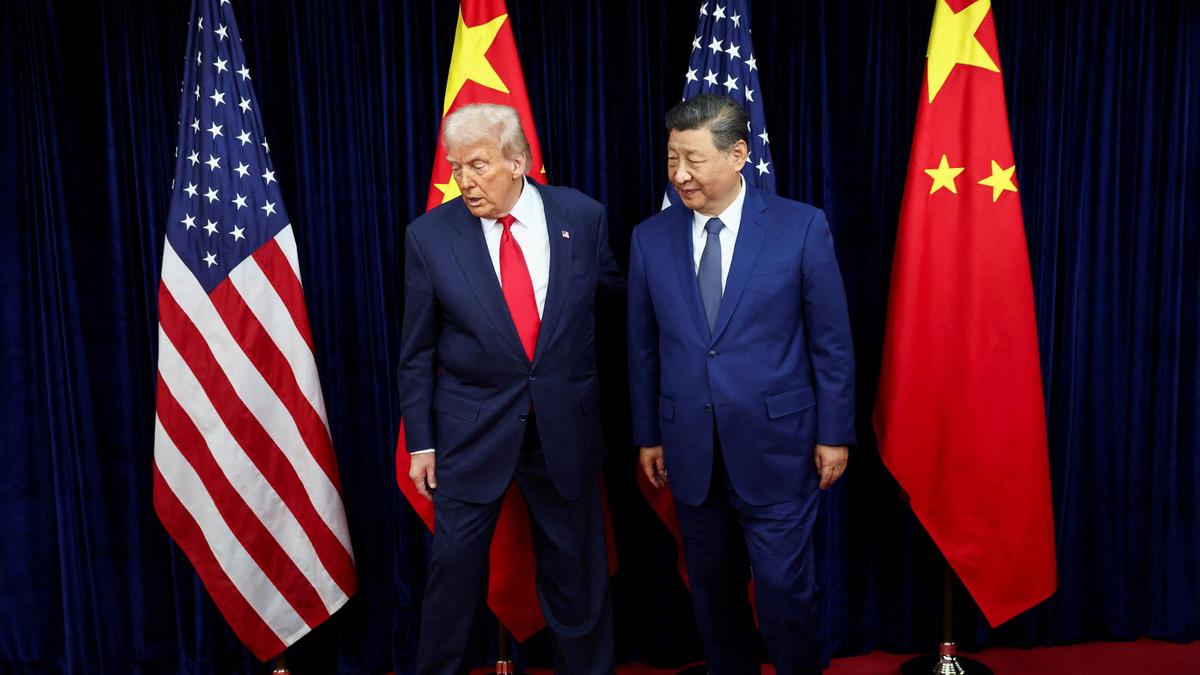
The rescheduling of a presidential visit to China following a kinetic conflict in the Middle East is not merely a calendar adjustment; it is a recalibration of global leverage. When the executive branch shifts focus from the Persian Gulf to the South China Sea, it signaled a transition from high-cost attritional warfare to high-stakes economic and technological containment. This visit represents the intersection of three specific strategic pressures: the stabilization of energy markets post-hostilities, the acceleration of the "Clean Network" decoupling, and the renegotiation of the bilateral trade deficit under a new security paradigm.
The Conflict-to-Commerce Transmission Mechanism
Military engagement in Iran creates an immediate inflationary shock through the Strait of Hormuz, affecting 20% of the world’s petroleum liquids. For the United States, the conclusion of such a conflict allows for a "de-risking" of the domestic economy, but for China—the world’s largest net importer of oil—the stakes are asymmetrical. The May visit occurs at the precise moment when Beijing’s energy vulnerability is at a peak, having depleted strategic reserves to mitigate wartime price spikes.
- The Energy Leverage Coefficient: By securing the Persian Gulf through military presence and subsequently visiting China, the U.S. demonstrates control over the primary input of Chinese industrial manufacturing. This creates a psychological and economic floor for the negotiations.
- The Inflationary Arbitrage: Post-war, the Federal Reserve’s interest rate trajectory is often influenced by energy costs. A visit that stabilizes U.S.-China relations reduces the "uncertainty premium" in global markets, lowering the cost of capital for American firms while simultaneously limiting China’s ability to use its massive treasury holdings as a weapon of financial warfare.
The Decoupling Architecture: Semi-Conductors and Sovereignty
While the public narrative focuses on trade balances, the core of the May summit is the structural partitioning of the global technology stack. The "Three Pillars of Decoupling" serve as the analytical framework for understanding the negotiations:
- Pillar 1: Lithography and Logic: The U.S. objective is to maintain a "two-generation gap" in semiconductor manufacturing. This visit will likely see the enforcement of stricter export controls on Extreme Ultraviolet (EUV) lithography equipment, framed as a security necessity following the Iranian conflict, where dual-use technologies played a critical role.
- Pillar 2: Data Localization and Privacy: The U.S. is pushing for a digital "iron curtain" that prevents the flow of sensitive citizen data to entities under the influence of the Chinese Communist Party. This involves renegotiating the terms under which Chinese cloud providers operate within the Western sphere.
- Pillar 3: Rare Earth Dependency Redundancy: China controls over 80% of the world's refined rare earth elements. The U.S. strategy involves building a "Resilient Mineral Alliance" with Australia and Canada, using the May visit to dictate the terms of China’s market access in exchange for continued, albeit limited, mineral flow.
The relationship between these pillars is not linear; they are interdependent. For instance, a failure to secure Pillar 1 (chips) makes Pillar 2 (data) irrelevant, as the hardware itself becomes the primary vector for data exfiltration.
The Cost Function of Post-War Diplomacy
Every diplomatic move has an opportunity cost, often ignored in standard news reporting. By choosing May for the visit, the administration is calculating that the "exhaustion phase" of the Iran conflict has reached a point where Beijing will be more inclined to offer concessions in exchange for regional stability.
The cost function of this delay can be expressed through three primary variables:
- The Time-Decay of Sanctions: The efficacy of economic sanctions against Iran was bolstered by Chinese compliance (or lack thereof). Delaying the visit until May allows the U.S. to monitor Chinese adherence to post-war sanctions, using that data as a "compliance score" during the trade talks.
- The Domestic Electoral Cycle: In a 2026 context, the timing aligns with the lead-up to midterm and primary cycles. A "tough on China" stance, validated by a successful high-level summit, provides a narrative of global leadership that balances the domestic fatigue associated with the Iran intervention.
- The Southeast Asian Security Buffer: The postponement allowed for the fortification of the AUKUS and Quad alliances. By the time the visit occurs in May, the U.S. has already "shored up" its flank in the Philippines and Japan, entering Beijing not as a supplicant for peace, but as a regional hegemon with a reinforced perimeter.
Structural Deficits and the Manufacturing Re-Shoring Mandate
The trade deficit is a symptom, not the disease. The disease is the loss of critical manufacturing capability. The May negotiations will likely pivot from simple tariffs to "Mandatory Domestic Sourcing" (MDS) requirements.
- The Capital Allocation Problem: For decades, U.S. firms have chased the "China Margin"—the 15-20% cost savings associated with offshore production. The administration’s goal is to negate this margin through a combination of "Border Adjustment Taxes" and "Domestic Production Credits."
- The Logistics Bottleneck: Post-Iran war, global shipping routes are stressed. The U.S. strategy involves leveraging this stress to encourage "Near-Shoring" in Mexico and South America, effectively reducing China’s role as the "World’s Factory."
The second limitation of the current trade relationship is the "Intellectual Property Leakage." Traditional trade deals have failed to stop state-sponsored corporate espionage. The May summit will likely introduce a "Verification Protocol" where Chinese firms must submit to third-party audits of their R&D processes to maintain access to the U.S. market—a demand that Beijing will find strategically intolerable, yet economically necessary.
Strategic Recommendation: The High-Friction Engagement
The path forward requires a shift from "Engagement for Reform" to "Engagement for Containment." The May visit should not aim for a comprehensive "Grand Bargain," which is historically prone to failure and non-compliance. Instead, the administration must pursue a "Friction-Based Stabilization."
This involves three tactical plays:
- Asymmetric Concessions: Trade agricultural exports (which benefit the U.S. heartland) for strict, verifiable limits on Chinese sub-sea cable investments. This prioritizes food security for China in exchange for digital security for the West.
- The "Two-Track" Dialogue: Maintain a high-profile, public-facing "Cooperation Track" on climate and global health to satisfy international observers, while simultaneously running a private, low-profile "Security Track" that outlines the specific economic triggers for further technological sanctions.
- The Currency Corridor: Establish a narrow corridor for RMB-USD exchange rates linked to the trade balance. If the deficit exceeds a specific threshold, the corridor shifts, effectively taxing Chinese exports via currency manipulation penalties.
The goal is not to "fix" the relationship, but to manage its inevitable decline in a way that maximizes U.S. technological and military superiority during the transition to a multipolar world. The May summit is the opening gambit in this new, more clinical phase of geopolitical competition.