The global economy operates on a precarious reliance on the 180-kilometer stretch of water separating mainland China from Taiwan. While mainstream analysis often focuses on the immediate theater of kinetic warfare, the true risk lies in the structural fragility of the global supply chain and the specific technical dependencies that render the Strait of Taiwan a singular point of failure for the 21st century. The strategic importance of this waterway is defined by three intersecting variables: the density of maritime commercial transit, the concentration of high-end semiconductor manufacturing, and the physics of subsea data infrastructure.
The Logistics of the Strait A Quantitative Assessment
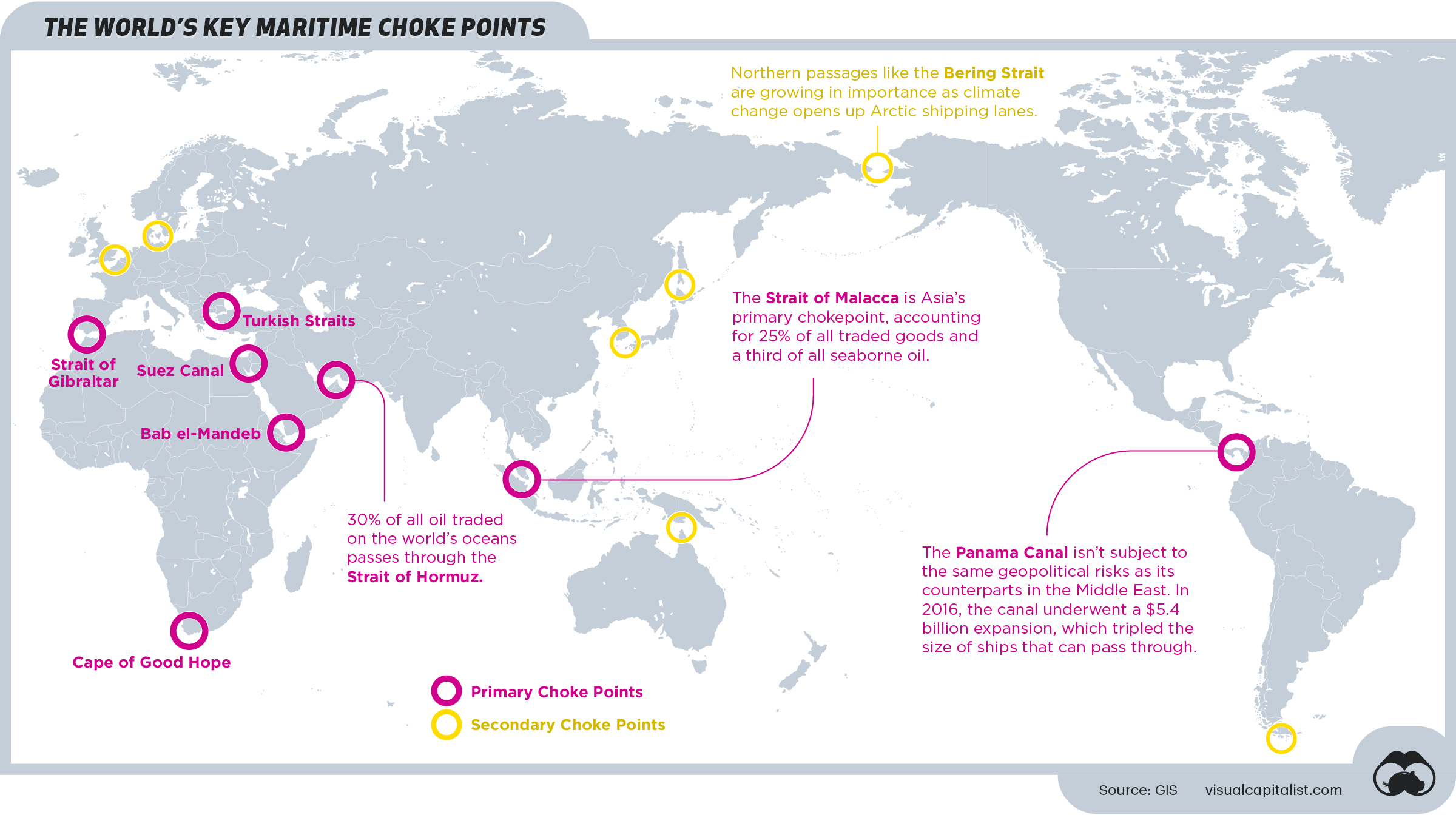
The Strait of Taiwan is not merely a regional channel; it is the primary artery for trade moving from the manufacturing hubs of Northeast Asia—specifically Japan, South Korea, and Northern China—toward the markets of Europe and the Middle East. Roughly 50% of the global container fleet and nearly 90% of the world's largest ships by tonnage pass through this corridor annually.
The logistical risk is governed by the Principle of Rerouting Elasticity. In the event of a blockade or a declared exclusion zone, maritime traffic must divert to the east of Taiwan into the Philippine Sea. This is not a simple geographic shift; it introduces specific operational stressors:
- Fuel and Time Penalties: Rerouting adds approximately three to four days of steaming time for vessels bound for the Malacca Strait. For a standard 20,000 TEU (Twenty-foot Equivalent Unit) container ship, this translates to an additional $500,000 to $800,000 in fuel costs alone, depending on current bunker prices.
- The Insurance Risk Premium: The moment the Strait is classified as a "listed area" by the Joint War Committee, hull and cargo insurance premiums spike. In previous maritime conflicts, these "war risk" premiums have reached 1% of the total vessel value per voyage, potentially adding millions in overhead before a single container is offloaded.
- Port Congestion Cascades: Global shipping operates on a "just-in-time" cadence. A three-day delay for 50% of the global fleet creates a backlog at destination ports like Singapore, Rotterdam, and Jebel Ali. This produces a bullwhip effect where temporary delays in the Strait manifest as weeks of port congestion globally, seizing up container availability and driving up freight rates.
The Silicon Shield Logic and the Failure of Diversification
The concept of the "Silicon Shield" suggests that Taiwan’s dominance in semiconductor fabrication—specifically via TSMC—deters conflict because a disruption would be mutually assured economic destruction. However, this logic ignores the Decoupling Lag. While the United States and the European Union are investing hundreds of billions via the CHIPS Acts to localize production, the actual migration of leading-edge lithography (3nm and below) takes a decade, not a year.
Taiwan produces over 60% of the world’s semiconductors and roughly 90% of the most advanced logic chips. The vulnerability here is not just the physical fabs, but the Integrated Ecosystem Dependency. A semiconductor fab is not a standalone factory; it is the node of a hyper-specialized network.
- Upstream Vulnerability: Fabs require a constant inflow of specialty chemicals, ultra-high-purity gases, and silicon wafers. Most of these materials arrive via the very ports that would be the first targets of a blockade.
- The Power Grid Constraint: Advanced lithography (EUV) is incredibly energy-intensive. A single EUV machine consumes approximately 1 megawatt of power. Taiwan’s power grid is an "islanded" system with no external interconnects. Any disruption to LNG (Liquefied Natural Gas) shipments—which provide 40% of Taiwan's power—effectively shuts down semiconductor production within weeks, regardless of whether the factories themselves are damaged.
The cost function of a total semiconductor stoppage is estimated at over $2 trillion in global GDP loss within the first year. This eclipses the impact of the 2008 financial crisis because, unlike financial capital, specialized physical capital like a 3nm fab cannot be "bailed out" or printed into existence.
Subsea Connectivity and Information Asymmetry
Beneath the waves of the Strait and surrounding waters lies the nervous system of the global internet. Taiwan serves as a critical landing station for at least 15 high-capacity subsea fiber optic cables connecting Southeast Asia to North America and Japan.
The strategic risk here is Symmetric Blindness. In a contested environment, subsea cables are notoriously difficult to protect and remarkably easy to sever using "gray zone" tactics—such as commercial fishing vessels "accidentally" dragging anchors.
A disruption of these cables does more than slow down consumer internet; it halts the synchronized financial data required for global high-frequency trading and cross-border bank settlements. The latency introduced by switching to satellite-based backups (like Starlink) is insufficient for the requirements of modern financial architecture. This creates a state of information asymmetry where the actor initiating the disruption gains a definitive edge in the opening hours of a crisis by knowing exactly when and where the "lights go out."
The Mechanism of Blockade vs. Invasion
Consultants and analysts often conflate a full-scale amphibious invasion with a "constriction" or blockade scenario. From a data-driven perspective, the blockade is the more probable and mathematically complex threat.
A Kinetic Blockade utilizes naval and aerial assets to physically stop ships. However, a Regulatory Blockade is more insidious. If a dominant regional power declares the Strait "internal waters" and demands that all commercial vessels report cargo and seek clearance, it creates a "legal friction" that many commercial shippers will not challenge.
This triggers the Threshold of Non-Intervention. Western powers may be willing to intervene to stop a literal invasion (an act of war), but may find it politically and legally difficult to intervene against "customs inspections" or "maritime safety zones." This creates a bottleneck where the mere threat of legal harassment diverts traffic, achieving the economic goals of a blockade without firing a shot.
Structural Bottlenecks in Energy Security
Taiwan imports nearly 98% of its energy. This creates a fixed survival timeline.
- Coal and Nuclear: While providing a base load, coal is bulky and requires constant replenishment. Nuclear is politically sensitive and currently being phased out in Taiwan.
- LNG (The Critical Variable): Taiwan’s move toward LNG increases its vulnerability. LNG must be stored in specialized cryogenic tanks, and Taiwan’s current storage capacity is estimated at only 7 to 11 days during peak summer demand.
The math of energy security dictates that any interruption of the Strait's traffic becomes an existential threat to the island's civil and industrial stability in less than a fortnight. This timeline is significantly shorter than the time required for an international coalition to mobilize a carrier strike group or coordinate a diplomatic response.
Mapping the Escalation Ladder
Strategic stability in the Strait is governed by the Escalation Dominance theory. If one side can increase the stakes at a level the other is unwilling or unable to match, they win by default.
- Level 1: Cyber-Economic Harassment: State-sponsored attacks on Taiwanese financial institutions and power grid controllers to test response times.
- Level 2: The Customs Blockade: Declaration of "Domestic Waters" status, requiring international shipping to comply with mainland regulations, effectively ending the Strait’s status as an international waterway.
- Level 3: Strategic Exclusion Zones: Live-fire exercises that effectively close the Strait to commercial traffic for "safety" reasons, forcing the aforementioned rerouting costs.
- Level 4: Targeted Infrastructure Sabotage: Precision strikes or "accidents" involving subsea cables and energy terminals.
The critical failure in Western strategic thinking is the assumption that the transition from Level 1 to Level 4 will be linear and telegraphed. In reality, the economic leverage provided by the Strait’s chokepoint allows an aggressor to skip to Level 3, achieving most strategic objectives before a formal state of war is ever recognized.
Strategic Imperatives for Global Operations
The narrowness of the Strait is a physical reality that cannot be engineered away, but the systemic risk can be mitigated through high-velocity restructuring of supply chains.
Corporations must transition from Efficiency-First to Resilience-First modeling. This involves "Friend-shoring"—moving high-end assembly to nations with land-bridge access to major markets—and the aggressive stockpiling of critical components. The "just-in-time" model is a liability in a world defined by chokepoint geopolitics.
For the semiconductor industry, the mandate is the Redundancy of Logic. This means building not just "shell" fabs in the US or Europe, but ensuring the entire "back-end" (testing and packaging), which is currently concentrated in Asia, is duplicated in the Western Hemisphere. Without the back-end, a front-end fab produces useless silicon wafers.
Investors and policymakers should monitor the Buffer Capacity of Taiwan’s energy reserves and the insurance "War Risk" triggers as the primary leading indicators of a shift from cold competition to active constriction. The Strait is a binary switch for the global economy; understanding the mechanics of that switch is the only way to anticipate the inevitable volatility.
Build internal contingencies based on a "Taiwan + 1" strategy. This requires identifying every component in the tier-two and tier-three supply chain that originates within the 100-mile radius of the Strait. If a component is "Taiwan-only," it is a structural weakness in the enterprise. Diversify the geographic origin of logic controllers and specialty sensors immediately, as these will be the first casualties of a maritime constriction.