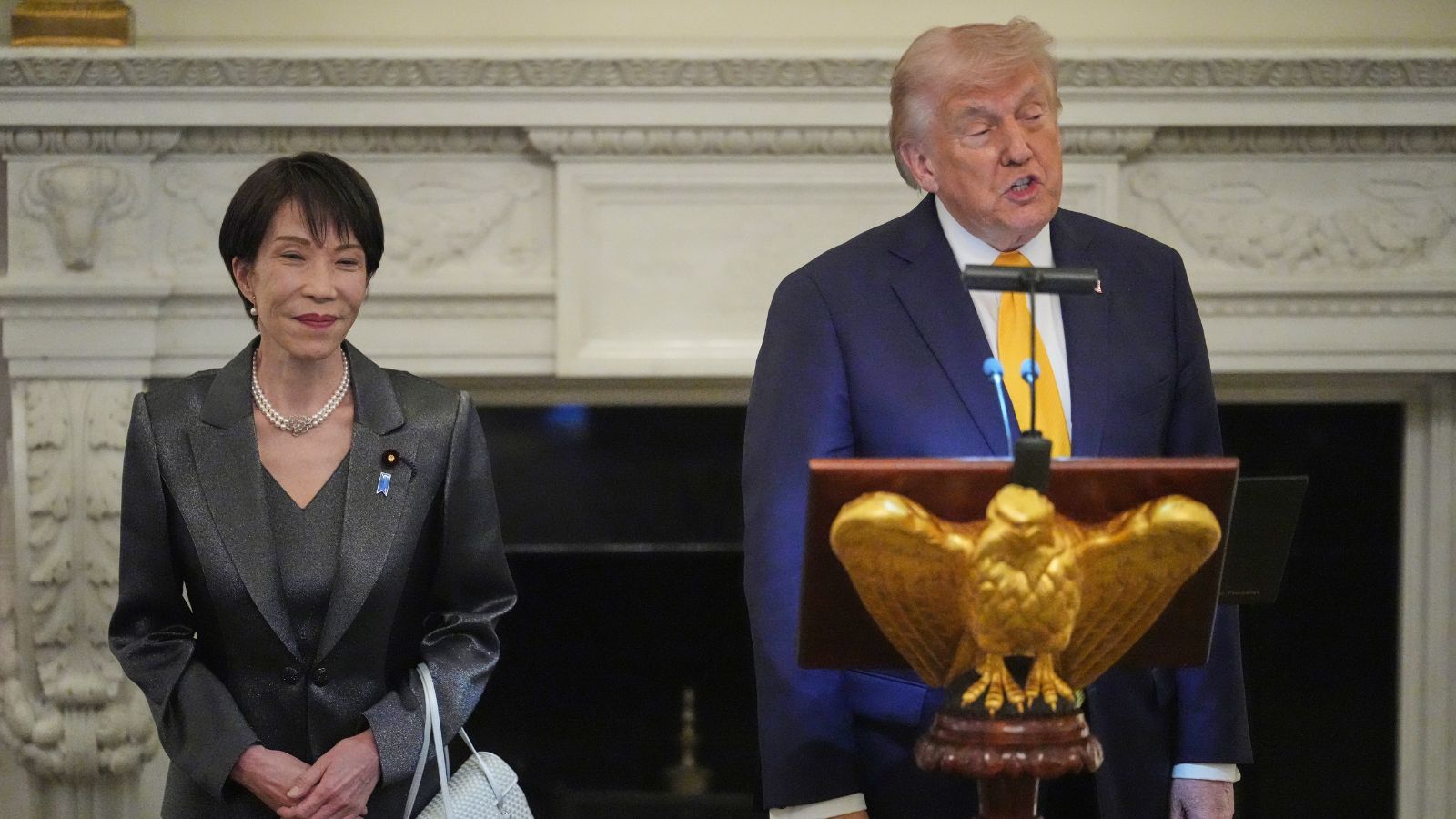
The air in the room didn't just carry the scent of expensive floor wax and old power. It carried the weight of eighty years of silence, suddenly broken by a single, sharp sentence.
Sanae Takaichi, a woman who has spent her career navigating the rigid, often frozen structures of Japanese conservative politics, looked across at the man who views global diplomacy as a series of high-stakes real estate closings. She didn't offer a dry policy paper. She didn't lead with trade deficit statistics or semiconductor supply chain logistics. Instead, she leaned into the one thing Donald Trump values above all else: the individual’s ability to bend history through sheer force of will.
"Only you can bring peace," she told him.
It was a masterful stroke of ego-alignment. In the world of international relations, this is known as the "Great Man" theory of history, the idea that the world doesn't move because of massive social forces or economic trends, but because a few specific people decide which way it should tilt. Takaichi was betting the house on that theory. She was telling the former president that the chaotic, fraying edges of the Indo-Pacific—the missile tests in the North, the gray-zone maneuvers in the South China Sea—were a puzzle that only he held the key to solving.
Then the mood shifted.
Trump, never one to let a moment of historical gravity pass without a sharp, idiosyncratic jab, steered the conversation back to the 1940s. He brought up Pearl Harbor.
It wasn't a history lesson. It was a reminder of the scar tissue that still exists under the skin of the most important alliance in the Pacific.
The Weight of the Unspoken
To understand why a comment about an eighty-year-old sneak attack still carries the sting of a fresh wound, you have to look past the headlines. Imagine a salaryman in Nagoya or a small business owner in Osaka. For them, the alliance with the United States isn't just a treaty. It is the invisible ceiling that has kept their world stable while the rest of the continent transformed.
When an American leader brings up Pearl Harbor in a room full of Japanese officials, it isn't just trivia. It’s an assertion of debt. It’s a way of saying, We remember how this started, and we know who won.
Takaichi’s mission was to bridge that gap. She represents a wing of the Liberal Democratic Party that wants Japan to stand taller, to spend more on its own defense, and to stop being the "junior partner" in the relationship. But to get there, she has to dance with a version of American populism that views every alliance through the lens of a balance sheet.
The tension in that room reflects a broader, more terrifying reality for the rest of us. If the relationship between the world’s largest and fourth-largest economies is based on personal flattery and historical grievances rather than shared institutional values, the floor becomes very slippery very fast.
The Invisible Stakes of a Handshake
Why does this matter to someone buying groceries in Ohio or a tech worker in Tokyo?
Because peace in the Pacific is the silent engine of the global economy. Every smartphone, every car part, and every grain of specialized chemical used in modern manufacturing relies on the fact that the waters between Japan and its neighbors remain boring. We want the Pacific to be boring. We need it to be a place where nothing happens except the steady, rhythmic movement of container ships.
When Takaichi tells Trump that only he can maintain that boredom, she is acknowledging a shift in the global order. The old ways—the slow, grinding gears of the State Department and the Ministry of Foreign Affairs—are being bypassed. We are entering an era of "Deals over Doctrines."
Consider the alternative. If the "Peace" Takaichi spoke of isn't maintained, the cost isn't measured in diplomatic "concern." It's measured in the sudden, violent disruption of everything we take for granted. A single miscalculation in the Taiwan Strait or a botched negotiation over base funding doesn't just stay in the headlines. It shows up in the price of your next laptop. It shows up in the stability of your retirement fund. It shows up in the sudden, chilling realization that the long peace we've enjoyed since 1945 was never a guarantee. It was a choice.
The Mirror of History
Trump’s "Pearl Harbor" crack served as a reminder that for a certain brand of American politics, the past is never actually past. It’s a ledger.
For the Japanese side, hearing that reference is like being reminded of a family shame at a wedding. It creates a dynamic of perpetual apology that Takaichi is desperately trying to evolve beyond. She wants a Japan that is "strong," a word she uses frequently. But strength in the shadow of a superpower requires a delicate kind of alchemy. You have to be strong enough to be a useful partner, but not so assertive that you trigger the old anxieties of your protector.
The paradox is striking. Takaichi is pushing for a more robust Japanese military—the very thing that would, in theory, satisfy American demands that allies "pay their fair share." Yet, the more Japan moves toward that strength, the more it stirs the ghosts of the 20th century that Trump so casually summoned.
It is a circle that refuses to be squared.
The Human Calculus
Behind the suits and the staged photos, there is a very human fear at play.
Leaders like Takaichi are looking at a world where the old certainties are melting. They see an America that is increasingly inward-looking, questioning the value of its overseas commitments. They see a China that is no longer content to wait. In that squeeze, flattery becomes a survival mechanism.
"Only you can bring peace" is more than a compliment. It is a plea.
It is the sound of a nation realizing that the institutional guardrails of the last century are being replaced by the whims of powerful individuals. If peace depends on the mood of a single person in a room in Mar-a-Lago or the West Wing, then the world is a much smaller, much more volatile place than we cared to admit.
We often think of history as a series of inevitable events, a river flowing toward a predetermined sea. But in that room, history looked like two people trying to outmaneuver each other’s ghosts. One person was looking toward a future where they could finally step out of the shadow of defeat; the other was using that shadow as a tether to keep them in place.
The "Pearl Harbor" comment wasn't a mistake or a slip of the tongue. It was a tactical deployment of memory. It was a way to ensure that even as Takaichi spoke of future peace, the hierarchy of the past remained firmly intact.
The real story isn't the quip itself. It’s the silence that followed it. It’s the way the Japanese delegation had to swallow the reminder and keep smiling, because the alternative—a Pacific without an American anchor—is too dark to contemplate.
The ledger remains open. The debts are still being tallied. And as the sun sets over the Pacific, the ships keep moving, unaware that their safety hangs on the fragile thread of a conversation between a woman who needs a hero and a man who refuses to forget a fight.
Somewhere in the deep waters of the Pacific, the rusted hulls of the old fleet still sit in the dark. They are silent, but as we saw in that meeting, they are never truly gone. They are the anchors of a conversation that Japan is dying to finish, and that America isn't quite ready to let go of.
The price of peace is high, but the price of memory might be even higher.
Would you like me to analyze the specific economic implications of a shift in the US-Japan defense guidelines?