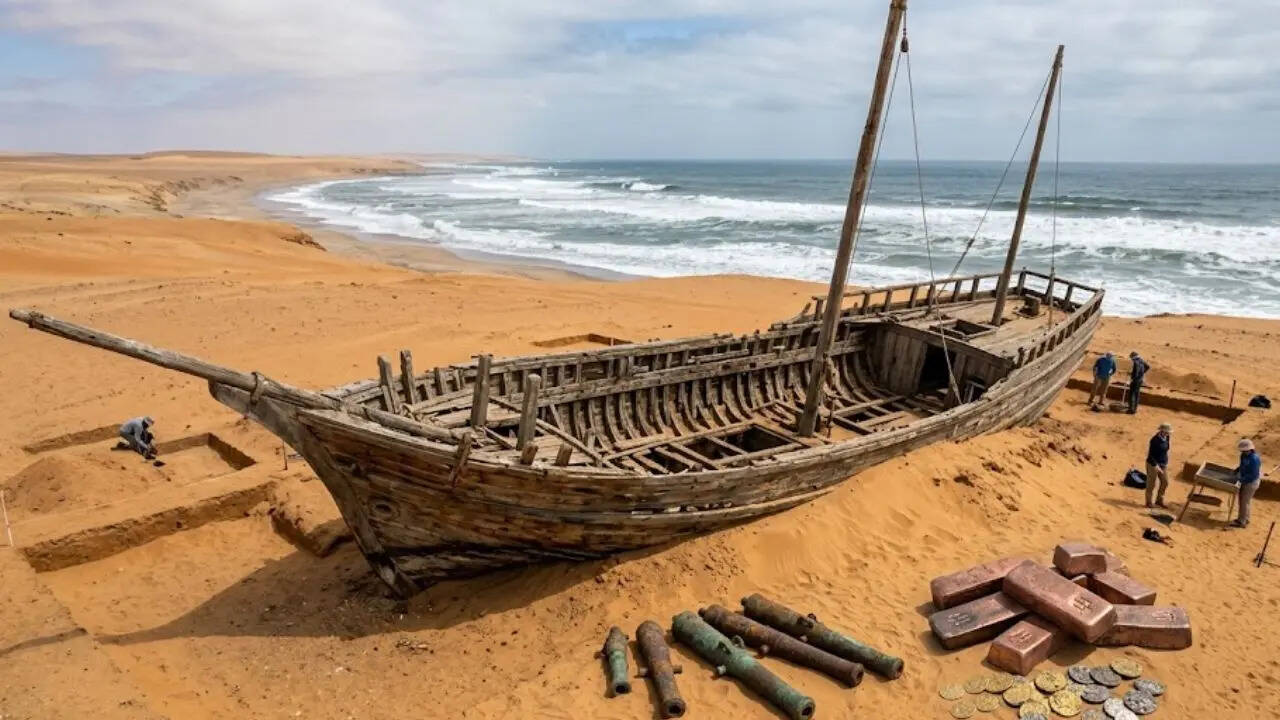
The wind in the Namib Desert does not just blow. It scours. It carries a fine, abrasive grit that can strip the paint off a truck in a single afternoon and swallow a mountain of sand by morning. For five centuries, this wind was the only thing that touched the Bom Jesus.
In 1533, the Portuguese carrack vanished. It didn't just sink; it exited the known world. It was a floating fortress of the Renaissance, a massive wooden lung breathing in the salt air of the Atlantic, carrying a fortune that could bankroll a small kingdom. Then, silence. For five hundred years, the ship was a ghost story told in Lisbon taverns.
In 2008, a geologist working for De Beers wasn't looking for history. He was looking for stones. Specifically, the kind of stones that make people kill: diamonds. Instead, his shovel struck copper. Not a coin, but a massive, hemispherical ingot. Then another. Then a cannon made of bronze, its muzzle choked with five centuries of silt.
He hadn't found a reef. He had found a shipwreck in the middle of a desert.
The Captain’s Final Mistake
Imagine a man named Francisco. He is hypothetical, but his reality is etched into the very manifest of the Bom Jesus. He is the navigator, standing on a deck slick with spray, staring into a fog so thick it feels like wet wool. In 1533, you didn't have GPS. You had a cross-staff, a lead weight on a string, and your own terrified intuition.
The Sperrgebiet—the "Forbidden Territory"—is a stretch of Namibian coastline where the icy Benguela Current crashes into the burning heat of the dunes. It creates a perpetual, blinding mist. Francisco would have heard the breakers before he saw them. A low, rhythmic thrumming that sounds like the earth cracking open.
The Bom Jesus was heavy. She was carrying over 2,000 pure copper ingots, tons of ivory, and thousands of gold coins minted with the crest of King Joao III. When she hit the rocks, she didn't gently settle. She disintegrated under her own immense weight. The surf pounded the hull into the sand, and as the tides shifted over the decades, the ocean retreated. The desert moved in. The sea became a graveyard of dunes.
A Fortune Frozen in Salt
When archaeologists finally brushed away the crust of the Namib, they found something more valuable than gold: a time capsule.
Gold doesn't decay. The coins—over 2,000 of them—looked as though they had been minted yesterday. They glittered against the dull grey of the sand, a jarring reminder of the human obsession with value. But the copper was the real treasure for the historians. Those 22-pound ingots were marked with a trident, the hallmark of the Fugger family, the German banking giants who essentially financed the Age of Discovery.
This wasn't just a ship. It was a ledger. It was a physical manifestation of the moment global trade was born.
Consider the sheer logistical nightmare of what was found in that sand. The ship carried 1.8 tons of elephant tusks. That represents a massive loss of life, both human and animal, all destined for the workshops of Europe to be carved into crucifixes and lute keys. The scale of the cargo tells us that the Portuguese weren't just exploring; they were stripping the world.
The Loneliness of the Long Wait
There is a specific kind of silence in the Namib. It is heavy. To stand where the Bom Jesus was found is to realize how small a human life is compared to the patience of the earth. The sailors who went down with that ship—some forty or fifty souls—simply vanished from the record. Their families in Portugal would have waited months, then years, watching the horizon for a sail that would never crest the curve of the world.
Eventually, the waiting stopped. The names were forgotten. The Bom Jesus became a "loss" on a balance sheet in a counting house in Lisbon.
The miracle of the find isn't just the gold. It’s the organic matter. Because the ship was buried so quickly by sand and salt, archaeologists found pieces of leather shoes. They found bowls. They found the remains of the crew's last meals. These aren't "artifacts" in the way a museum curator sees them. They are the leftovers of a Tuesday afternoon that went horribly wrong five centuries ago.
One man’s shoe, worn at the heel, tells a story of a long watch and a tired stride. A pewter plate suggests a moment of shared laughter before the fog rolled in. We see ourselves in these scraps. We see our own fragility, our own desperate hope that the things we build might outlast us.
The Irony of the Diamond Mines
The only reason the Bom Jesus survived at all is because of human greed.
The Namibian coast is one of the most restricted areas on the planet. Because it is rich in diamonds, the mining companies have patrolled it with an iron fist for over a century. No tourists. No casual beachcombers. No developers. The "Forbidden Territory" became an accidental sanctuary for history.
Had the ship run aground anywhere else, scavengers would have picked it clean within a generation. The wood would have been burned for warmth. The copper would have been melted into tools. The gold would have been spent in a dozen different ports.
Instead, the diamond guards unknowingly protected a different kind of wealth. They kept the world away while the salt air and the shifting dunes mummified the wreck. It took a diamond miner—the modern equivalent of those 16th-century treasure hunters—to finally break the seal.
The irony is thick enough to touch. The Portuguese were sailing to India to secure a monopoly on spices and gold, fueled by a nascent capitalist fever. Five hundred years later, their bones were disturbed by a corporation doing the exact same thing, just with a different mineral.
The Sand Does Not Give Up Its Secrets Easily
Archaeology in the Namib is a race against the very environment that preserved the find. As soon as an object is uncovered, the wind begins its work. Wood that has been damp and pressurized for centuries can shatter in the dry desert air within hours.
The team worked in a frenzied precision. They had to document the location of every ingot, every cannon, every fragment of timber before the desert claimed it again. They were operating in a landscape where the temperature can swing forty degrees in a single day, where the wind can reach eighty miles per hour, turning a grain of sand into a bullet.
They found more than 2,500 gold coins. They found Portuguese portuguezes, Spanish excelentes, and even Venetian ducats. It was an international wallet. It proved that even in 1533, the world was deeply, irrevocably connected by the pursuit of wealth.
But the gold is cold. It doesn't tell us how the water tasted as it rushed into the hold. It doesn't tell us what the cabin boy whispered as the mast snapped like a dry twig.
The Echo in the Dunes
We like to think of history as a linear progression, a series of stepping stones leading to us. But the Bom Jesus suggests something different. It suggests that history is a series of disappearances.
For every ship that makes it to port, how many are still out there, buried under a dune or resting in a trench? We are walking over a world of lost things. We build our cities on top of ruins and sail our ships over graveyards, blissfully unaware that the ground beneath us is crowded with the ghosts of people who were just as certain of their future as we are of ours.
The Bom Jesus was a marvel of its age. It was the "cutting-edge" technology of 1533. It was supposed to be invincible, a titan of the seas. Now, its ribs are being studied in a lab, and its gold is locked in a vault in Windhoek.
The desert is still there. The wind hasn't stopped scouring the coast. The "Forbidden Territory" remains silent, patrolled by guards and ghosts. And somewhere, perhaps only a mile or two from where the Bom Jesus was found, there is likely another mast, another hull, another fortune waiting for the wind to shift just right.
The sand is patient. It can wait another five hundred years. It knows that eventually, everything returns to the dust. We are just passing through, clutching our gold coins and hoping the fog doesn't hide the rocks.
The ocean has moved on, and the desert has claimed the shore, leaving a Renaissance wreck to bake in the sun—a golden splinter in the thumb of time.


