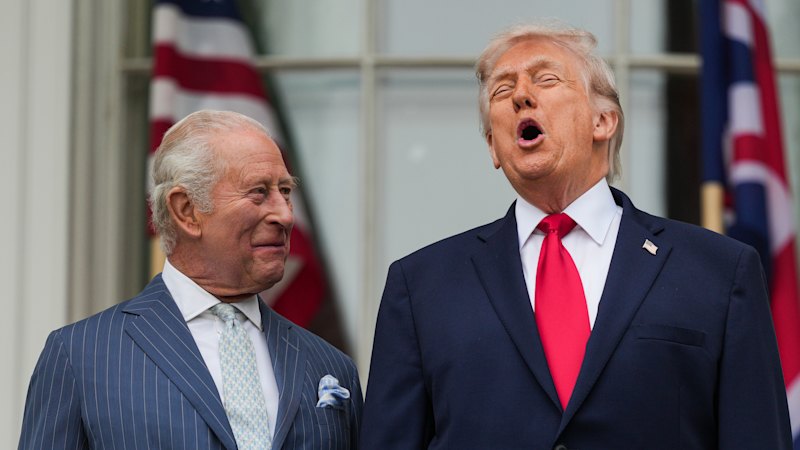
The air inside a royal drawing room doesn’t move like the air in a subway station or a crowded boardroom. It is heavy, scented with beeswax and centuries of silence, a vacuum designed to absorb the ego of whoever enters. When an American president walks into that space, they aren’t just meeting a man in a well-tailored suit. They are colliding with an institution that measures time in epochs rather than election cycles.
The recent exchange between King Charles III and Donald Trump wasn't merely a diplomatic formality. It was a clash of two entirely different ways of existing in the world. On one side, you have the frantic, neon-lit energy of modern American populism, where power is seized through noise. On the other, the quiet, almost rhythmic endurance of the British Crown, where power is maintained through the absence of it.
The Weight of the Crown Against the Will of the Crowd
We often think of kings as relics. We see the gold carriages and the velvet robes and assume the person inside is a decorative piece of furniture. But Charles occupies a position that is uniquely exhausting. He is the human manifestation of a constitutional boundary. His job is to say everything while technically saying nothing at all.
When he sat across from Trump, the stakes weren’t about policy or trade deals. Those are for the suits in Whitehall. The stakes were about the preservation of a specific kind of global order. Charles represents the long view—the idea that the environment, international cooperation, and the dignity of the office are not seasonal trends. They are the floorboards of civilization.
Trump, conversely, is the ultimate disruptor. He views the world as a series of deals to be won or lost in the next ten minutes. To him, the "long view" is a distraction from the immediate victory.
The King didn't use a megaphone. He used the subtle architecture of conversation. He spoke of legacy. Not the kind of legacy built with gold letters on the side of a skyscraper, but the kind that is measured in the health of soil and the stability of oceans. He was trying to explain that some things are too big to be traded away.
A Dialogue of Deaf Ears
Imagine two people trying to describe a mountain. One person describes the minerals they can mine from it today to make a profit. The other describes the mountain as a landmark that has guided travelers for a thousand years and must remain for a thousand more. They are looking at the same rock, but they are living in different universes.
This is the fundamental tension of their meeting.
Charles has spent his entire life preparing for the moment where he must defend the intangible. He knows that his influence is a fragile thing. If he speaks too loudly, he breaks the constitutional spell that keeps the monarchy alive. If he remains too quiet, he becomes irrelevant.
He chose to speak about the climate—his life’s work—not as a political "issue," but as a duty of stewardship. It was a plea for a shared reality. But how do you convince a man who believes he creates his own reality? You don't. You simply plant the seed and hope the soil isn't too salted to let it grow.
The Invisible Script
There is a specific kind of theater in these encounters. Every gesture is a coded message. The length of a handshake, the tilt of a head, the specific choice of a gift—these are the "facts" of royal diplomacy, but they are wrapped in a layer of human psychology that a standard news report always misses.
The King’s challenge was to offer a correction without offering an insult. He had to remind the most powerful man in the free world that power is a loan, not a gift. It is a concept that feels alien in the current political climate, where "winning" is the only metric of success.
Consider the quiet pressure of that room. Trump, a man who thrives on the chaos of the rally and the roar of the crowd, was suddenly forced into a space where the loudest thing was the ticking of a clock. It is in these moments of forced stillness that the truth usually comes out.
But did it?
The skepticism surrounding this meeting isn't about whether the words were said. It’s about whether they were heard. We live in an era where information is abundant but wisdom is scarce. You can give someone the most accurate map in the world, but if they refuse to believe in the existence of North, the map is just a piece of paper.
The Fragility of the Status Quo
There is a haunting quality to the idea that the fate of global initiatives might hinge on the chemistry between two men in a gilded room. It feels archaic. It feels dangerous. Yet, this is the human element that drives history.
We want to believe that systems govern the world—treaties, laws, economic formulas. But systems are just ghosts. The reality is people. It is the ego of a president. It is the duty of a king. It is the way their eyes meet or don't meet when the cameras are turned off.
Charles is playing a game of decades. He understands that the person occupying the White House is a temporary tenant. He is looking past Trump, toward the future of the Anglo-American relationship and the health of the planet. He is trying to act as a bridge between the world we have and the world we might lose.
The problem is that bridges only work if there is stable ground on both sides. If one side is eroding, the bridge becomes a path to nowhere.
Beyond the Handshake
The news cycle moved on almost immediately. The headlines focused on the optics, the perceived snubs, and the polite quotes released by the press offices. But the real story is the silence that followed.
It is the silence of a King wondering if his life's work can survive a four-year term. It is the silence of a President who perhaps, for a fleeting second, felt the weight of history pressing down on him in a way that his Twitter feed never could.
We are left watching these figures like actors on a distant stage. We analyze their lines and critique their costumes, but we often forget that the play they are performing is about us. The "what he needed to hear" wasn't just for Trump. It was for anyone who thinks that the present moment is the only thing that matters.
The King’s message was a reminder that we are all temporary. Our buildings will crumble, our deals will expire, and our names will eventually be forgotten. The only thing that remains is the world we leave behind for the people who haven't been born yet.
It is a difficult thing to hear when you are at the top of the world. It is an even more difficult thing to believe when you think you own it.
The sun set over the palace that evening, casting long, thin shadows across the grass. Inside, the beeswax still scented the air. The chairs were empty. The vacuum had returned. The King had said his piece, and the President had gone his way. Two men, two legacies, and a planet that continues to spin, indifferent to whether or not they finally found a common language.
History doesn't shout. It whispers in the rooms where the air doesn't move.