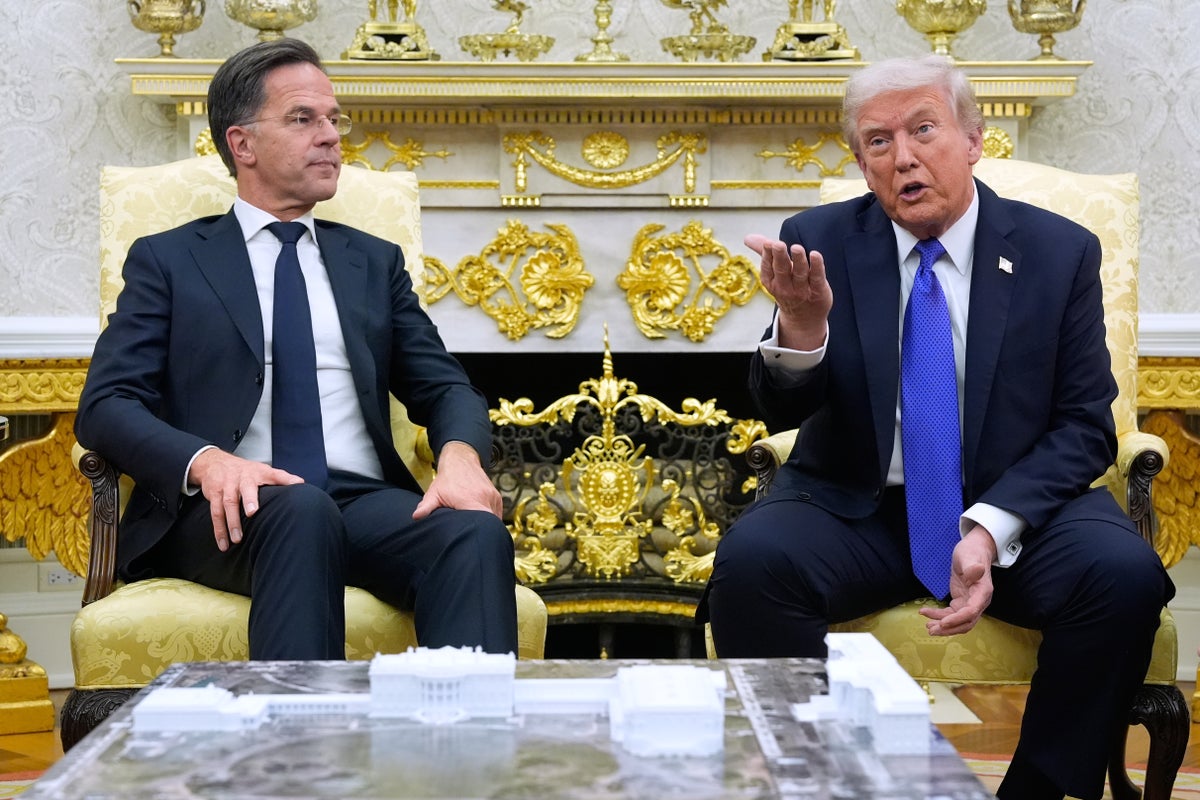
Donald Trump’s recent assertions that NATO failed to provide support during past tensions with Iran signal more than just campaign rhetoric. They represent a fundamental shift in how the United States might leverage its military alliances to enforce Middle East policy. The core of the current friction lies in a "transactional" view of mutual defense, where historical loyalty is traded for immediate tactical compliance. If a second Trump administration follows through on reported plans to penalize allies who refuse to join a potential conflict with Iran, the very structure of the North Atlantic Treaty Organization faces an existential threat.
The grievances voiced by Trump center on a perceived lack of reciprocity. In his view, the United States provides a security umbrella for Europe against Russia, yet receives little in return when American interests are challenged in the Persian Gulf. This perspective ignores the specific geographic and legal constraints of the North Atlantic Treaty. Article 5, the cornerstone of the alliance, is strictly limited to an attack on a member state in Europe or North America. It was never designed as a blank check for global military expeditions. You might also find this similar article useful: The Berdegué Mandate and the High Stakes of Mexico's Broken Food System.
The Geographic Trap of Article 5
To understand why the alliance didn't "show up" for Iran in the way Trump demands, one has to look at the fine print of the 1949 treaty. The collective defense mechanism is triggered only by an armed attack in a specific zone. When the U.S. pursued its "maximum pressure" campaign against Tehran, European capitals viewed it as a unilateral American policy rather than a collective defense necessity.
European leaders, particularly in Paris and Berlin, argue that joining a conflict with Iran would actually decrease their security. They fear a refugee crisis that would dwarf the 2015 migration wave, coupled with the immediate threat of Iranian-backed cyberattacks on European infrastructure. Trump’s inner circle sees this as cowardice. They are currently drafting policy papers that suggest "tiering" NATO membership based on an ally's willingness to support U.S. objectives outside of Europe. This would effectively turn a defensive pact into a global mercenary force. As discussed in detailed articles by The New York Times, the effects are worth noting.
The Economic Weaponization of Alliances
The proposed penalties for "unhelpful" allies aren't just military; they are deeply economic. Sources close to the former president’s policy teams indicate that trade tariffs and the withdrawal of intelligence-sharing agreements are on the table. This is a departure from traditional diplomacy. Normally, disagreements between allies are handled through back-channel negotiations. Here, the threat is public and punitive.
Consider the impact on the defense industry. If a country like Germany or Italy is labeled "unreliable" regarding Iran, the U.S. could restrict their access to high-end military technology, such as the F-35 fighter program. This isn't just about punishing a government; it’s about decoupling integrated supply chains that have existed for decades.
The Intelligence Gap
A major point of contention is the Strait of Hormuz. The U.S. has repeatedly asked for a unified NATO maritime presence there to counter Iranian harassment of tankers. While some allies like the UK joined, others opted for a separate, European-led mission. This splintering of command structures is exactly what Trump cites as evidence of NATO’s obsolescence.
The problem is one of fundamental strategy. Washington views Iran as a primary threat to global stability. Europe, while wary of a nuclear-armed Tehran, views the preservation of the Joint Comprehensive Plan of Action (JCPOA) frameworks as the only way to prevent total regional collapse. You cannot force an ally to fight a war they believe is a mistake without breaking the alliance itself.
Reforming the Burden Sharing Narrative
The "two percent" spending goal has long been the benchmark for NATO health. Trump has successfully moved the needle on this, with many more nations now meeting that target. However, he is now shifting the goalposts. It is no longer enough to spend money on your own defense; you must now spend blood and treasure on American-led initiatives in the Middle East.
This creates a paradox. If NATO allies increase their military spending to satisfy the U.S., they become more capable of operating independently. A more capable Europe might be less inclined to follow Washington's lead if that lead heads toward a hot war with Iran. We are seeing the early stages of a "strategic autonomy" movement in Europe that is fueled directly by the fear of American unpredictability.
The Iranian Response to Western Disunity
Tehran isn't watching these developments in a vacuum. The Iranian leadership understands that a fractured NATO is a weaker deterrent. If they believe the U.S. cannot count on its allies for logistics, overflight rights, or basing, their calculus changes. They become bolder.
The "punishment" model of diplomacy creates a vacuum that other powers are eager to fill. If the U.S. pulls back from its commitment to NATO allies because of Iran, Russia and China stand ready to offer alternative security arrangements. These wouldn't be based on democratic values, but on the same transactional realism that the "America First" doctrine champions.
Redefining the Transatlantic Contract
The tension isn't going away. Whether Trump wins or loses, the question of what an ally owes the U.S. in a multipolar world has been raised. The old Cold War certainties are dead. We are entering an era where alliances are no longer seen as permanent fixtures, but as temporary alignments of interest.
The risk of this approach is the total erosion of trust. In the world of high-stakes intelligence and nuclear deterrence, trust is the only currency that matters. Once you tell an ally that their protection is conditional on their participation in an unrelated conflict, the treaty becomes just another piece of paper. The U.S. might find that in trying to force cooperation, it has instead guaranteed its own isolation.
If the goal is to stop Iran from becoming a nuclear power or a regional hegemon, a divided West is the worst possible starting point. Punishing allies might play well in a domestic stump speech, but it fails the test of long-term geopolitical stability. A military alliance that operates through coercion rather than consensus is no longer an alliance; it is an empire. And empires, historically, are much more expensive to maintain than partnerships.
The immediate task for the U.S. foreign policy establishment is to find a middle ground that acknowledges American frustrations without blowing up the most successful military pact in history. That requires a level of nuance that is currently absent from the political discourse. If the U.S. moves to a "pay-to-play" model for security, it shouldn't be surprised when its partners start looking for a better deal elsewhere.



